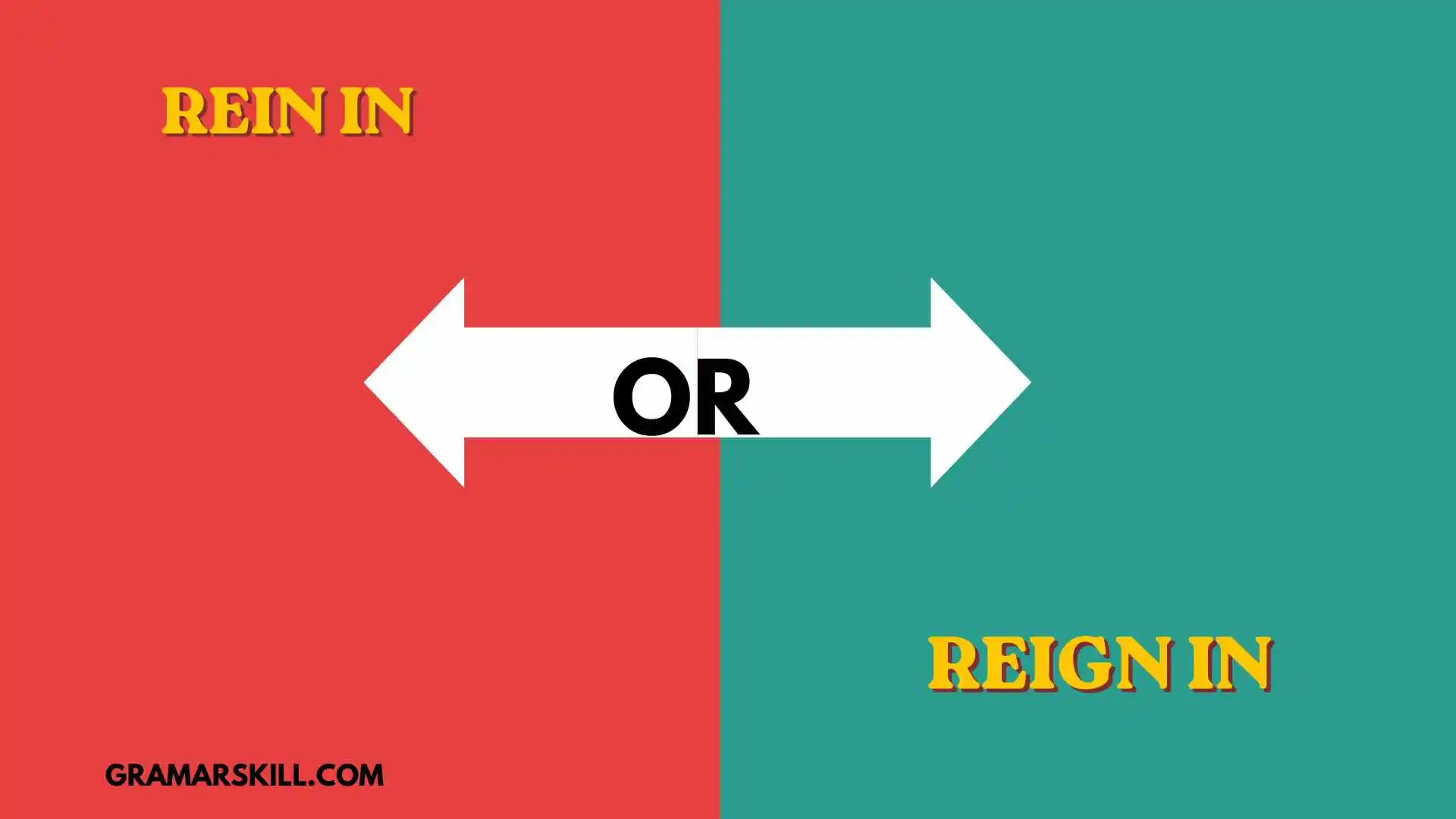
Have you ever paused while writing and wondered whether to use “rein in” or “reign in”? You’re not alone. This is a very common confusion in English because both phrases sound exactly the same. However, despite their similar pronunciation, they have completely different meanings and uses.
Understanding the difference between these two phrases is important, especially if you want to write clearly and professionally. Whether you are writing for a UK (British English) or US (American English) audience, using the correct phrase can improve your communication and avoid misunderstandings. In addition, mastering such tricky word pairs helps you build strong grammar skills and confidence in writing.
Quick Answer
The correct phrase in most situations is “rein in.” It means to control, limit, or restrain something.
On the other hand, “reign in” is usually incorrect in this context. Although “reign” relates to ruling or being in power, it does not fit when you want to express control or restriction. Therefore, if you are talking about stopping or controlling something, always use “rein in.”
Meaning of the Correct Form: Rein In
The phrase “rein in” comes from horse riding. A rein is a strap used to control a horse. When you “rein in” a horse, you pull the reins to slow it down or control its movement.
Modern Meaning
Today, “rein in” means:
- To control something
- To limit something
- To stop something from getting out of control
Examples (UK & US English)
- The government needs to rein in spending.
- She tried to rein in her emotions during the meeting.
- Parents should rein in their children’s screen time.
- The company must rein in its expenses to avoid losses.
👉 Notice that these examples work the same in both British English and American English. There is no spelling difference here only meaning matters.
More Real-Life Usage
- Business: Companies often try to rein in costs.
- Personal life: You may need to rein in your habits.
- Politics: Leaders aim to rein in inflation.
In addition, this phrase is widely used in formal and informal writing, making it very versatile.
Meaning of the Incorrect Form: Reign In
Now let’s look at “reign in.”
Literal Meaning of “Reign”
The word “reign” means:
- To rule as a king or queen
- To be in power
Why “Reign In” Is Incorrect
Although “reign” is a real word, “reign in” does not make sense when talking about control or restriction.
❌ Incorrect:
- The teacher tried to reign in the noisy students.
✔ Correct:
- The teacher tried to rein in the noisy students.
Rare Exception
In very rare creative or poetic contexts, someone might use “reign in” intentionally. However, in standard English (both UK and US), it is considered incorrect for everyday usage.
Keyword Comparison / Key Differences

Let’s clearly compare both phrases:
| Feature | Rein In | Reign In |
| Meaning | To control or limit | Related to ruling (incorrect in this context) |
| Origin | Horse riding (reins) | Royal rule (king/queen) |
| Correct Usage | ✅ Yes | ❌ No (in most cases) |
| UK English | Same usage | Incorrect |
| US English | Same usage | Incorrect |
Key Takeaway
- Use “rein in” when talking about control
- Avoid “reign in” in this meaning
Rein In or Reign In
| Keyword | Information |
|---|---|
| Rein in synonym | Common synonyms of rein in include control, restrain, curb, limit, contain, and hold back. The phrase is often used when talking about controlling emotions, spending, behavior, or growth. |
| Rein vs reign pronunciation | rein (rayn) and reign (rayn) are pronounced exactly the same (/reɪn/). Although they sound identical, their meanings are different. |
| Rein in or reign in Oxford | Oxford usage recognizes rein in as the correct idiom when meaning to control, limit, or restrain something. The phrase comes from horse riding, where reins are used to control a horse. |
| Rein in or reign in grammar | In grammar and standard English usage, rein in is the preferred form when referring to control or restraint. Reign in is usually considered a misspelling unless the context specifically relates to ruling or a reign. |
| Rein in or reign in Oxford Dictionary | According to Oxford dictionaries, rein in means to keep under control or limit something. It is the accepted dictionary form, while reign in is generally not listed as the standard idiomatic expression. |
| Rein in or reign in meaning | Rein in means to control, restrict, or hold back someone or something. Example: The company tried to rein in its expenses. Reign in would literally suggest beginning a reign or rule, which is rarely intended in everyday writing. |
Common Mistakes People Make
Many people confuse these two phrases because they sound identical. However, here are the most common mistakes:
1. Mixing Sound with Meaning
People hear “rain/rein/reign” and assume they are interchangeable. However, pronunciation does not determine correctness.
❌ She needs to reign in her anger.
✔ She needs to rein in her anger.
2. Assuming “Reign” Means Control
Since kings “reign,” people think it relates to control. However, “reign” means to rule, not to restrain.
3. Spelling Errors in Writing
Even experienced writers sometimes write “reign in” by mistake, especially in fast typing.
4. Overthinking Formal Writing
In formal UK and US writing, using the wrong phrase can reduce credibility. Therefore, always double-check.
Correct Usage in Sentences
Here are multiple examples to help you fully understand:
Everyday Situations
- I need to rein in my spending this month.
- He tried to rein in his excitement.
- The coach told the players to rein in their aggression.
Professional Context
- The company plans to rein in costs.
- Managers must rein in unnecessary expenses.
- The government is working to rein in inflation.
UK vs US Usage
Good news: There is no difference between UK and US usage here.
- UK: The council must rein in public spending.
- US: The government must rein in public spending.
👉 Both are correct and identical.
Incorrect Examples (Avoid These)
- ❌ She tried to reign in her emotions.
- ❌ We must reign in the budget.
Tips to Remember the Correct Usage
Learning the difference can be easy if you use these simple tricks:
1. Think of a Horse 🐎
- “Rein” = horse control
- If you are controlling something → use rein in
2. Remember: “Reign” = King 👑
- A king “reigns” (rules)
- It has nothing to do with controlling emotions or actions
3. Replace with “Control”
If you can replace the phrase with “control,” then rein in is correct.
Example:
- Control spending → Rein in spending ✅
4. Visual Memory Trick
- Rein = Rope (control)
- Reign = Crown (rule)
5. Practice with Sentences
The more you use the phrase correctly, the easier it becomes.
FAQs Section
1. Is “reign in” ever correct?
In standard English, no. It is almost always incorrect when you mean “control.” However, it may appear in poetic or creative writing.
2. What does “rein in” mean in simple words?
It means to control, limit, or stop something from going too far.
3. Do UK and US English use different forms?
No. Both British English and American English use “rein in” the same way.
4. Why do people confuse these phrases?
Because they sound exactly the same (homophones). Therefore, many people mix up the spelling.
5. Can I use “rein in” in formal writing?
Yes, absolutely. It is widely accepted in both formal and informal writing.
6. Is “rein in” only used for negative things?
Not always. It can be used for anything that needs control, whether positive or negative.
7. What is an easy way to remember the difference?
Think of a horse:
- You use reins to control it → “rein in”
Conclusion
To sum up, the confusion between “rein in” and “reign in” is very common, but the solution is simple. The correct phrase you should use is “rein in,” which means to control or limit something. On the other hand, “reign in” is usually incorrect and should be avoided in both UK and US English.
Therefore, whenever you want to express control whether it’s emotions, spending, or behavior remember the image of controlling a horse with reins. This small trick can help you avoid mistakes and improve your writing instantly.
READ MORE ARTICLES..
innie or outie: What’s the difference & usage? 2026
vaccum or vacuum: What’s the difference & usage? 2026
Pass or Past: Correct Meaning, Usage, and Examples in 2026
Hight or Height: Correct Spelling and Grammar Rules 2026