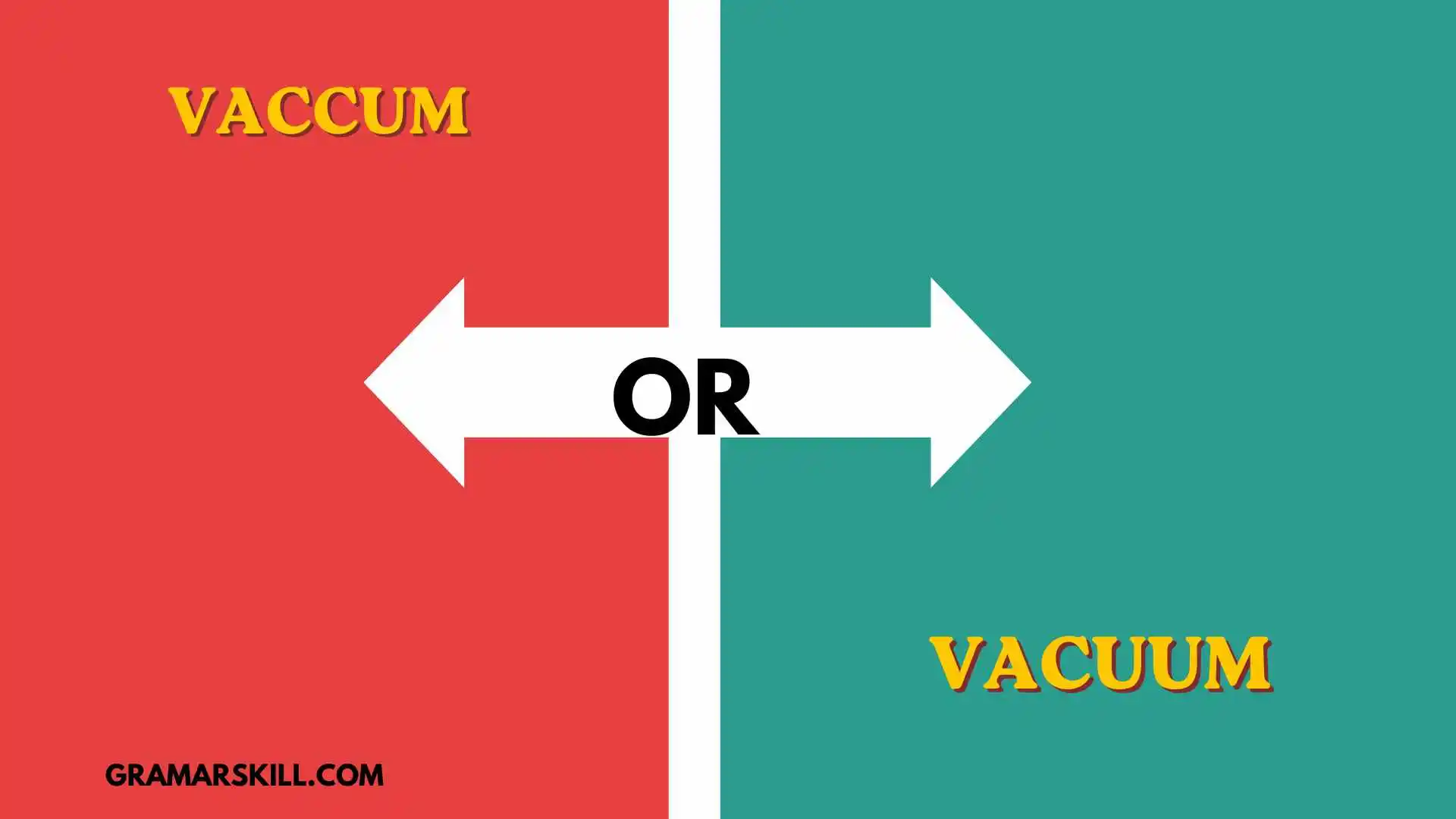
Many people often get confused between the words “vaccum” and “vacuum”. You might have seen both spellings online, in books, or even in casual conversation. However, only one of these is correct.
Understanding the correct spelling and usage is important not only for writing essays, reports, or emails but also for everyday communication. Mistakes in spelling can make your writing appear unprofessional or unclear. This confusion is common among both UK and US English speakers, though British and American English do have slight variations in vocabulary and usage.
In addition, the word “vacuum” is not just a spelling issue it has practical applications in science, technology, and household tasks. Knowing how to use it correctly can help avoid misunderstandings in both professional and casual contexts.
Quick Answer
The correct spelling is “vacuum”.
“Vaccum” is a common misspelling. Whether you are writing in UK English or US English, the correct form remains the same. The word can refer to:
- A space entirely empty of matter (scientific context)
- A household appliance used for cleaning (vacuum cleaner)
Remember: double “u” after “v” – vacuum, not vaccum.
Meaning of the Correct Form
The correct spelling “vacuum” has several meanings depending on the context. Let’s break it down:
1. Scientific Meaning
A vacuum refers to a space where there is no matter, meaning it is completely empty of air or other substances. This usage is common in physics, chemistry, and space studies.
Examples:
- UK English: “Scientists studied the effects of zero gravity in a vacuum.”
- US English: “The experiment required a vacuum chamber to remove all air.”
In both UK and US contexts, the term has the same meaning and spelling.
2. Household Meaning
A vacuum is also a device used to clean floors, carpets, and other surfaces by sucking up dirt and dust.
Examples:
- UK English: “I need to buy a new vacuum for my flat.”
- US English: “The vacuum cleaner broke, so I couldn’t clean the living room.”
Tip: In American English, “vacuum cleaner” is more commonly used, while in British English, you might also hear simply “hoover”, which comes from the famous brand.
Meaning of the Incorrect Form
The spelling “vaccum” is incorrect. It is often used by mistake, especially in informal writing or typing errors.
Common Mistakes Include:
- Writing “vaccum cleaner” instead of “vacuum cleaner”
- Using “vaccum” when referring to a space without matter
Example:
- ❌ Incorrect: “I need to vaccum the carpet.”
- ✅ Correct: “I need to vacuum the carpet.”
Remember, there is no dictionary or formal use for “vaccum.” It is purely a typo or error.
Keyword Comparison / Key Differences

| Aspect | Vacuum (Correct) | Vaccum (Incorrect) |
| Spelling | v-a-c-u-u-m | v-a-c-c-u-m |
| Meaning | Space empty of matter, cleaning device | None (common typo) |
| Usage (UK & US) | Scientific, household, figurative | Informal/wrong |
| Recognition in Dictionaries | Yes | No |
| Example Sentence (UK) | “The vacuum removed all dust.” | ❌ “The vaccum removed all dust.” |
| Example Sentence (US) | “He bought a new vacuum cleaner.” | ❌ “He bought a new vaccum cleaner.” |
Vaccum or Vacuum
| Keyword | Information |
|---|---|
| Vaccum or Vacuum Reddit | On Reddit grammar and language forums, users frequently ask whether “vaccum” or “vacuum” is correct. The correct spelling is vacuum, while vaccum is a common misspelling caused by omitting one of the “u” letters. Most Reddit discussions confirm that “vacuum” is the only accepted spelling in standard English. |
| Vaccum or Vacuum Cleaner | The correct term is vacuum cleaner, which refers to an electrical appliance used for cleaning floors, carpets, and other surfaces by suction. The spelling vaccum cleaner is incorrect and should be avoided in formal and informal writing. |
| Vaccum or Vacuum Meaning | Vacuum means a space that contains little or no matter. It can also refer to a cleaning device that uses suction to remove dirt and dust. The spelling vaccum has no dictionary meaning because it is simply a misspelling of vacuum. |
| Vaccum or Vacuum Pronunciation | The correct word vacuum is pronounced as /ˈvæk.juːm/. A simple pronunciation guide is: “VAK-yoom.” The spelling vaccum is incorrect, so its pronunciation is not recognized in standard English. |
Common Mistakes People Make

Even native speakers sometimes confuse the spelling, especially when typing quickly. Here are common mistakes and tips to avoid them:
- Double letters confusion – People often write “vaccum” thinking there should be a double “c”. Remember: double “u”, not “c”.
- Autocorrect errors – Phones or word processors sometimes suggest “vaccum” if typed incorrectly. Always double-check.
- Mixing British and American English – While British and American English spell “vacuum” the same way, some may confuse regional terms like “hoover” in the UK with “vacuum cleaner” in the US.
- Using “vaccum” in technical writing – Scientific papers must use “vacuum”; using the wrong spelling can lead to loss of credibility.
Correct Usage in Sentences
Here are multiple examples of correct usage in both UK and US English:
Household Examples
- UK: “I spent an hour vacuuming the living room carpet.”
- US: “She bought a vacuum to clean her apartment.”
- UK: “Make sure your vacuum has a bag; otherwise, dust will spread.”
- US: “The vacuum cleaner is very powerful and easy to use.”
Scientific Examples
- UK: “Air molecules are almost entirely absent in a vacuum.”
- US: “Space is considered a near-perfect vacuum.”
- UK: “Experiments in a vacuum help scientists understand particle behaviour.”
- US: “The lab used a vacuum pump to remove air from the chamber.”
Figurative Use
- UK: “After the manager left, a vacuum of leadership emerged.”
- US: “The sudden departure of the CEO created a vacuum in decision-making.”
Tip: The figurative use applies in both US and UK English to describe a situation where something important is missing.
Tips to Remember the Correct Usage
- Think of the double “u” – The easiest trick is to remember “vacuum = v + ac + uu + m”. Two “u”s, not two “c”s.
- Link it to the device – Picture a vacuum cleaner sucking up dust. The extra “u” can remind you of the “suction” or “air pull”.
- Say it out loud – Pronounce the word slowly: “vac-u-um”. Hearing the double “u” sound helps recall the correct spelling.
- Mnemonic trick – Think: “Vacuum cleans everything up UU – so it has double u.”
- Check context – If you are talking about science or cleaning, it is definitely vacuum, never vaccum.
FAQs
Q1: Is “vaccum” ever correct?
A: No. “Vaccum” is a common misspelling. Always use vacuum in UK and US English.
Q2: Why do people write “vaccum”?
A: Usually because of typing errors, autocorrect suggestions, or confusion with double letters.
Q3: Is “vacuum cleaner” used differently in the UK and US?
A: Slightly. In the UK, people may also say “hoover”, whereas in the US, “vacuum cleaner” is standard.
Q4: Can “vacuum” be used figuratively?
A: Yes. It can describe a gap or absence, e.g., “a vacuum in leadership.” This usage is common in both UK and US English.
Q5: How do you remember the correct spelling?
A: Remember the double “u” after “v” (v-a-c-u-u-m). Think of a vacuum cleaner sucking up dust!
Q6: Is the pronunciation different in UK vs US English?
A: Slightly. In the UK, it may sound like /ˈvæk.juːm/ and in the US, more like /ˈvæk.juːm/ with minor accent differences, but spelling is identical.
Q7: Does “vacuum” have plural forms?
A: Yes, the plural is “vacuums” for both meanings, e.g., “All vacuums in the store were on sale.”
Conclusion
In summary, the correct spelling is vacuum with double “u”, never vaccum. The word applies to science, cleaning devices, and even figurative expressions. Both UK and US English use the same spelling, though regional terms like hoover exist in the UK for household devices.
Key Takeaways:
- Double “u” after “v” → vacuum
- “Vaccum” is incorrect
- Applies to science, cleaning, and figurative language
- UK/US usage is largely the same; minor differences in household terminology
Understanding the difference ensures your writing is accurate, professional, and clear. Next time you need to clean your carpet or describe an empty space, remember: vacuum, not vaccum!
READ MORE ARTICLES..
is it here here or hear hear: what’s the difference & usage? 2026
Tyre or Tire: Which Spelling Is Right for You in 2026
Ms Mrs or Miss: Full Comparison with Easy Tips and Examples
Threw or Through Explained in Simple English with Examples 2026

I’m Henry Collins, a passionate grammar enthusiast who loves making English simple and clear for everyone. I enjoy breaking down tricky grammar rules into easy, everyday language. Through my writing, I aim to help learners build confidence and write with accuracy. My goal is to turn confusion into clarity one word at a time.