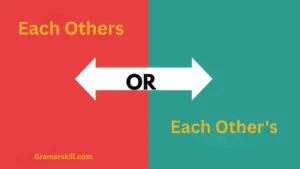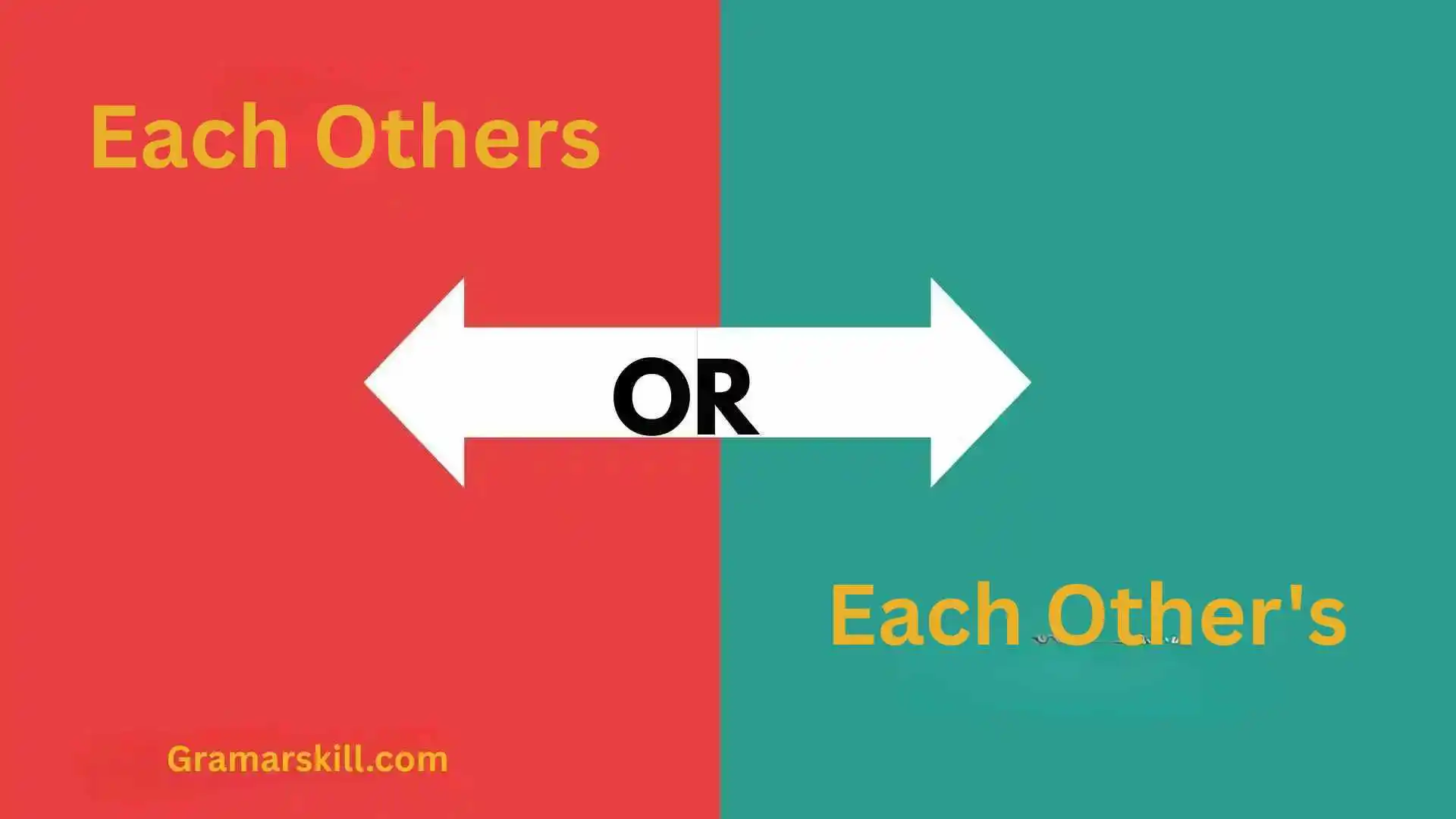
Many English learners, and even native speakers, often get confused between “each others” and “each other’s”. These two forms might look similar, but they have very different grammatical roles. Choosing the correct form is essential to avoid mistakes in writing and speaking, whether you are in the UK or the US.
The confusion usually arises because people hear phrases like “They love each other” or “They respect each other’s opinions”, and then mistakenly think they can drop the apostrophe. However, apostrophes can completely change the meaning of a sentence.
Understanding this small but important detail is not just about grammar rules. It affects clarity and professionalism in both personal and professional communication. In addition, with English being widely used globally, knowing the correct form is vital for formal writing, academic work, business communication, and everyday interactions.
Quick Answer
Correct Form: each other’s
Incorrect Form: each others
Use “each other’s” when showing possession. For example: They respect each other’s opinions. The apostrophe + s indicates that something belongs to someone else in a mutual relationship.
“Each others” without an apostrophe is grammatically incorrect and should be avoided. Remember, “each other” is correct when used as a pronoun in sentences like They love each other, but never add an s unless indicating possession.
Meaning of the Correct Form
Each other’s is the possessive form of each other. It is used to show that something belongs mutually to two or more people. The apostrophe + s indicates possession, similar to other possessive nouns in English.
Examples:
- UK English:
- John and Mary always look after each other’s children.
- The students admired each other’s creativity during the group project.
- US English:
- They shared each other’s lunch because they forgot theirs at home.
- The team members praised each other’s hard work after the game.
Notice that whether you are using UK or US English, the rule remains the same: whenever you show mutual possession, use each other’s.
Meaning of the Incorrect Form
Each others without an apostrophe is never correct. It often appears due to misunderstanding how apostrophes work in English. Some learners assume that adding an s at the end is enough to indicate possession, but in English, you must use ‘s for singular or mutual possession.
Incorrect Examples:
- They admired each others work. ❌
- We borrowed each others books from the library. ❌
These sentences are incorrect because they omit the apostrophe, which is crucial to indicate possession.
Corrected Versions:
- They admired each other’s work. ✅
- We borrowed each other’s books from the library. ✅
Even in casual writing, omitting the apostrophe can make your text look unprofessional or confusing.
Keyword Comparison / Key Differences
| Feature | Each Other | Each Other’s | Each Others |
| Function | Pronoun | Possessive pronoun | ❌ Incorrect |
| Example | They love each other. | They admire each other’s talent. | They admire each others talent. ❌ |
| Use | Refers to a mutual action or feeling | Refers to something belonging mutually | Not used in proper English |
| UK/US Difference | Same rule in both | Same rule in both | Same – incorrect everywhere |
Key Takeaways:
- Each other → used for mutual actions (They respect each other.)
- Each other’s → used for mutual possession (They respect each other’s ideas.)
- Each others → never correct
In both British and American English, these rules apply consistently. While spelling conventions differ slightly in some words (like favourite/favorite or realise/realize), the use of each other’s is identical.
Common Mistakes People Make
Even advanced writers can make mistakes with each other’s. Here are the most common ones:
- Omitting the apostrophe
- They encouraged each others efforts. ❌
- Correct: They encouraged each other’s efforts. ✅
- Confusing with plural forms
Some think each others is the plural of each other, but in English, each other is already reciprocal, so adding an s is unnecessary. - Using each other in the possessive without ‘s
- They shared each other ideas. ❌
- Correct: They shared each other’s ideas. ✅
- Mixing UK and US grammar conventions
While minor spelling differences exist (like travelling vs traveling), each other’s does not change. Both UK and US learners often mistakenly apply a plural rule, which is incorrect. - Replacing each other with one another incorrectly
- The three friends admired one another’s talent. ✅ (correct)
- The three friends admired each others talent. ❌ (incorrect)
Tips: Always check if the sentence shows mutual possession. If it does, use ‘s.
Correct Usage in Sentences
Here are multiple examples showing correct usage for both UK and US audiences:
Mutual Possession:
- UK:
- The colleagues respected each other’s opinions during the meeting.
- Siblings often borrow each other’s clothes without asking.
- US:
- The neighbors helped each other’s families during the storm.
- Players congratulated each other’s achievements after the match.
Mutual Actions (No Possession):
- UK:
- They trust each other completely.
- The teachers praised each other for their hard work.
- US:
- They text each other every day.
- The volunteers supported each other throughout the project.
Common Situations to Use Each Other’s Correctly:
- Sharing belongings
- They borrowed each other’s books.
- Complimenting achievements
- The writers admired each other’s stories.
- Expressing mutual feelings
- They cared deeply about each other’s happiness.
- Teamwork scenarios
- Team members respected each other’s opinions.
Tips to Remember the Correct Usage
Here are some easy ways to remember when to use each other’s:
- Check for possession – If the sentence shows that something belongs to someone else, add ‘s.
- They shared each other’s snacks. ✅
- Mnemonic Trick: Think: “If it owns something, add an apostrophe s.”
- Ask yourself: Does the sentence answer whose?
- Whose lunch did they share? → Each other’s lunch.
- Avoid adding an s blindly – each other is already reciprocal; adding s without an apostrophe is wrong.
- Read aloud – Often, saying the sentence helps identify missing apostrophes.
FAQs
1. Can I use “each others” in casual writing?
No. Even in informal writing, each others is incorrect. Always use each other’s for possession.
2. Is there a difference between UK and US usage?
No. Both UK and US English use each other’s the same way. The apostrophe is required for possession in both.
3. When should I use “each other” without the apostrophe?
Use each other when describing mutual actions, feelings, or relationships.
- They love each other. ✅
- They help each other with homework. ✅
4. Can “each other’s” be used for more than two people?
Yes. Each other’s can indicate mutual possession among any number of people.
- The students admired each other’s ideas. ✅
5. Is “one another’s” different from “each other’s”?
Slightly. One another’s is typically used for three or more people, but in modern English, they are often interchangeable.
- They respected one another’s opinions. ✅
- They respected each other’s opinions. ✅
6. How can I avoid common mistakes with each other’s?
Remember these rules:
- Use ‘s for possession.
- Use each other for actions/feelings.
- Never use each others without an apostrophe.
7. Does pronunciation change with each other’s?
No. Pronunciation remains the same; the apostrophe only affects writing.
Conclusion
Understanding the difference between each other, each other’s, and each others is simple once you remember the key rule:
- Use each other for mutual actions or feelings.
- Use each other’s for mutual possession.
- Never use each others without an apostrophe.
Mastering this small detail improves your writing, prevents misunderstandings, and makes you look professional and fluent in English.
Whether you are in the UK or the US, following this rule is straightforward and consistent. Next time you write a sentence showing mutual possession, remember: the apostrophe matters!
READ MORE ARTICLES..
Pannel or Panel: Differences, Definitions, and Examples 2026
is it a hour or an hour: What’s the difference & usage?
Less or Equal to Sign in Math: Definition, Uses, and Tips 2026
When to Use Colon or Semi Colon with Easy Examples 2026

I am Julian Parker, a passionate grammar enthusiast and content writer dedicated to making English rules simple and easy to understand. I specialize in breaking down complex grammar topics into clear, practical explanations. I enjoy helping readers improve their writing skills with confidence. My goal is to make learning grammar engaging, simple, and accessible for everyone.