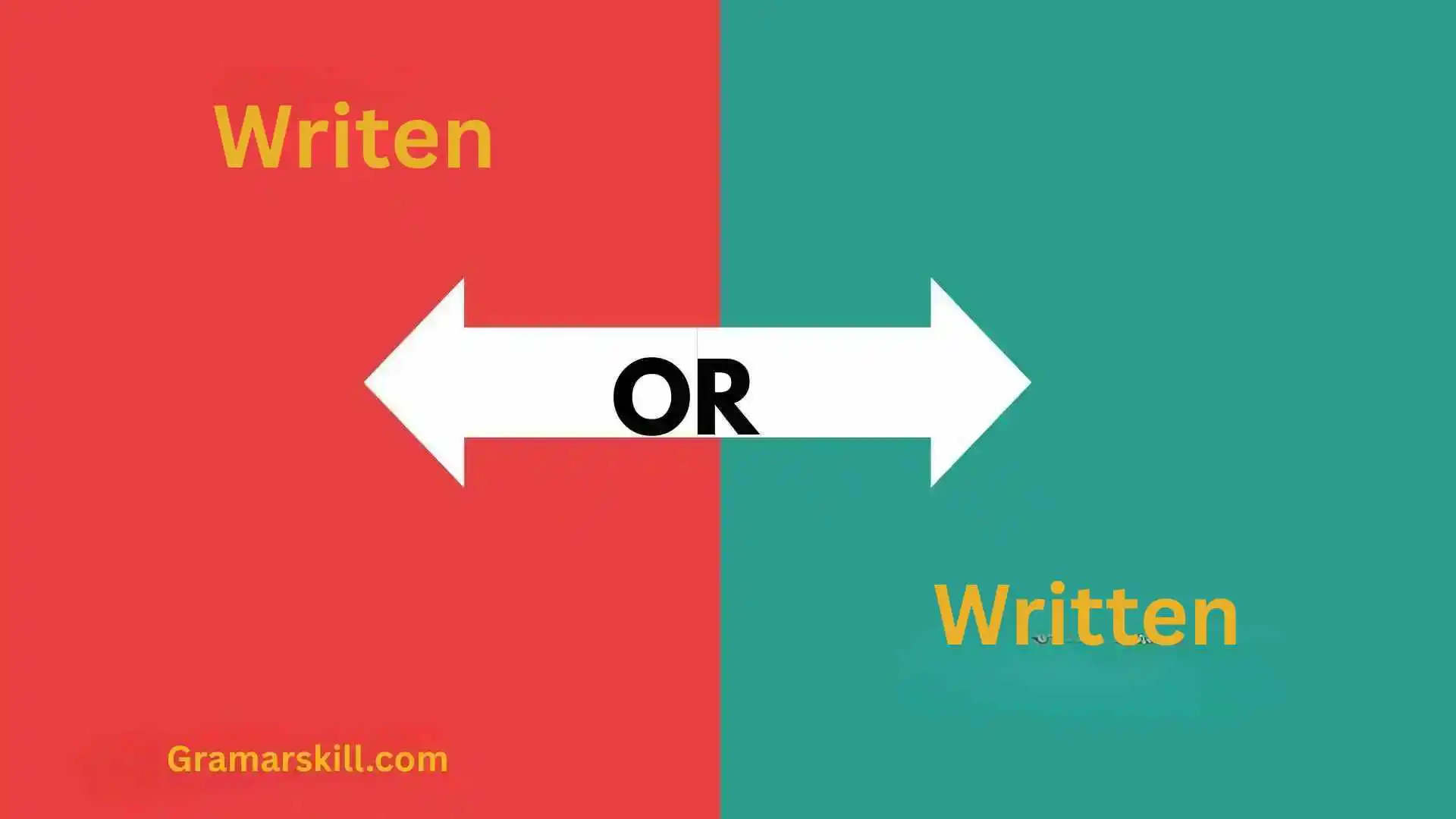
English learners and even native speakers often stumble when it comes to past participles. One common dilemma is whether to use “writen” or “written.” This confusion arises because English spelling rules can be tricky, especially when forming the past participle of irregular verbs like “write.”
Understanding the correct form is essential not only for academic writing but also for professional communication. Using “writen” might seem harmless in casual contexts, but in formal writing emails, reports, or essays it can appear careless.
Moreover, with the subtle differences between British English (UK) and American English (US) spelling conventions, learners sometimes wonder if either form could be correct in one variant of English. This article will guide you clearly and thoroughly so that you never have to guess again.
Quick Answer
The correct form is “written.”
- “Writen” is incorrect and should be avoided.
- Use “written” as the past participle of the verb “write” in both British and American English.
Example:
- ✅ I have written three letters today.
- ❌ I have writen three letters today.
Whether you are writing in the UK or the US, “written” is always the standard form.
Meaning of the Correct Form: Written
The word “written” is the past participle of the verb “write.” It is used in perfect tenses, passive voice, and other constructions that require the past participle.
Key uses include:
- Present Perfect Tense:
- UK: She has written a beautiful poem.
- US: She has written a beautiful poem.
- Past Perfect Tense:
- UK: By the time he arrived, I had written three emails.
- US: By the time he arrived, I had written three emails.
- Passive Voice:
- UK: The novel was written by Jane Austen.
- US: The novel was written by Jane Austen.
Notes:
- There is no difference between UK and US spelling for “written.”
- It is always spelled with a double “t” and ends with “-en.”
Meaning of the Incorrect Form: Writen
The spelling “writen” is a common mistake. It is often a result of:
- Typing errors or fast writing
- Confusing similar verbs like “ridden” (past participle of “ride”)
- Forgetting the double “t” rule for irregular past participles
Examples of incorrect usage:
- ❌ I have writen a report.
- ❌ The book was writen last year.
Remember, “writen” does not exist in standard English. Using it in formal writing is considered a spelling error.
Keyword Comparison / Key Differences
| Feature | Written (Correct) | Writen (Incorrect) |
| Part of speech | Past participle of “write” | Not a word in English |
| Usage | Perfect tenses, passive voice | Always wrong |
| UK vs US | Same spelling in both UK & US | Incorrect in both |
| Example | I have written my essay. | I have writen my essay. |
Summary: Always use written; never use writen.
Common Mistakes People Make
Many people make mistakes even when they know the word “written.” Here are the most frequent errors:
- Dropping one “t”
- ❌ She has writen five letters.
- ✅ She has written five letters.
- Confusing with similar words
- ❌ He has writen the rules.
- ✅ He has written the rules.
- Using in casual chat incorrectly
- ❌ I just writen you.
- ✅ I just written you.
- Mixing tenses
- ❌ I write a letter yesterday.
- ✅ I wrote a letter yesterday.
- ✅ I have written a letter today.
- Incorrect spelling in digital tools
- Auto-correct sometimes suggests “writen,” so always double-check.
Correct Usage in Sentences
Here are multiple examples to help you internalize the correct usage:
UK English Examples
- I have written to the manager regarding the issue.
- Have you written your assignment yet?
- She had already written three chapters before the deadline.
US English Examples
- I have written an email to the customer service team.
- He has written several articles on technology.
- Have you written the meeting minutes?
Tips: Both UK and US examples use the same spelling, so once you memorize “written,” you are correct in both versions.
Tips to Remember the Correct Usage
- Double the “t”: Think of “written” as “write + t + en.”
- Past participle rule: Most irregular verbs in English have unique past participle endings. “Write → wrote → written.”
- Mnemonic trick:
- “I wrote it, now it is written.”
- Check verbs ending with “-en”: Other examples include driven, eaten, stolen – notice the “-en” ending pattern.
- Avoid shortcuts in typing: Don’t type “writen” even in informal chat; it can become a habit.
FAQs (Frequently Asked Questions)
1. Is “writen” ever correct in English?
No, “writen” is always incorrect. The correct past participle is “written.”
2. Does UK and US English use “written” differently?
No, both UK and US English use “written” with the same spelling.
3. Can I say “I writen a book”?
No, you should say “I have written a book” or “I wrote a book.”
4. Why do people confuse “writen” and “written”?
It’s usually a typing mistake or forgetting the double “t” in past participles.
5. How do I remember the correct spelling?
Think: write → wrote → written. Remember the double “t” and “-en” ending.
7. Are there other irregular verbs like “write”?
Yes, examples include: driven, eaten, stolen, spoken, broken – notice the “-en” pattern for past participles.
Conclusion
In summary, when choosing between “writen” or “written,” the correct choice is always “written.” This form is consistent in both UK and US English and is used in perfect tenses, passive voice, and other constructions requiring the past participle of “write.”
Avoid the common mistake “writen” by remembering the double “t” and “-en” ending. Practice using “written” in daily writing, emails, and formal documents to reinforce correct spelling.
READ MORE ARTICLES..
Whit or Whitout: Meaning, Usage, and Common Mistakes Explained 2026
Crain or Crane: Grammar Rules You Should Know 2026
monkeys or monkies : Easy guide with simple explanation?
Too Long or To Long: Which one is correct & usage? 2026