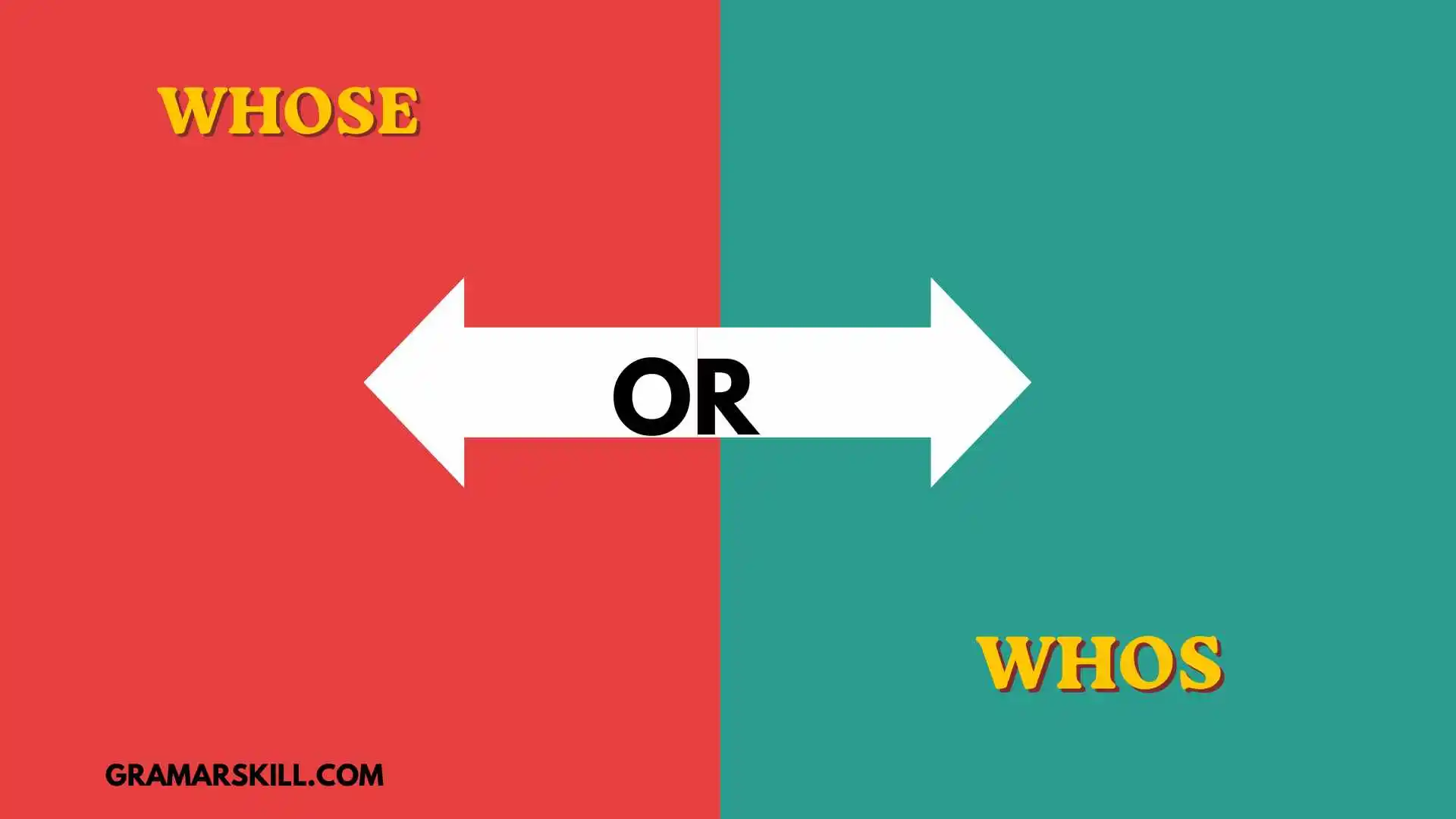
English learners often stumble upon words that sound the same but have very different meanings. One of the most common examples is “whose” and “whos”. Despite sounding similar, these two words are not interchangeable. Misusing them can make your writing seem unprofessional or confusing, whether you are writing in British English or American English.
Understanding the difference is not only important for grammar accuracy but also for clear communication. Imagine sending an email, writing a story, or completing an assignment and accidentally using “whos” instead of “whose” the meaning of your sentence changes completely.
In this guide, we will explore the meanings, differences, common mistakes, and tips to remember when to use each word. By the end, you’ll confidently write sentences without second-guessing yourself, whether you are in the UK, the US, or anywhere English is spoken.
Quick Answer
“Whose” is the correct word to use when asking about ownership or possession. For example:
- “Whose book is this?”
On the other hand, “whos” is almost always incorrect in standard English. The only exception is when it appears as part of “who’s”, which is a contraction of “who is” or “who has”:
- “Who’s coming to the party?” (Who is coming)
If you remember this simple distinction, you will rarely make mistakes.
Meaning of the Correct Form
Whose
“Whose” is a possessive pronoun used to ask or describe ownership.
Examples:
- UK English: “Whose jacket is hanging on the chair?”
- US English: “Whose phone is ringing?”
- Descriptive usage: “I met a man whose dog is very friendly.”
Key points:
- It can refer to people, animals, or even things: “Whose idea was this?”
- It is never used as a contraction.
- Always links ownership to the noun that follows.
Meaning of the Incorrect Form (if any)
Whos
“Whos” on its own is not a word in standard English. It is considered a common spelling mistake.
Confusion usually arises because:
- People hear “who’s” and mistakenly write “whos.”
- Auto-correct or fast typing often omits the apostrophe.
Incorrect examples:
- ❌ “Whos going to help me?”
- ❌ “I don’t know whos book this is.”
The correct versions would be:
- ✅ “Who’s going to help me?” (Who is going)
- ✅ “I don’t know whose book this is.” (Ownership)
Keyword Comparison / Key Differences
| Feature | Whose | Whos / Who’s |
| Part of Speech | Possessive pronoun | Contraction of “who is” or “who has” |
| Usage | Shows ownership or belonging | Shows action or state (is/has) |
| Correct Example | “Whose bag is this?” | “Who’s finished their homework?” |
| Common Mistake | ❌ “I don’t know whos pen this is.” | ❌ “Whose coming to the meeting?” |
Key UK vs US Notes:
- Both British and American English use “whose” in exactly the same way.
- “Who’s” is also consistent in both variants.
- The mistake of writing “whos” is universal and not acceptable in formal writing anywhere.
Common Mistakes People Make
- Mixing possession with contraction
- ❌ “Whos bag is this?”
- ✅ “Whose bag is this?”
- Using “whose” for “who is”
- ❌ “Whose coming to the party?”
- ✅ “Who’s coming to the party?”
- Confusion in descriptive sentences
- ❌ “I met a girl whos dog is cute.”
- ✅ “I met a girl whose dog is cute.”
- Fast typing or texting errors
- People often omit the apostrophe in “who’s” → “whos.”
- Mixing up in formal vs informal contexts
- Formal writing should always use correct spelling: “whose” or “who’s.”
- Informal texts sometimes accept “whos,” but it is still grammatically incorrect.
Correct Usage in Sentences
Asking Ownership
- UK: “Whose umbrella did you borrow yesterday?”
- US: “Whose shoes are these on the floor?”
Describing Possession
- UK: “She is the artist whose paintings were displayed at the gallery.”
- US: “I know a teacher whose students always excel in maths.”
Using Contractions Correctly
- Who’s (who is / who has) examples:
- “Who’s ready for the meeting?”
- “Who’s seen the new movie?”
Tips: Always check if you mean possession (whose) or state/action (who’s).
Tips to Remember the Correct Usage
- Ask yourself this: Is it ownership? → Use whose.
- Contraction check: Can I replace it with “who is” or “who has”? → Use who’s.
- Mnemonic:
- “Whose shows possession, Who’s shows action.”
- Read aloud: If it sounds like “who is,” add the apostrophe.
- Double-check in emails or formal writing: Avoid “whos” entirely.
FAQs
Q1: Can “whos” ever be correct?
A: Only if you are intentionally using it as shorthand in informal text messaging. Otherwise, it is considered a mistake. Always use whose or who’s.
Q2: Is “whose” used for things as well as people?
A: Yes. For example: “Whose keys are on the table?” or “Whose idea was this?”
Q3: What is the difference between “whose” and “who’s”?
A: Whose shows ownership. Who’s is a contraction of “who is” or “who has.”
Q4: Does British English use “whose” differently from American English?
A: No. Both UK and US English use “whose” in the same way.
Q5: How can I avoid mixing “whose” and “who’s”?
A: Remember the ownership test: If it shows possession, use whose. If it replaces “who is” or “who has,” use who’s.
Q6: Can “whose” be used in plural form?
A: Yes. Example: “Whose books are on the shelves?”
Q7: Are there common typos to watch out for?
A: Yes. Avoid “whos”, as it is always incorrect in formal writing.
Conclusion
Understanding the difference between “whose” and “whos” is essential for clear and professional English. Remember:
- Whose = possession
- Who’s = who is / who has
- Whos = almost always wrong
By practicing the examples and tips provided, you can eliminate confusion in your writing. Start applying these rules in your emails, essays, and casual messages, and soon you’ll never mix them up again.
Call-to-Action: Next time you write a sentence involving ownership or asking “who is,” pause and choose the right word your clarity and professionalism will thank you!
READ MORE ARTICLES..
Primers or Moisturizer First: What’s the Skincare Truth? 2026
Phased or Fazed: Common Mistakes and Correct Usage Guide (2026)
St Paddy or St Patty: History, Grammar, and Real Usage Tips 2026
Different Than or Different From: Difference & usage? 2026