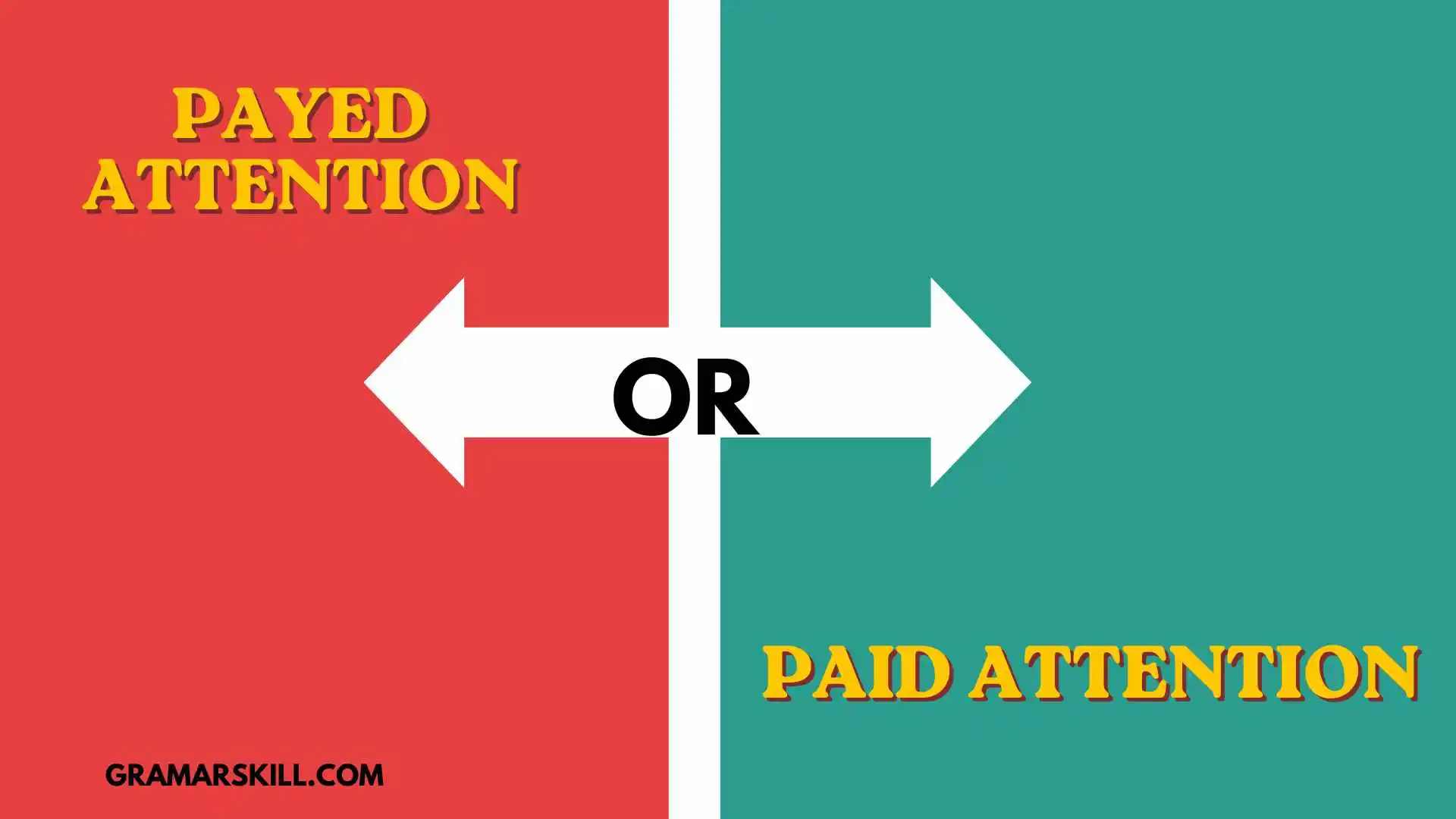
English learners and even native speakers often stumble when deciding whether to write “payed attention” or “paid attention.” This confusion is not just a spelling or grammar issue it can affect your credibility in writing, formal communication, and even casual conversations. Many people assume that both forms are correct, but in reality, there’s a clear distinction.
Understanding the difference is crucial for both UK and US English speakers. While the pronunciation sounds the same, the written forms have different meanings and proper contexts. Using the wrong form can lead to awkward sentences, misunderstandings, or even unintentional humor especially in formal writing, emails, or professional content.
In this article, we’ll explain everything you need to know about payed attention vs paid attention, including meanings, correct usage, common mistakes, and tips to remember the right form. Whether you are a British English or American English speaker, this guide will make your usage flawless.
Quick Answer
The correct phrase is “paid attention.”
- Paid attention is the standard, grammatically correct form used to indicate that someone focused or concentrated on something.
- Payed attention is almost always incorrect in modern English unless referring to a specific nautical context where “payed” means to let out rope or cable.
So, in everyday English whether in the UK or the US always use paid attention.
Meaning of the Correct Form: Paid Attention
Paid attention is a phrasal verb construction:
- Paid – past tense of “pay”
- Attention – focus or consideration
When combined, it means to focus on something carefully, notice details, or listen carefully.
Examples in US English:
- She paid attention during the lecture and scored top marks.
- Please pay attention when I explain this process; it’s very important.
Examples in UK English:
- He paid attention to the traffic rules and avoided fines.
- Students are expected to pay attention in class at all times.
Key Notes:
- This is universally correct in both UK and US English.
- It applies to both formal and informal contexts.
- Can be used with visual, auditory, or cognitive focus.
Meaning of the Incorrect Form: Payed Attention
The form “payed attention” is technically a word but almost never correct in this context.
- Payed is the past tense of “pay” in nautical contexts only.
- In shipping or sailing, payed refers to letting out rope, tar, or sealing seams.
Example (nautical context only):
- The sailors payed the ropes carefully to secure the ship.
Outside of this very rare context, writing “payed attention” is considered a mistake in standard English.
Why people make this mistake:
- English learners often confuse “paid” vs “payed” because they sound the same.
- Informal writing or typing errors often lead to the incorrect form spreading.
Keyword Comparison / Key Differences
| Feature | Paid Attention | Payed Attention |
| Correct? | ✅ Yes | ❌ Usually No (except nautical) |
| Meaning | Focused, listened carefully | Let out rope or tar (nautical) |
| Usage in UK English | Common and correct | Rare and incorrect |
| Usage in US English | Common and correct | Rare and incorrect |
| Common Mistakes | Miswriting as “payed” | Confusing with “paid” |
| Example | She paid attention to details. | The sailors payed the rope. |
Important: Even though “payed” exists in English, it is not interchangeable with “paid” in everyday speech or writing.
| Heading | Information |
|---|---|
| Payed Attention or Paid Attention Meaning | Paid attention is the correct phrase and means to carefully listen, watch, notice, or focus on something. Payed attention is usually incorrect because payed is a rare nautical term used for letting out rope or sealing a ship’s deck. |
| Payed Attention or Paid Attention Past Tense | The correct past tense of pay attention is paid attention. Since the verb pay changes to paid in the past tense, examples include: She paid attention during the meeting and They paid attention to the teacher’s instructions. |
| Payed Attention or Paid Attention Grammar | In standard English grammar, paid attention is always correct when referring to focus or concentration. Payed attention is considered a spelling error in this context because payed is not the regular past tense form of pay when discussing attention. |
| Payed Attention or Paid Attention Examples | Correct examples: I paid attention to the road while driving. The students paid attention during the lecture. He paid attention to every detail of the project. Incorrect example: She payed attention to the instructions. |
| Paid Attention Synonym | Common synonyms for paid attention include focused on, noticed, observed, listened carefully, concentrated on, took notice of, heeded, and watched closely. These alternatives can help improve variety in writing and speech. |
Common Mistakes People Make
Many writers, students, and professionals make these mistakes when using paid attention. Here are the most common ones:
- Using “payed attention” in school essays:
- ❌ She payed attention to the teacher.
- ✅ She paid attention to the teacher.
- Confusing homophones:
- ❌ I payed attention to your instructions.
- ✅ I paid attention to your instructions.
- Mixing British and American spelling:
- Both UK and US English use paid attention. Avoid “payed attention” everywhere except rare nautical contexts.
- Over-correcting or informal mistakes:
- Some people mistakenly use “payed” because they think it looks correct.
- Remember: always check the context; if it’s about focusing or noticing, use paid.
Correct Usage in Sentences
Here are multiple examples for both UK and US audiences:
UK English Examples:
- The children paid attention to the wildlife guide during the safari.
- He paid attention to the road signs and avoided the fines.
- Teachers expect students to pay attention at all times in class.
- I paid attention to her advice, and it really helped me.
US English Examples:
- Make sure you pay attention during the safety briefing.
- She paid attention to every detail of the contract.
- He paid attention when the coach explained the strategy.
- I paid attention to the traffic signals and didn’t get a ticket.
Tips for natural sentences:
- Use “pay attention to” for present tense.
- Use “paid attention to” for past events.
- Avoid using payed attention unless you are describing ropes or nautical work.
Tips to Remember the Correct Usage
- Mnemonic Trick:
- Think “You always get paid when you focus.”
- If it’s about noticing or focusing, it’s paid attention.
- Context Check:
- If you’re talking about learning, listening, or watching—use paid.
- If you’re talking about ships, ropes, or tar “payed” might be correct.
- Rule of Thumb:
- In 99% of situations, paid attention is correct.
- Only use payed if you are writing about nautical processes.
- Pronunciation Tip:
- Both forms sound the same, so always check the written context.
- Writing Tip:
- If unsure, write a sentence using focus instead: “I focused on the lecture.” This avoids confusion altogether.
FAQs
1. Is “payed attention” ever correct?
- Only in very rare nautical contexts, like working with ropes or tar. For general English, it is incorrect.
2. Can I use “paid attention” in both British and American English?
- Yes, it is universally correct in all forms of English.
3. How do I remember the difference between “paid” and “payed”?
- Think of money: you paid for things, you also paid attention. “Payed” is for nautical tasks.
4. Is “pay attention” the same as “paid attention”?
- Yes, “pay attention” is present tense, and “paid attention” is past tense.
5. Why do people write “payed attention”?
- Because of confusion with pronunciation or misunderstanding past tense rules.
6. Are there any UK-specific exceptions?
- No. Both UK and US English strictly use paid attention in regular communication.
7. Can I use “paid attention” in professional emails?
- Absolutely. It is formal, correct, and appropriate for work, school, and professional contexts.
Conclusion
In conclusion, the correct form is “paid attention” for nearly all situations in everyday English. Using “payed attention” is almost always a mistake unless you are specifically referring to nautical activities like handling ropes or tar.
Remember these key points:
- Paid attention = focus or listen carefully
- Payed attention = nautical context only
- Applies to both UK and US English
- Always double-check your context if unsure
By following this guide, you’ll avoid common mistakes, sound more professional, and communicate clearly. Next time you’re writing an essay, email, or social post, pay attention to your grammar and make sure you’re paid attention is spelled correctly!
READ MORE ARTICLES..
Sent or Send: Learn the Correct Usage Step by Step 2026
indepth or in-depth: what’s the difference & usage? 2026
CC’ed or CC’d: Correct Spelling and Real-Life Examples 2026
led to or lead to: what’s the difference & usage? 2026

I am Julian Parker, a passionate grammar enthusiast and content writer dedicated to making English rules simple and easy to understand. I specialize in breaking down complex grammar topics into clear, practical explanations. I enjoy helping readers improve their writing skills with confidence. My goal is to make learning grammar engaging, simple, and accessible for everyone.