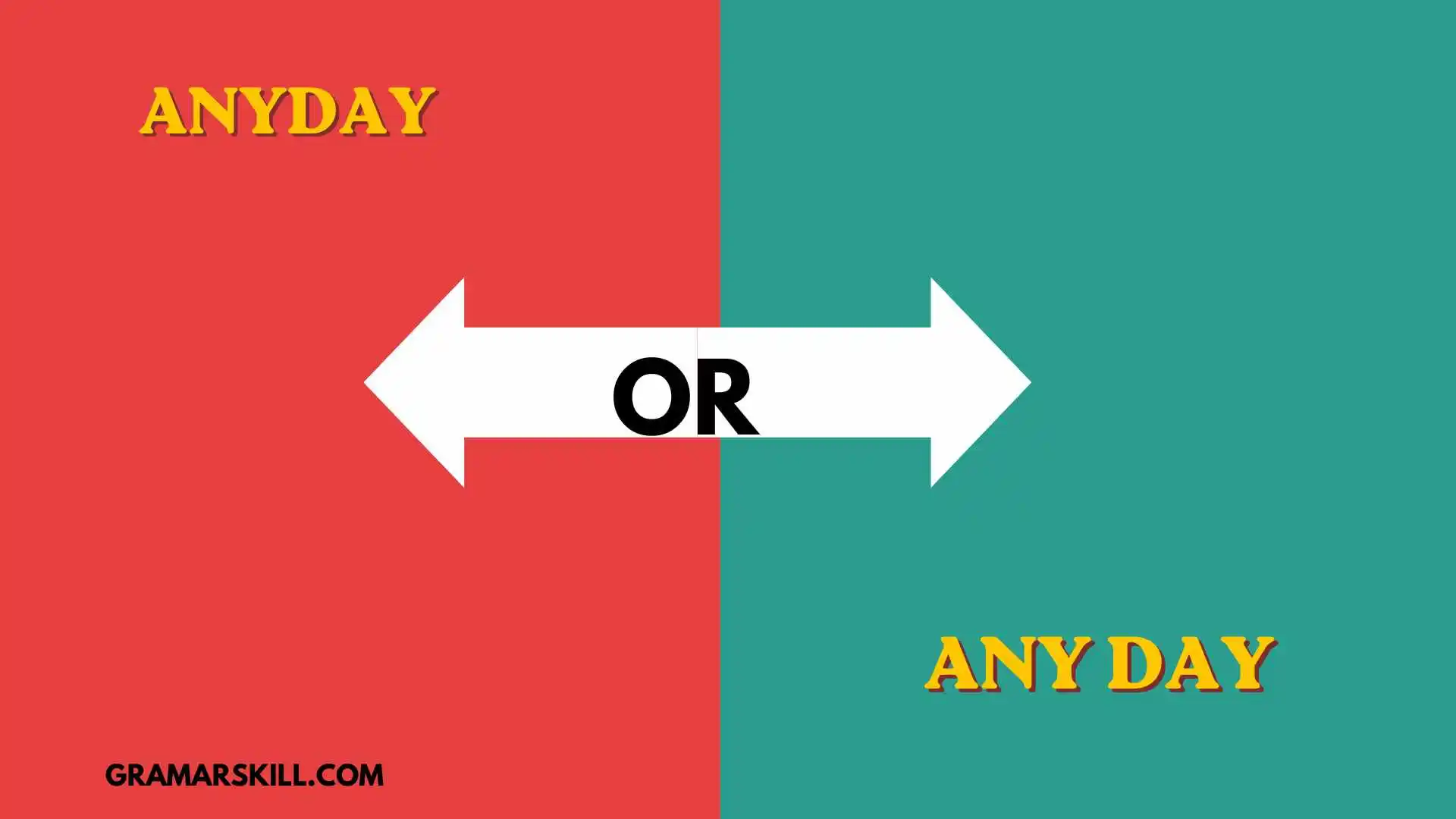
Many English learners and even native speakers often feel confused about whether to write “anyday” or “any day.” At first glance, both look correct. However, only one form is grammatically accepted in standard English.
This confusion happens because English often combines words over time (like “everyday” vs “every day”). So, it’s natural to wonder if “anyday” follows the same pattern. However, the rules here are slightly different, and understanding them will improve your writing clarity.
Whether you follow British English (UK) or American English (US), knowing the correct form is important. It helps you write professionally, avoid mistakes in exams, and communicate clearly in emails, essays, and daily conversations.
Quick Answer
The correct form is “any day” (two words).
👉 “Any day” means any time or whenever possible.
❌ “Anyday” (one word) is not standard English and should be avoided in both UK and US writing.
Example:
- ✅ I can meet you any day next week.
- ❌ I can meet you anyday next week.
Meaning of the Correct Form (Any Day)
What does “any day” mean?
“Any day” is a phrase that means:
- At any time
- On any specific day
- Whenever convenient
It is widely used in both British English and American English without any difference in spelling or meaning.
Examples in British English (UK)
- I can visit you any day this week.
- You may call me any day between Monday and Friday.
- The delivery could arrive any day now.
Examples in American English (US)
- I’m free any day after work.
- We can schedule the meeting any day next month.
- The package should arrive any day now.
Different Contexts of Usage
- Availability
- I’m available any day.
- Possibility
- The results could come out any day.
- Flexibility
- Choose any day that suits you.
Important Note
“Any day” always works as a noun phrase, where:
- “Any” = refers to one or more unspecified options
- “Day” = a unit of time
Together, they form a flexible time expression.
Meaning of the Incorrect Form (Anyday)
Is “anyday” a real word?
❌ No, “anyday” is not a standard word in formal English.
It is:
- Not accepted in academic writing
- Not used in professional communication
- Not recognized in standard UK or US dictionaries
Why do people use “anyday”?
People often confuse it with words like:
- “Everyday” (which is correct in some contexts)
- “Someday” (which is also correct)
However, unlike those words, “anyday” has not become an accepted compound word.
Where you might see “anyday”
You may see “anyday”:
- In informal texting
- On social media
- In casual writing
However, you should avoid using it in formal or correct English.
Keyword Comparison / Key Differences
| Feature | Any Day ✅ | Anyday ❌ |
| Correctness | Correct | Incorrect |
| Usage | Formal & informal | Informal only (not recommended) |
| Meaning | Refers to any time/day | No proper meaning |
| UK English | Accepted | Not accepted |
| US English | Accepted | Not accepted |
Key Takeaway
- Use “any day” in all situations.
- Avoid “anyday”, especially in professional or academic writing.
Anyday or Any Day Meaning, Answer, Sentences, Examples, and Grammar
| Topic | Explanation |
|---|---|
| Meaning of “Any Day” | Any day is the correct and standard English phrase. It means on any day, at any time, or whenever something may happen. |
| Meaning of “Anyday” | Anyday is generally considered a nonstandard spelling in formal English. Although it occasionally appears in informal writing, most style guides recommend using any day instead. |
| Anyday or Any Day – Which Is Correct? | In grammar and professional writing, any day is the preferred and correct form. Use it in emails, essays, business communication, and academic writing. |
| Anyday or Any Day Answer | The correct choice is usually any day. Example: You can visit us any day next week. |
| Any Day in a Sentence | I am available any day this month. You can call me any day after 5 p.m. The package should arrive any day now. |
| Anyday in a Sentence | Informal example: I’d choose coffee over tea anyday. However, most editors would change anyday to any day. |
| Any Day Examples | The baby is due any day now. Feel free to stop by any day. The results could be announced any day. |
| Anyday Examples | I’d pick this restaurant anyday. She would support her friends anyday. These examples are informal, and any day is usually preferred. |
| Grammar Rule | Use any day when referring to an unspecified day or time. Since any functions as a determiner modifying the noun day, the phrase should remain two separate words. |
| Quick Tip | If you can replace it with on any day and the sentence still makes sense, use any day (two words). |
| Final Verdict | ✅ Any day = Correct and standard English. ❌ Anyday = Informal and generally avoided in formal writing. |
Common Mistakes People Make
Even though the rule is simple, people still make mistakes. Let’s look at some common ones.
1. Writing “anyday” as one word
❌ I will come anyday you call me.
✅ I will come any day you call me.
2. Confusing with “everyday”
People think:
- “everyday” = correct
- so “anyday” = must also be correct
👉 But this is wrong.
- “Everyday” (one word) = common or routine
- “Any day” (two words) = any time
3. Using it in formal writing
❌ Please schedule the meeting anyday.
✅ Please schedule the meeting any day.
4. Ignoring grammar rules in casual texting
While texting may allow shortcuts, using incorrect forms can build bad habits.
5. Mixing meanings
❌ I like to relax anyday.
✅ I like to relax any day.
Correct Usage in Sentences
Here are clear examples for both UK and US readers.
Daily Conversation Examples
- I can help you any day.
- You can visit us any day.
- She is available any day this week.
Professional Examples
- The manager is available for meetings any day.
- Please submit your report any day before Friday.
- Interviews will be conducted any day next week.
UK-Specific Style Examples
- The parcel may arrive any day now.
- You can contact the office any day during working hours.
US-Specific Style Examples
- The shipment should arrive any day now.
- Feel free to call me any day after 5 PM.
Casual Examples
- Let’s hang out any day!
- I’m free any day, just tell me.
Negative Examples (Incorrect Usage)
- ❌ I’ll meet you anyday.
- ❌ Call me anyday.
- ❌ You can come anyday.
Tips to Remember the Correct Usage
Here are some easy tricks to avoid mistakes.
1. Think of “Any Day” as Two Words Always
👉 If you mean “any time,” use two words.
2. Replace with “Any Time”
If “any time” fits, then “any day” is correct.
- I can come any day
- I can come any time
3. Remember: Not All Words Combine
Just because:
- everyday ✅
does not mean: - anyday ❌
4. Use the “Test Sentence Trick”
Ask yourself:
👉 Can I separate the words naturally?
- “any day” → Yes
- “anyday” → No
5. Stick to Standard English
When in doubt:
👉 Always choose the safer, correct form: any day
FAQs (Frequently Asked Questions)
1. Is “anyday” ever correct?
No, “anyday” is not correct in standard English. Always use “any day.”
2. Do UK and US English treat this differently?
No. Both British and American English use “any day” and do not accept “anyday.”
3. Why is “everyday” correct but “anyday” is not?
“Everyday” has evolved into a compound word with a different meaning (routine or common).
However, “anyday” has not been accepted as a compound word.
4. Can I use “anyday” in informal texting?
You can, but it is not recommended. It may lead to bad writing habits and confusion.
5. What is the meaning of “any day now”?
It means very soon.
Example:
- The baby is expected any day now.
6. Is “any day” formal or informal?
It works in both formal and informal contexts.
7. How can I avoid this mistake in exams?
- Always remember: two words = correct
- Practice writing sentences
- Avoid shortcuts like “anyday”
Conclusion
Understanding the difference between “anyday or any day” is simple once you know the rule.
👉 “Any day” is always correct and should be used in both British and American English.
👉 “Anyday” is incorrect and should be avoided in formal and standard writing.
In summary:
- Use “any day” for flexibility and time references
- Avoid combining the words into “anyday”
- Practice with real-life sentences to build confidence
READ MORE ARTICLES..
Jesus’ or Jesus’s: Explained in Simple English 2026
Separate or Seperate: differences & how to use them? 2026
Grammar or Grammer: Top Mistakes and How to Fix Them Fast in 2026
Planning or Planing: what is difference & usage. 2026

I’m Daniel Brooks, a passionate grammar enthusiast dedicated to making English simple and clear for everyone. I love breaking down confusing rules into easy, practical explanations you can actually use. Through my content, I aim to help learners write with confidence and accuracy. I believe good grammar isn’t about perfection it’s about clear communication.