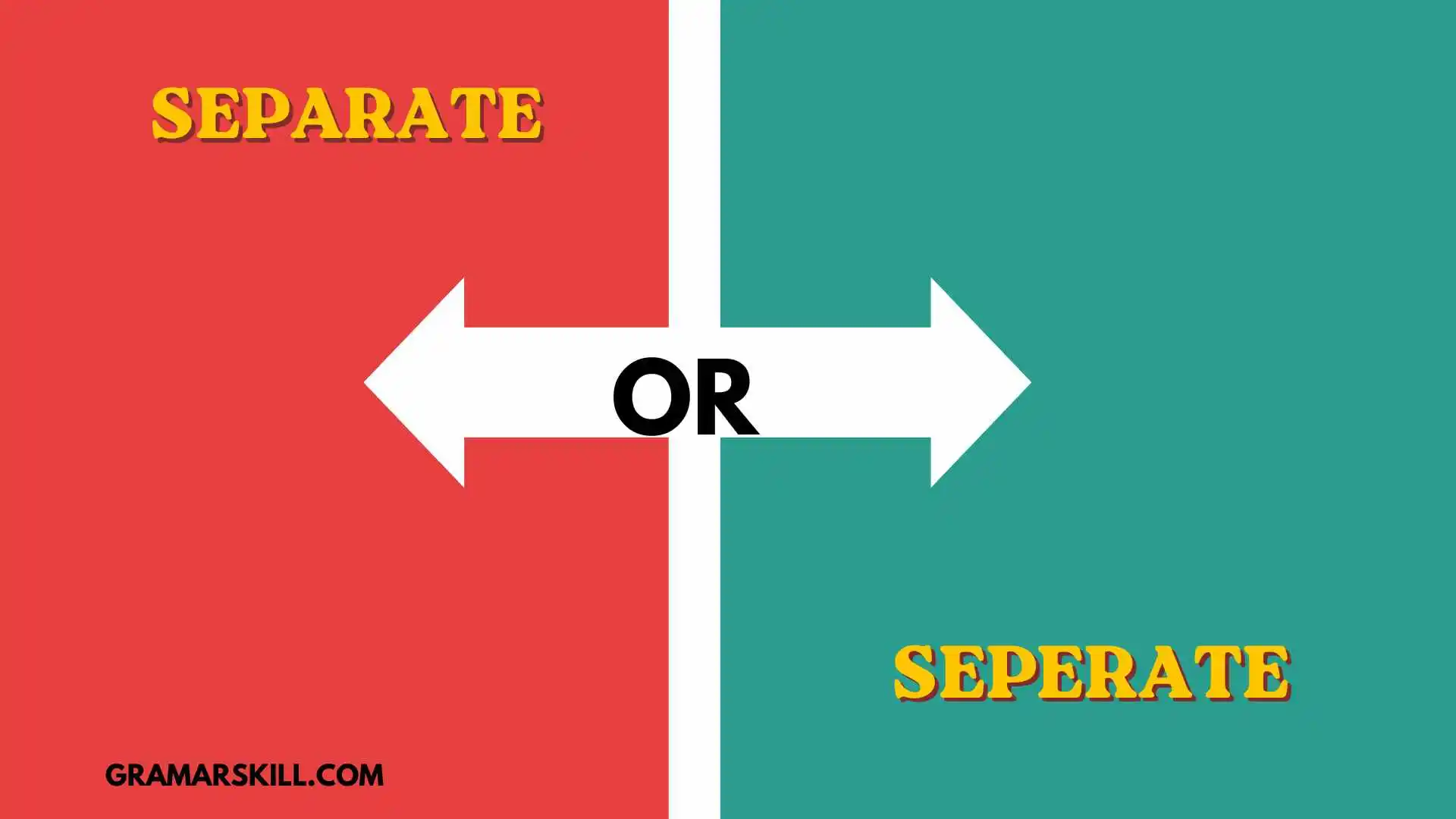
Many English learners and even native speakers often wonder: should it be separate or seperate? This confusion is extremely common because the pronunciation of the word can trick your brain into thinking it should be spelled differently. While it sounds like “seperate,” the correct spelling is always separate.
Understanding the difference is crucial not only for professional writing but also for academic work, emails, and everyday communication. Using the wrong spelling can make your writing appear careless, even if the meaning is clear.
Both British English (UK) and American English (US) use separate, but the misspelling seperate shows up frequently in informal writing. Learning the correct form ensures you write confidently and correctly across all English contexts.
Quick Answer
The correct spelling is separate. The version seperate is a common misspelling.
- ✅ Correct: separate
- ❌ Incorrect: seperate
Whether in the UK or US, the rule is simple: always use separate.
Meaning of the Correct Form
The word separate is an adjective, verb, or noun, depending on the context. Its general meaning involves dividing, distinguishing, or keeping apart.
1. As a Verb
Separate means to divide or set apart.
- US Example: Please separate the recyclables from the trash.
- UK Example: She separated the clothes into whites and colors.
2. As an Adjective
Separate describes things that are not joined or are distinct.
- US Example: They live in separate houses.
- UK Example: Each student has a separate desk in the classroom.
3. As a Noun (less common)
Separate can also refer to something considered individually.
- Example: The issue is a separate from the main discussion.
In both UK and US English, separate is the only correct form.
Meaning of the Incorrect Form
The spelling seperate is a frequent mistake because the pronunciation makes it tempting to insert an extra “e.” However, seperate has no recognized meaning in English.
- Incorrect Example: Please seperate the documents.
- ✅ Corrected: Please separate the documents.
The key is to remember: “a comes before r” in separate. A mnemonic trick: “Sep-A-rate, not Sep-E-rate.”
Keyword Comparison / Key Differences
| Aspect | Correct: Separate | Incorrect: Seperate |
| Spelling | s-e-p-a-r-a-t-e | s-e-p-e-r-a-t-e |
| Usage | Verb, adjective, noun | Not recognized |
| UK/US Difference | Same in both | Wrong in both |
| Examples | We must separate work from play. | We must seperate work from play. (WRONG) |
Key Point: There is no regional difference. Both British and American English insist on separate.
Common Mistakes People Make
- Mixing vowels: Writing “seperate” instead of “separate.”
- Incorrect: She had to seperate the ingredients.
- Correct: She had to separate the ingredients.
- Splitting words incorrectly: Writing “seperate” as two words, like “se perate.”
- Always keep it together: separate.
- Confusing pronunciation with spelling: The word sounds like it has an “e” in the middle, which misleads writers.
- Using the wrong form in formal writing:
- Emails, reports, and essays often show this mistake.
- Always double-check: separate is the safe choice.
Correct Usage in Sentences
UK English Examples
- She prefers to have separate accounts for work and personal expenses.
- The teacher asked students to work in separate groups.
- They decided to separate the two teams for the tournament.
US English Examples
- Please separate the recyclables from the trash.
- The siblings have separate bedrooms.
- We need to separate these tasks to make the workflow more efficient.
Tips: Notice that the meaning doesn’t change between UK and US English. The spelling separate is universal.
Tips to Remember the Correct Usage
- Mnemonic Trick:
Remember “Sep-A-rate” – the a comes before the r. - Break it Down:
Think: se-par-ate. Each part helps you remember the correct order of letters. - Visual Clues:
Imagine a line separating two groups. The word separate visually splits with the a in the middle. - Checklists:
Before submitting a formal document, always scan for separate vs seperate. Spell checkers often catch this, but mental reminders are crucial. - Practice Makes Perfect:
Write sentences using separate daily. For example:- I need a separate notebook for math.
- Can you separate the items into two piles?
FAQs
Q1: Is “seperate” ever correct?
- No. Seperate is always incorrect. The correct form is separate in both UK and US English.
Q2: Why do people write “seperate”?
- It’s due to pronunciation. The middle “a” sounds like an “e,” which leads to the common spelling mistake.
Q3: Are there differences between UK and US spelling?
- No. Separate is the same in British and American English. Both regions avoid “seperate.”
Q4: How can I remember the correct spelling?
- Use the mnemonic: Sep-A-rate. Break the word into syllables to reinforce the correct order.
Q5: Can I use “seperate” in informal writing?
- It’s best not to. Even in casual emails or messages, separate is preferred for clarity.
Q6: What is the opposite of separate?
- Words like join, combine, or unite can be opposites, depending on context.
Q7: Can “separate” be a noun?
- Yes, though rarely. Example: Each topic is treated as a separate in the report.
Conclusion
In conclusion, the correct spelling is always separate. The misspelling seperate is widespread but never accepted in standard English. Whether you’re writing for UK or US readers, academic essays, professional emails, or casual messages, using separate correctly demonstrates strong language skills.
Remember the tips:
- Break it down: sep-a-rate
- Use mnemonics
- Practice with real-life examples
By mastering separate, you eliminate one of the most common English spelling mistakes. Next time you write, check your document, and ensure your writing reflects confidence and correctness. Start applying these strategies today and never worry about separate or seperate again!

I’m Daniel Brooks, a passionate grammar enthusiast dedicated to making English simple and clear for everyone. I love breaking down confusing rules into easy, practical explanations you can actually use. Through my content, I aim to help learners write with confidence and accuracy. I believe good grammar isn’t about perfection it’s about clear communication.