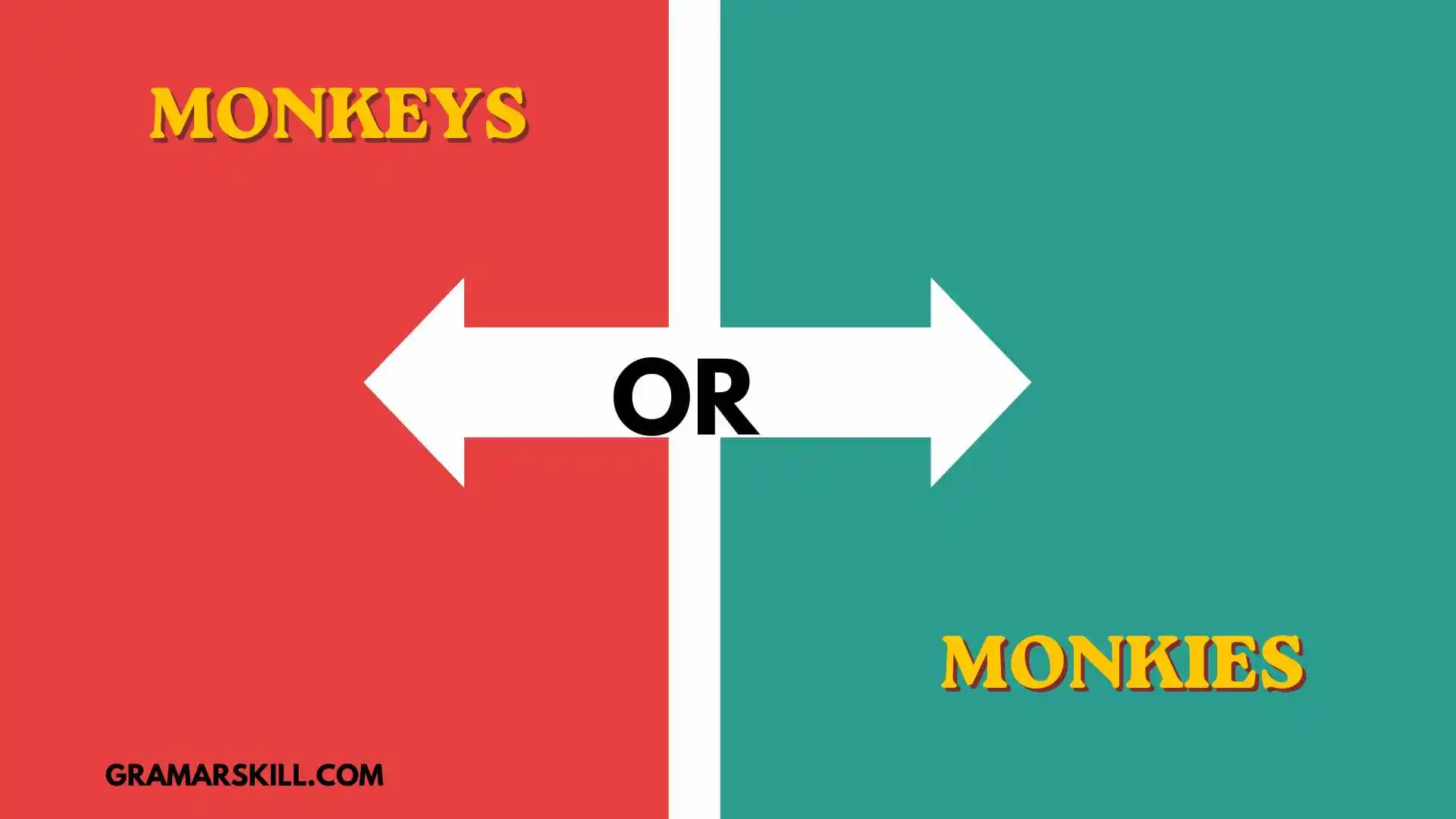
Have you ever wondered whether to write “monkeys” or “monkies”? This is a common question among English learners and even native speakers. Many people see the word in casual writing or online and assume that “monkies” might be correct.
Understanding the correct spelling is essential because it helps you write confidently in both UK (British English) and US (American English) contexts. Spelling mistakes can make your writing look unprofessional, even in informal situations like social media posts or personal essays.
In addition, knowing the difference helps learners of English avoid confusion when reading books, watching documentaries, or writing school assignments. Since “monkeys” are familiar animals in both regions, clarity in spelling is key.
Quick Answer
The correct spelling is “monkeys”.
“Monkies” is incorrect and should be avoided in formal and informal writing. In both British English and American English, the plural of “monkey” is always monkeys.
This rule is consistent across dictionaries, style guides, and educational materials. Therefore, whenever you need to refer to more than one monkey, always use “monkeys”.
Meaning of the Correct Form
The word “monkeys” is the plural form of “monkey”, which refers to primates that are widely known for their intelligence, agility, and playful behavior.
Examples in sentences:
- US English: “The children enjoyed watching the monkeys at the zoo in New York.”
- UK English: “During our trip to London Zoo, we saw several monkeys swinging in the trees.”
Additional points:
- In biology, monkeys are classified into Old World monkeys (like baboons) and New World monkeys (like capuchins).
- The word is used metaphorically too, e.g., “He’s monkeying around with his homework,” but the plural still follows the rule: monkeys.
Meaning of the Incorrect Form
“Monkies” is a common misspelling.
Some people write “monkies” because the word “key” in English often changes to “ies” in plurals, such as:
- Baby → Babies
- City → Cities
However, “monkey” does not follow this rule. The reason is that words ending with a vowel + y (like ey) form their plural simply by adding s, not ies.
Incorrect examples:
- ❌ “I saw three monkies in the forest.”
- ❌ “The zoo has many different monkies.”
Corrected examples:
- ✅ “I saw three monkeys in the forest.”
- ✅ “The zoo has many different monkeys.”
Keyword Comparison / Key Differences
| Feature | Monkeys | Monkies |
| Correctness | ✅ Correct | ❌ Incorrect |
| Plural Form Rule | Follows vowel + y rule (just add s) | Breaks English plural rule |
| UK English | ✅ Same | ❌ Wrong |
| US English | ✅ Same | ❌ Wrong |
| Example Sentence | “Monkeys are very playful.” | “Monkies are very playful.” ❌ |
Key point: There is no UK vs US difference. Both countries use monkeys as the plural.
Why Is It Monkeys and Not Monkies? | Monkeys or Monkies Meaning | Monkeys or Monkies Plural
| Topic | Explanation |
|---|---|
| Correct Spelling | Monkeys is the correct plural form of monkey. Monkies is considered incorrect in standard English. |
| Why Is It “Monkeys” and Not “Monkies”? | When a noun ends with a vowel + y, you simply add -s to make it plural. Since monkey ends in ey (a vowel + y), the correct plural is monkeys. |
| Monkeys or Monkies Meaning | Both words are intended to refer to more than one monkey, but only monkeys is accepted in modern English dictionaries and grammar rules. |
| Monkeys or Monkies Plural | The plural of monkey is monkeys. The spelling monkies is a common mistake. |
| Grammar Rule | If a word ends in a consonant + y, change y to ies (baby → babies). If it ends in a vowel + y, add s (monkey → monkeys, toy → toys). |
| Example Sentences | ✅ The monkeys were playing in the trees. ✅ We saw several monkeys at the zoo. ❌ The monkies were playing in the trees. |
| Quick Answer | Always use monkeys when writing the plural form of monkey. |
Common Mistakes People Make
Many learners make errors because of English plural rules:
- Changing “y” to “ies” incorrectly
- Wrong: “monkies”
- Correct: “monkeys”
- Relying on autocorrect
- Some apps may suggest “monkies” as a typo; always double-check.
- Mixing metaphorical expressions
- Wrong: “He has a few monkies on his back.”
- Correct: “He has a few monkeys on his back.”
- Confusing with other words ending in -ey
- Honey → Honeys (acceptable in informal contexts for plural)
- Monkey → Monkeys (always correct)
Tip: When in doubt, think of the word “key” → plural is keys, not kies. The same applies to “monkey” → monkeys.
Correct Usage in Sentences
Here are real-life examples for both UK and US readers:
UK Examples:
- “The monkeys at London Zoo love climbing the trees.”
- “Children laughed as the monkeys played in the park.”
- “Some monkeys are trained to perform tricks in circuses, although this practice is controversial.”
US Examples:
- “San Francisco’s zoo has over 50 monkeys from around the world.”
- “The rainforest tour allowed us to see wild monkeys swinging between branches.”
- “Monkeys are intelligent animals and can use tools in some cases.”
Tips for Writing:
- Always check the word before adding ies; “monkey” is an exception.
- If writing for children or educational content, you can include fun facts to make “monkeys” engaging.
Tips to Remember the Correct Usage
- Vowel + y rule: Words ending in a vowel + y (like ey) just add s to form plurals. Example: monkey → monkeys, key → keys.
- Mnemonic trick: “Monkey’s key to plural is simply s.”
- Think zoology: Monkeys are animals, not abstract nouns, so follow the simple plural rule.
- Double-check in dictionaries: Both Oxford English Dictionary and Merriam-Webster confirm monkeys as the only correct plural.
- Visual reminder: Imagine a group of monkeys swinging in trees — more than one = monkeys.
FAQs Section
1. Is “monkies” ever correct?
No. “Monkies” is always considered a spelling mistake in both UK and US English.
2. Why do some people write “monkies”?
They confuse the plural rule for words ending with “y.” Only consonant + y changes to ies, while vowel + y just adds s.
3. What is the plural of monkey?
The plural is monkeys, both in British and American English.
4. Are there any UK vs US differences in spelling?
No. The word monkeys is universally accepted in both regions.
5. Can I use “monkies” in informal writing?
Even in informal writing, it is considered wrong. It may confuse readers or look unprofessional.
6. How do I remember the correct spelling?
Use the vowel + y rule: Monkey ends in ey → just add s → monkeys.
7. Are there idioms with monkeys I should know?
Yes, for example:
- “Monkey business” (mischievous behaviour)
- “Monkey on your back” (a persistent problem)
Always use monkeys when pluralizing the animal.
Conclusion
To summarize, the correct spelling is always “monkeys”. Avoid “monkies” in all types of writing. This rule applies to both UK and US English, and it aligns with the general pluralisation rules for words ending in vowel + y.
Remember:
- Monkey → Monkeys (plural)
- Vowel + y → add s
- Consonant + y → change y to ies
By following these simple tips, you can confidently use the word in school, work, or casual writing. Next time you see a playful group of primates, you’ll know exactly how to spell it.
Call to Action: Practice writing sentences with monkeys in your daily notes, and soon the correct spelling will become second nature!
READ MORE ARTICLES..
trys or tries: What is the difference & how to use them.2026
Plushie or Plushy: Which Spelling Is Correct? (2026)
Jesus’ or Jesus’s: Explained in Simple English 2026
Geese or Goose: Singular vs Plural Made Super Easy in 2026

I’m Daniel Brooks, a passionate grammar enthusiast dedicated to making English simple and clear for everyone. I love breaking down confusing rules into easy, practical explanations you can actually use. Through my content, I aim to help learners write with confidence and accuracy. I believe good grammar isn’t about perfection it’s about clear communication.