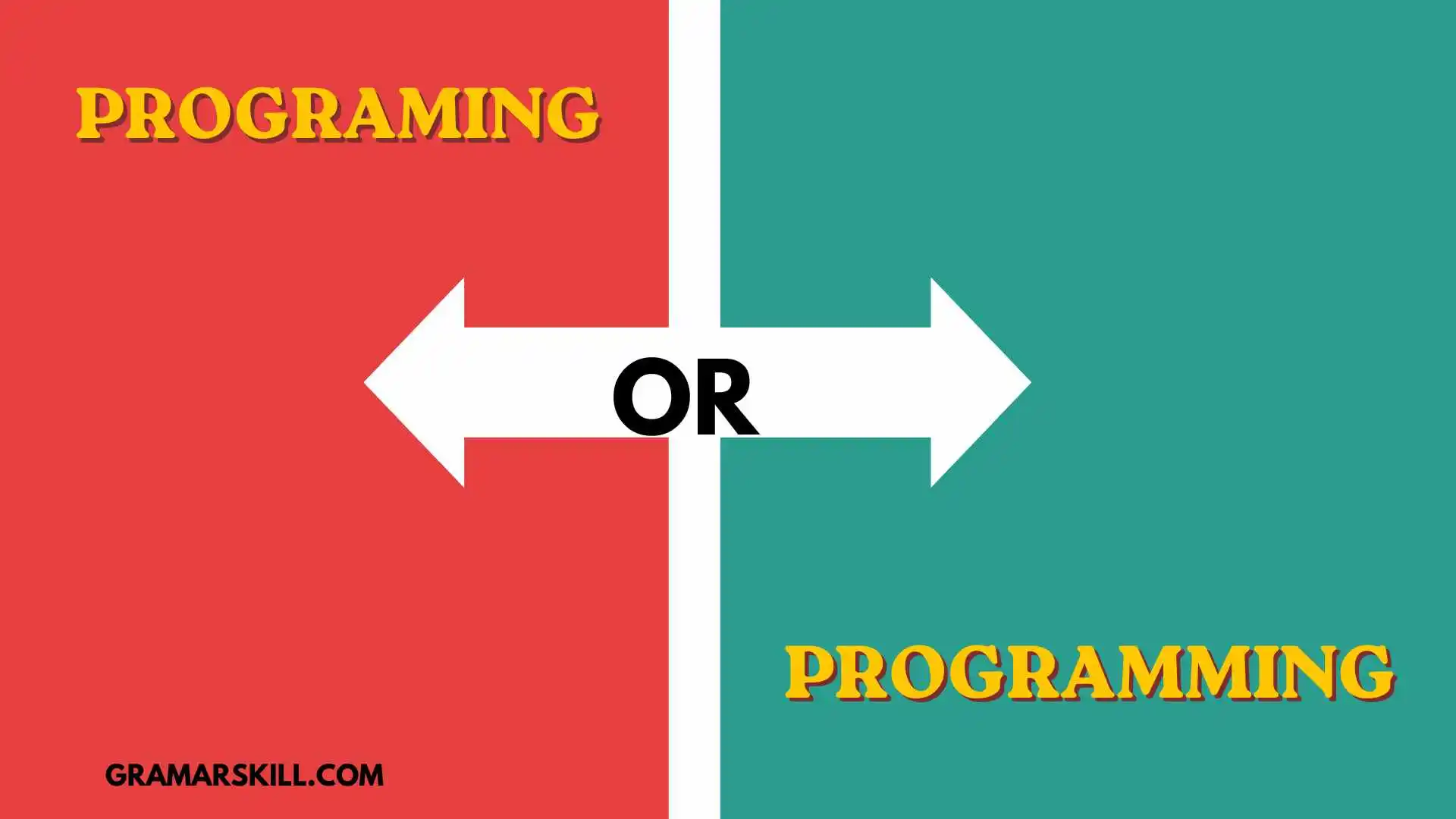
If you’ve ever written an email, a report, or even a social media post about coding, you might have paused at the spelling: should it be programing or programming? This question is more common than you think, and even seasoned writers sometimes get it wrong. The difference may seem minor, but using the correct form matters, especially in professional, academic, or online content.
Understanding this difference is not just about spelling. It also reflects your grasp of English conventions across regions. In the United States and the United Kingdom, some words are spelled differently, which can confuse learners. With “programing or programming,” this confusion mainly stems from the use of single versus double consonants when forming gerunds or participles.
For anyone learning English, or even for native speakers writing technical or business documents, clarity matters. Using the wrong form can affect credibility and readability. Therefore, getting this right is essential for writers, educators, software developers, and anyone communicating about coding or software projects.
Quick Answer
The correct form is programming.
- Programming (with a double “m”) is standard in both American English (US) and British English (UK).
- Programing (with a single “m”) is mostly considered a typo in modern usage, though some older UK references may show it.
In short: always use programming when talking about writing computer programs, developing software, or creating code.
Meaning of the Correct Form: Programming
Programming is the gerund or present participle form of the verb to program, which means writing instructions for a computer.
- Example (US English):
“She is learning programming to build mobile apps.” - Example (UK English):
“He enjoys programming in Python during his free time.”
Key Points:
- Programming = writing software code.
- Used in technical, academic, and professional contexts.
- Always spelled with two “m”s to follow English spelling rules for doubling consonants after a short vowel in stressed syllables.
Extra Context (UK vs US):
- Both UK and US English agree on programming.
- Unlike words like “travelling/traveling,” “programming” does not differ between regions.
Meaning of the Incorrect Form: Programing
Programing (with a single “m”) is often considered incorrect in modern English. However, it sometimes appears in:
- Typos or informal writing: Many writers accidentally drop an “m.”
- Example: “I am learning programing online.” ❌
- Older UK sources: Some historical UK publications used single “m,” though this is now outdated.
- Different context (rarely): In niche dictionary references, programing can refer to creating a schedule or program (like a TV program), but this is extremely uncommon.
Bottom line: avoid using programing for computer coding, apps, or software.
Keyword Comparison / Key Differences
| Feature | Programming | Programing |
| Correct usage | Writing computer code or software | Rarely correct; often a typo |
| Spelling | Double “m” | Single “m” |
| US English | ✅ Standard | ❌ Incorrect |
| UK English | ✅ Standard | ⚠ Rare, historical |
| Example | “Programming is a valuable skill in IT.” | “I love programing.” ❌ |
Key takeaway: If you’re writing about coding, apps, websites, or software, always use programming.
Common Mistakes People Make
Even experienced writers sometimes use the wrong form. Here are the most frequent errors:
- Dropping an “m” after “program”
- Incorrect: “I enjoy programing in JavaScript.”
- Correct: “I enjoy programming in JavaScript.”
- Confusing with “TV programming”
- In broadcasting, you might see programming (UK/US) referring to schedules. Some writers mistakenly think “programing” works here, but programming is still standard.
- Assuming British English uses a single “m”
- Incorrect assumption: “In the UK, it’s programing.” ❌
- Reality: UK English also uses programming.
- Mixing with “program” as a noun
- “Program” is the noun: “I installed a new program.”
- “Programming” is the action: “I am programming a new application.”
Correct Usage in Sentences

American English Examples:
- “He is studying programming to become a software engineer.”
- “Programming in Python is easier than in C++ for beginners.”
- “I watched a tutorial on web programming yesterday.”
- “Our team is developing a new app, and I am responsible for programming the backend.”
- “Learning programming skills can boost your career opportunities.”
British English Examples:
- “She enjoys programming during her spare time at university.”
- “Programming challenges help students develop logical thinking.”
- “He has a keen interest in artificial intelligence and programming robots.”
- “The course includes lessons on data structures and programming techniques.”
- “UK tech companies value strong programming knowledge in applicants.”
Tip: Notice the consistency in spelling for both regions. Double “m” is standard.
Tips to Remember the Correct Usage
- Think “double the m” for coding – If it involves computers, always double the “m.”
- Mnemonic trick: Program + mm = Programming. The extra “m” mirrors the word “machine,” which also has two consonants.
- Compare with similar verbs:
- Stop → Stopping
- Program → Programming
This follows the same doubling rule after a stressed vowel.
- Check context: If you’re talking about software or code, programming is correct.
- Spell-checker: Modern software like MS Word, Google Docs, or Grammarly will usually flag programing as incorrect.
FAQs
1. Is “programing” ever correct?
Only in very rare, historical, or informal contexts. For coding, software, and apps, it is always incorrect.
2. Does UK English use “programing” instead of “programming”?
No, UK English also uses programming for software coding.
3. Can I use “programing” in a CV or resume?
No. Always use programming to avoid looking careless.
4. Why do people confuse the two spellings?
The confusion comes from the doubling rule in English spelling. Some writers mistakenly drop an “m” after “program.”
5. Is “programming” used only for computers?
Mostly yes. But it can also refer to creating schedules, courses, or broadcasts. Example: “TV programming is scheduled for 8 PM.”
6. How do I remember the difference between “program” and “programming”?
- Program = noun (the software, the app, the schedule)
- Programming = verb/gerund (the act of coding)
7. Are there other similar words that double consonants?
Yes! Examples include:
- Run → Running
- Swim → Swimming
- Begin → Beginning
This helps you remember program → programming.
Conclusion
In conclusion, when choosing between programing or programming, the correct form is programming in both US and UK English. Using the correct spelling not only ensures clarity but also reflects professionalism and attention to detail.
Remember the key tips: double the “m” after “program”, think of “programming” as the act of coding, and always check context. Avoid the single “m” version unless referencing an extremely rare historical usage.
Whether you’re writing a blog, CV, academic article, or technical documentation, using programming correctly will help your writing shine. Start practicing today, and soon it will feel natural to spell it correctly every time.

I am Julian Parker, a passionate grammar enthusiast and content writer dedicated to making English rules simple and easy to understand. I specialize in breaking down complex grammar topics into clear, practical explanations. I enjoy helping readers improve their writing skills with confidence. My goal is to make learning grammar engaging, simple, and accessible for everyone.