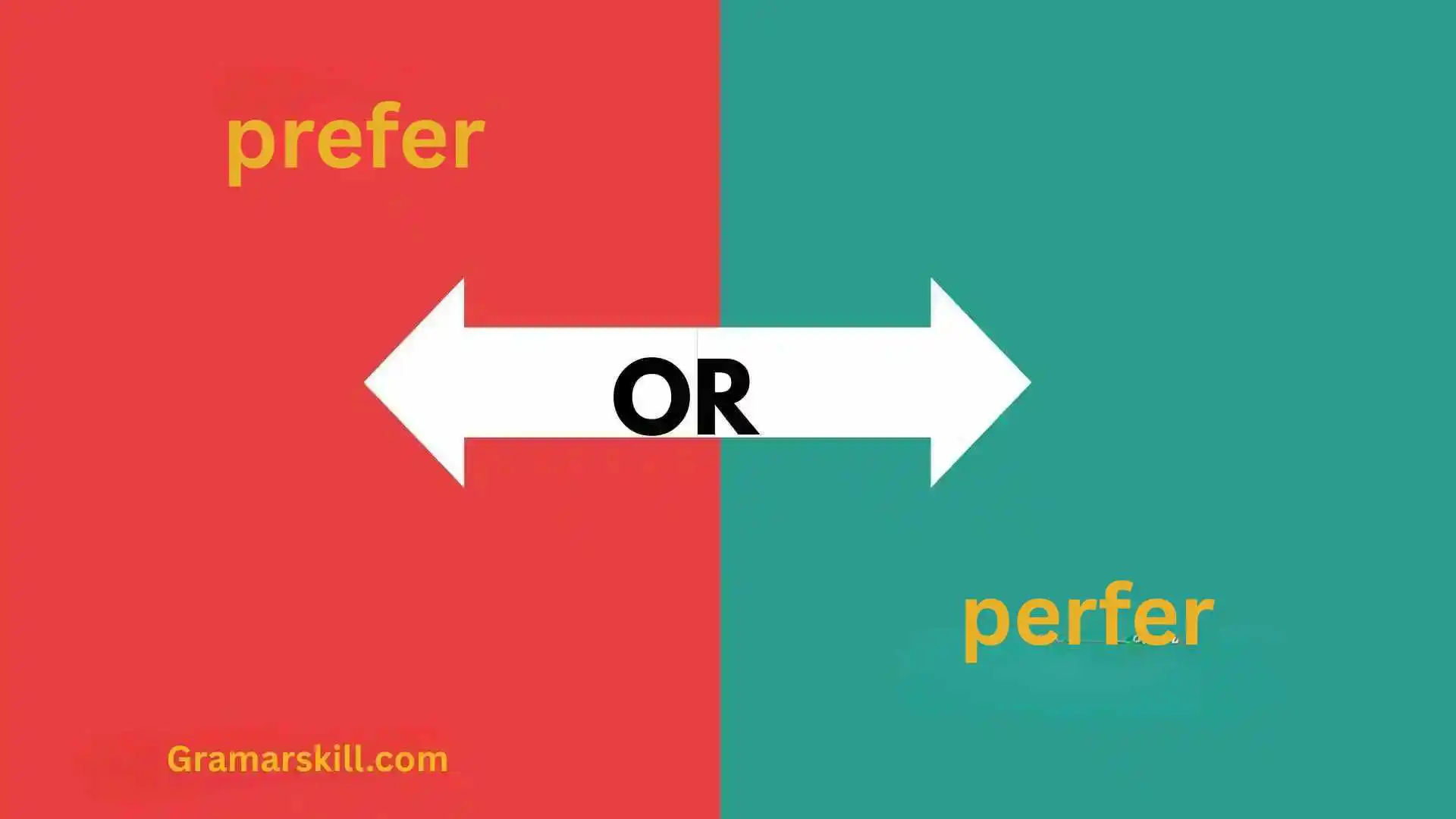
Many English learners and even native speakers often get confused between “prefer” and “perfer.” This confusion usually arises because the words sound similar when spoken quickly, but in reality, only one is correct. Understanding the difference is crucial for writing and speaking confidently, whether you are in the UK or the US.
In both British and American English, correct spelling and usage matter for professional writing, emails, academic work, and everyday communication. While “prefer” is widely recognized and used, “perfer” is considered a spelling mistake and is rarely, if ever, accepted in formal contexts.
This article will guide you through the correct usage, common mistakes, and practical tips for remembering the correct spelling. By the end, you will be able to write confidently without second-guessing.
Quick Answer
Simply put:
- ✅ Correct: prefer – used to indicate a choice, liking, or inclination.
- ❌ Incorrect: perfer – a common misspelling of “prefer.”
Example:
- Correct: I prefer tea over coffee.
- Incorrect: I perfer tea over coffee.
Whether you are writing in British English or American English, “prefer” is always correct.
Meaning of the Correct Form
The word “prefer” is a verb that shows choice, liking, or priority between two or more options.
Key Points:
- It expresses personal preference.
- Can be followed by a noun, pronoun, or verb in the infinitive form.
Examples in US English:
- I prefer summer to winter.
- She prefers reading books rather than watching TV.
Examples in UK English:
- I prefer tea to coffee.
- They prefer to travel by train instead of flying.
Notice that in UK English, “prefer to” is slightly more common than in US English, though both are correct.
Grammar Tip:
- Structure: prefer + noun/pronoun + to + noun/pronoun
- Or: prefer + verb (infinitive)
- Example: I prefer walking to driving.
Meaning of the Incorrect Form
The word “perfer” is not a real English word. It is simply a typo or misspelling of “prefer.” Using it in writing can make your text look unprofessional or careless.
Example of incorrect usage:
- ❌ I perfer chocolate over vanilla.
- ❌ She perfer to work from home.
Even in informal writing, such as texting or social media, it is recommended to use “prefer” to avoid confusion.
Keyword Comparison / Key Differences
| Feature | Prefer | Perfer |
| Type | Verb | Not a word |
| Meaning | Shows choice or liking | Incorrect spelling |
| Usage | I prefer coffee to tea. | ❌ I perfer coffee to tea. |
| UK English | Common usage | ❌ Not used |
| US English | Common usage | ❌ Not used |
| Acceptable in formal writing | ✅ Yes | ❌ No |
Key Difference: “Prefer” is correct everywhere, while “perfer” is always wrong. There are no exceptions in either British or American English.
Common Mistakes People Make
Even fluent English speakers sometimes write “perfer” because of:
- Typing errors – hitting “r” before “e.”
- Phonetic spelling – mishearing the word.
- Autocorrect errors – some software may not catch “perfer.”
Example Scenarios:
US English Mistakes:
- ❌ I perfer jogging in the morning.
- ✅ I prefer jogging in the morning.
UK English Mistakes:
- ❌ Do you perfer tea or coffee?
- ✅ Do you prefer tea or coffee?
Quick Tip: If you are unsure, remember the “e before r” rule: prefer = e before r.
Correct Usage in Sentences
Here are multiple examples for both UK and US audiences:
UK English:
- I prefer apples to oranges.
- We prefer staying in hotels rather than hostels.
- She prefers to drink tea in the morning.
- Do you prefer walking or cycling?
- They prefer quiet evenings at home.
US English:
- I prefer coffee over tea.
- He prefers working from home to commuting.
- Do you prefer to watch movies or read books?
- We prefer traveling by car.
- She prefers listening to podcasts instead of music.
Infinitive Usage Examples:
- I prefer to read before bed.
- She prefers to eat at local restaurants.
- They prefer to travel by train.
Tips to Remember the Correct Usage
- Mnemonic Trick:
- Think “I ‘prefer’ e before r.”
- Remember that “perfer” is just a misspelling.
- Think “I ‘prefer’ e before r.”
- Visual Cue:
- Picture the word “preference” – it contains “prefer”, not “perfer.”
- Picture the word “preference” – it contains “prefer”, not “perfer.”
- Practice Writing:
- Regularly write sentences using “prefer” in emails, notes, or social media.
- Regularly write sentences using “prefer” in emails, notes, or social media.
- Use Spell Check:
- Most writing apps highlight “perfer” as incorrect.
- Most writing apps highlight “perfer” as incorrect.
- UK vs US Tip:
- Both use prefer.
- UK English slightly favors “prefer to” over “prefer + -ing”, while US English often accepts both.
- Both use prefer.
FAQs
1. Is “perfer” ever correct?
- No. “Perfer” is always a misspelling. Always use “prefer.”
2. Can I say “prefer over” instead of “prefer to”?
- In US English, “prefer over” is common: I prefer coffee over tea.
- In UK English, “prefer to” is more formal: I prefer coffee to tea.
3. Is “prefers” used for third-person singular?
- Yes. She prefers chocolate.
4. Can “prefer” be used in past tense?
- Yes. I preferred tea yesterday.
5. Are there similar words to “prefer”?
- Yes. Words like favour/favor, like, enjoy can sometimes replace it.
6. How do I remember spelling?
- Think of the word “preference”; the correct form is in there.
7. Is “prefer” formal or informal?
- It is neutral; it works in both formal and informal contexts.
Conclusion
In summary, “prefer” is the correct form to express likes, choices, and priorities, while “perfer” is always a misspelling. Understanding the correct usage is essential for writing clearly and professionally in both UK and US English.
Remember these key points:
- ✅ Always use prefer.
- ✅ Use prefer + to/over/noun/verb depending on the sentence.
- ✅ In UK English, prefer to is slightly more common; in US English, both prefer to and prefer over work.
- ✅ Avoid perfer; it looks unprofessional.
READ MORE ARTICLES..
is a play italicized or quoted: Easy guide with explanation. 2026
do you underline or italicize book titles: Easy guide.
adhd or anxiety: What’s the difference & usage? 2026
ally or allie: What’s the difference & usage?

I am Julian Parker, a passionate grammar enthusiast and content writer dedicated to making English rules simple and easy to understand. I specialize in breaking down complex grammar topics into clear, practical explanations. I enjoy helping readers improve their writing skills with confidence. My goal is to make learning grammar engaging, simple, and accessible for everyone.