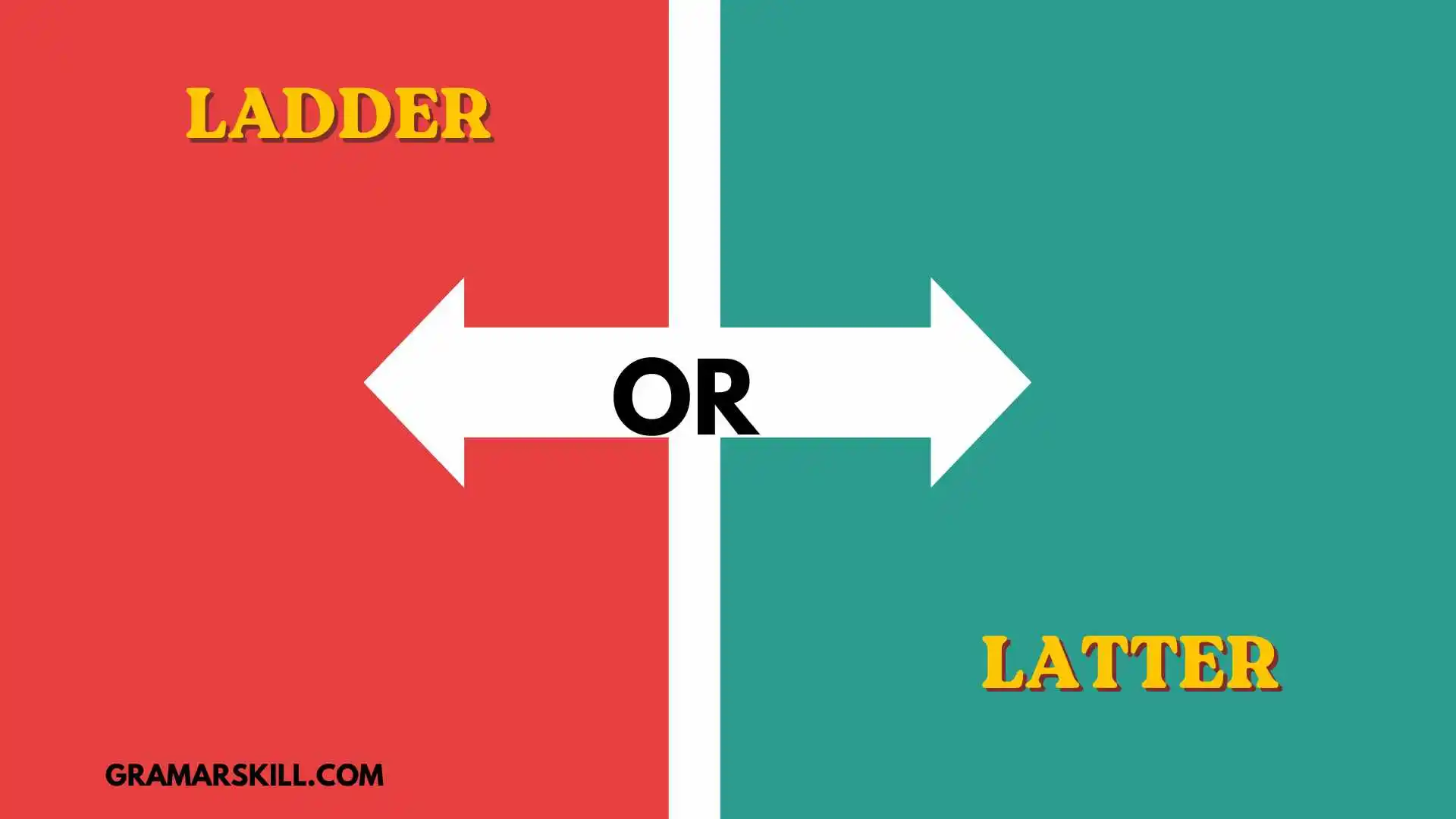
Many English learners and even native speakers often stumble when deciding between “ladder” and “latter.” Though they sound somewhat similar, they have entirely different meanings and uses. Mixing them up can lead to confusion in both writing and speaking, especially for those navigating British and American English contexts.
Understanding the difference is essential because these words appear frequently in daily life, work, education, and literature. Misusing them not only changes the meaning of a sentence but can also make the writer seem careless or uninformed.
In this guide, we will explore the correct meanings of both words, highlight common mistakes, provide real-life examples, and give easy tips to remember their proper use. By the end, you will confidently choose between “ladder” and “latter” in any situation.
Quick Answer
The word “ladder” refers to a physical object used for climbing, like a tool made of steps or rungs. For example: “I climbed the ladder to reach the roof.”
On the other hand, “latter” is an adjective or pronoun used to refer to the second of two mentioned items or the last in a list. For example: “I prefer coffee and tea; I enjoy the latter more.”
Simply put: use “ladder” for climbing, “latter” for referring to the second or last option.
Meaning of the Correct Form
Ladder
A ladder is a noun describing a device with steps, typically used to climb to higher places.
Examples (UK & US English):
- UK: “He placed the ladder against the wall to paint the ceiling.”
- US: “Make sure the ladder is stable before you climb up.”
Additional notes:
- Ladders can be made of wood, metal, or rope.
- The word is always a physical object and rarely used metaphorically in simple English.
Latter
Latter is used to indicate the second of two items mentioned or the last item in a group.
Examples (UK & US English):
- UK: “Between Shakespeare and Dickens, the latter is my favourite author.”
- US: “I had tea and coffee, and I enjoyed the latter.”
Additional notes:
- Latter is a comparative or relative term; it helps avoid repetition.
- Often paired with former, which refers to the first item in a list.
- Example: “Between cats and dogs, the former is more independent, while the latter is more loyal.”
Meaning of the Incorrect Form
Many people confuse ladder and latter because they sound alike, especially when spoken quickly. Using one instead of the other changes the meaning entirely.
Common incorrect usages:
- “I climbed the latter to fix the roof.” ❌ (should be ladder)
- “I prefer coffee and tea; I enjoy the ladder more.” ❌ (should be latter)
Why it matters:
Confusing these words can make your sentence illogical or humorous in unintended ways.
Keyword Comparison / Key Differences

| Feature | Ladder | Latter |
| Part of Speech | Noun | Adjective / Pronoun |
| Meaning | A device to climb | The second or last item mentioned |
| Usage Example | “Use the ladder to reach the attic.” | “Of the two options, I chose the latter.” |
| UK vs US | Same meaning in both | Same meaning in both |
| Common Confusion | Often mistaken for “latter” in speech | Often mistaken for “ladder” in speech |
Tip: If you can physically touch it, it’s probably a ladder. If it’s a choice or position in a sequence, it’s latter.
Ladder or Latter Grammar
| Topic | Ladder | Latter |
|---|---|---|
| Meaning | A ladder is a piece of equipment with steps or rungs used for climbing up or down. | Latter refers to the second of two people, things, or options mentioned previously. |
| Grammar | Used as a noun. | Used as a noun, adjective, or pronoun depending on the sentence. |
| Synonym | Stairway, stepladder, climbing frame. | Second, last-mentioned, latter-mentioned. |
| In a Sentence | He used a ladder to reach the roof. | Between tea and coffee, I prefer the latter. |
| Examples | The firefighter climbed the ladder quickly. She bought a new ladder for home repairs. | The book discusses history and science; the latter section is more detailed. Of the two candidates, the latter received more votes. |
| Common Usage | Refers to a physical object used for climbing. | Refers to the second item in a pair or list of two items. |
| Key Difference | A ladder is something you can climb. | Latter is a word used to identify the second of two mentioned things. |
Common Mistakes People Make
- Spelling Confusion: Typing “ladder” when they mean “latter” and vice versa.
- Example: “I prefer the ladder option.” ❌ (correct: latter)
- Pronunciation Mix-Up: Some accents blur the “a” and “e” sounds.
- Mixing Physical vs Abstract: Remember, ladder is concrete, latter is abstract.
- Overusing “latter” without a pair:
- Incorrect: “I like pizza and pasta, the latter is great.” ✅ (correct)
- Incorrect: “I like pizza, the latter is great.” ❌ (No second item mentioned)
- Ignoring UK/US contexts: While the meaning remains the same, spelling and context in literature or formal writing may affect tone. For instance, in British English, formal essays often prefer “latter” for clarity.
Correct Usage in Sentences
Ladder Examples
- “She climbed the ladder to clean the windows.”
- “A sturdy ladder is essential for painting high walls.”
- “In the garden, he kept a wooden ladder to pick apples.”
Latter Examples
- “Between sushi and ramen, I enjoyed the latter more.”
- “The former was expensive, but the latter was affordable.”
- “Of the two films, the latter won several awards.”
UK vs US Note:
- UK: “I prefer the latter to the former.”
- US: “I like the latter better than the former.”
Tips to Remember the Correct Usage
- Ladder = Steps: Think of a ladder with rungs. Physical object, climb, height.
- Latter = Letter “T” for Two: It often refers to the second or last of two things.
- Pair with former: If you use latter, also note the first item as former.
- Touch Test: Can you touch it? Yes → ladder. Abstract choice → latter.
- Mnemonic sentence: “I climbed the ladder, but I chose the latter option.”
FAQs (UK & US Audience)
1. Can “latter” be used for more than two items?
Yes, it can refer to the last item in a list.
- Example: “Among all proposals, the latter was most practical.”
2. Is “ladder” only used physically?
Mostly, yes. Figuratively, people sometimes say “career ladder” to describe promotions.
3. Do British and American English spell these words differently?
No, both spellings are identical in UK and US English.
4. Can “latter” refer to the first item?
No. Always refer to the second or last item. Use former for the first.
5. Is it okay to use “ladder” metaphorically?
Yes, e.g., “He climbed the corporate ladder,” but always physical ladders mean climbing.
6. How do I remember the difference easily?
Remember: ladder = climb, latter = second/last. Physical vs abstract is your guide.
7. Can “latter” be plural?
No, it’s used as an adjective or pronoun, not a noun, so it does not take a plural form.
Conclusion
Confusing ladder and latter is common, but once you understand their distinct meanings, you can use them confidently. Ladder is a tangible object for climbing, while latter refers to the second or last item in a sequence.
Remember these key points:
- Ladder = physical, tangible, climbing tool.
- Latter = abstract, choice-based, second/last item.
- Pair latter with former to avoid confusion.
By practicing these distinctions and using mnemonic tricks, you’ll never mix them up again. Start noticing them in daily reading and writing, and soon correct usage will come naturally.
Call-to-Action: Next time you write or speak, test yourself: “Is this a ladder I can climb, or a latter I’m referring to?” Your confidence in English will skyrocket!
READ MORE ARTICLES..
Artic or Arctic: Spelling Rules, Pronunciation, and Usage 2026
grammer or grammar: What’s the difference & usage?
Fulfill or Fulfil: Which Spelling Should You Use? 2026
Likeable or Likable: What’s the difference & usage? 2026

I am Julian Parker, a passionate grammar enthusiast and content writer dedicated to making English rules simple and easy to understand. I specialize in breaking down complex grammar topics into clear, practical explanations. I enjoy helping readers improve their writing skills with confidence. My goal is to make learning grammar engaging, simple, and accessible for everyone.