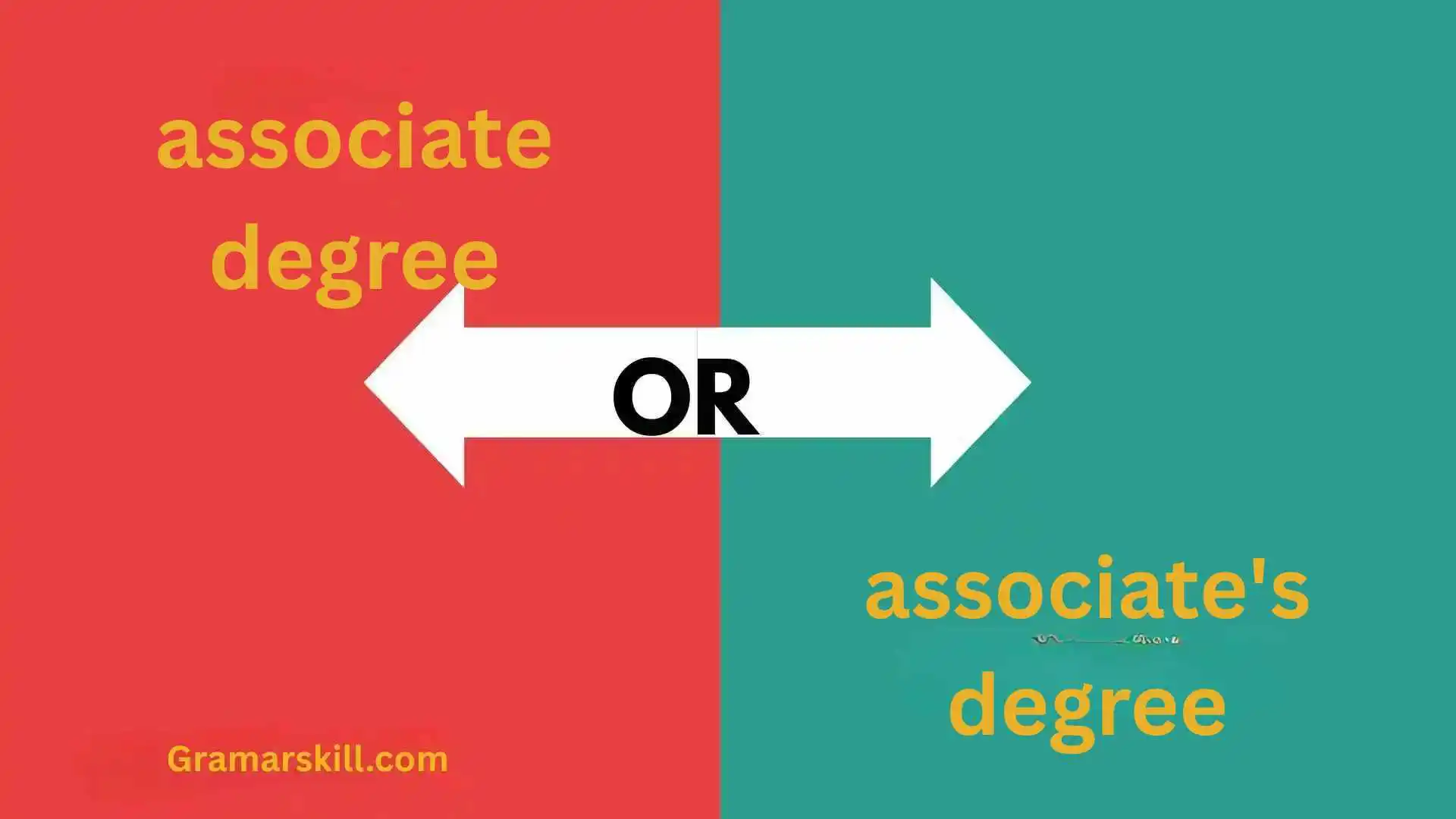
Many students, job seekers, and language enthusiasts often wonder: “is it associate or associate’s degree?” This question is common because the difference seems subtle but can affect both grammar and meaning. While both words might appear similar, their usage varies depending on whether you’re referring to the degree itself or the field or type of associate qualification. Misusing them could lead to confusion on resumes, applications, and educational documents.
Understanding this distinction is especially important for international students and professionals who are navigating both UK and US English. In the US, the term “associate’s degree” is widely used, whereas in the UK, educational terminology differs, and “associate degree” might appear in formal references. Therefore, knowing the right usage not only improves clarity but also ensures professionalism.
In this article, we’ll break down the difference clearly, provide examples, and show practical tips to remember the correct usage in everyday situations.
Quick Answer
The correct term is “associate’s degree” when referring to the academic qualification.
- Use “associate’s degree” to indicate a degree obtained after completing a two-year college program, mainly in the US.
- “Associate degree” without the apostrophe is sometimes seen in informal writing or in UK contexts, but grammatically, it is less precise.
In short, if you are writing formally or applying to educational programs, always use associate’s degree in the US. In UK English, you might see associate degree, but double-check the institution’s preferred terminology.
Meaning of the Correct Form
1. Associate’s Degree Explained
An associate’s degree is a formal academic qualification typically earned after two years of college study. It serves as a foundation for further education, like a bachelor’s degree, or for direct entry into a profession.
Examples:
- US English:
- “She earned her associate’s degree in nursing from a community college.”
- “Many students pursue an associate’s degree in business before transferring to a four-year university.”
- UK English:
- While less common, you may see: “He completed an associate degree in computing at a UK college.”
Key Points:
- The apostrophe ’s shows possession: it is the degree of an associate.
- It is formal and correct in educational contexts.
- Used mostly in the United States, especially in academic transcripts and resumes.
2. Why UK English Might Drop the Apostrophe
In the UK, institutions sometimes write “associate degree” without the apostrophe. This is more of a stylistic or regional preference rather than a grammatical error. For instance:
- “The college offers an associate degree in media studies.”
However, for formal international communication, adding the apostrophe is safer.
Meaning of the Incorrect Form
Using “associate degree” without the apostrophe in US English is considered grammatically incorrect. It may be understood, but it does not reflect proper possessive form, which can appear unprofessional in official documents.
Incorrect Examples (US context):
- ❌ “I graduated with an associate degree in engineering.”
- ❌ “She plans to earn associate degree next year.”
Why it’s wrong: The term associate’s degree indicates the degree belongs to or is awarded to an associate, so the apostrophe is necessary in formal US English.
Keyword Comparison / Key Differences
| Feature | Associate’s Degree (Correct) | Associate Degree (Incorrect / UK Variant) |
| Apostrophe | Yes | No |
| Grammatical correctness | ✅ Correct in US English | ❌ Incorrect in US English |
| Usage in US English | Widely used | Rare and informal |
| Usage in UK English | Less common | Sometimes acceptable |
| Indicates possession | Yes | No |
| Examples | “Her associate’s degree helped her career.” | “He completed an associate degree in London.” |
Transition note: Therefore, while UK English might accept the variant, US English strongly prefers the apostrophe for clarity and correctness.
Common Mistakes People Make
- Omitting the apostrophe in US writing
- ❌ “I just finished my associate degree.”
- ✅ “I just finished my associate’s degree.”
- Confusing with “associate” as a job title
- ❌ “I am an associate degree holder at the firm.”
- ✅ “I hold an associate’s degree in finance.”
- Using lowercase incorrectly
- ❌ “I have an Associate’s degree.” (capitalization matters in some contexts)
- ✅ “I have an associate’s degree in marketing.”
- Mixing UK and US terminology
- “I earned my associate degree in the US.” → acceptable informally, but better: associate’s degree
- Misplacing the apostrophe
- ❌ “I earned my associates’ degree.” (apostrophe after “s” is wrong)
- ✅ Correct: associate’s degree
Tip: Remember, the apostrophe always goes before the s, because it is singular possessive, not plural.
Correct Usage in Sentences
US English Examples:
- “John’s associate’s degree in graphic design gave him a head start in his career.”
- “After completing her associate’s degree, she transferred to a four-year university.”
- “Many employers accept candidates with an associate’s degree for entry-level roles.”
UK English Examples (less formal):
- “She has an associate degree in hospitality management from a London college.”
- “Completing an associate degree can prepare students for further study in the UK.”
Comparison Example:
- US: “I am proud of my associate’s degree in IT.”
- UK: “I completed an associate degree in IT last year.”
Transition Note: On the other hand, always check the institution’s preferred style, especially if you are writing an official document.
Tips to Remember the Correct Usage
- Think of possession – the degree belongs to an associate, so use the apostrophe: associate’s.
- US English rule – always include the apostrophe.
- UK English – check if your school uses associate degree; if unsure, use the apostrophe.
- Mnemonic Trick: “Associate owns the degree” → apostrophe goes before s.
- Avoid plural confusion – never write “associates’ degree” unless multiple associates share a degree (rare and incorrect for normal usage).
Pro Tip: When writing resumes, cover letters, or academic applications in the US, always use “associate’s degree” to avoid mistakes.
FAQs
1. Can I write “associate degree” instead of “associate’s degree”?
- In US English, no, the correct form is associate’s degree.
- In UK English, some institutions accept associate degree, but check their guidelines.
2. Why is the apostrophe important?
- It shows possession, meaning the degree belongs to an associate, which is grammatically correct.
3. Is it “Associate Degree” or “associate’s degree” in a resume?
- Use associate’s degree in US resumes. Capitalization depends on the style guide, but lowercase is generally fine unless used as a heading.
4. Can international students use “associate degree”?
- UK or other international institutions may allow it, but US applications require “associate’s degree”.
5. What is the difference between an associate’s degree and a bachelor’s degree?
- An associate’s degree usually takes 2 years; a bachelor’s degree takes 4 years.
6. Are there types of associate’s degrees?
- Yes, common types include:
- Associate of Arts (AA)
- Associate of Science (AS)
- Associate of Applied Science (AAS)
7. Can I abbreviate it as “AA degree”?
- Yes, “AA” for Associate of Arts or “AS” for Associate of Science, but never drop the apostrophe if you write associate’s degree in full.
Conclusion
Understanding “is it associate or associate’s degree” is crucial for students, professionals, and anyone dealing with educational qualifications. The correct term is associate’s degree, showing proper possession and grammatical accuracy in US English. While UK English sometimes allows the variant associate degree, it is safer to use the apostrophe for clarity, professionalism, and international recognition.
Key Takeaways:
- Use associate’s degree for formal and US contexts.
- Check institution guidelines for UK usage.
- Remember the apostrophe before s – it shows ownership.
- Avoid common mistakes like dropping the apostrophe, confusing it with a job title, or misplacing capitalization.
READ MORE ARTICLES..
Dwarfs or Dwarves: Differences, Definitions, and Proper Use 2026
Anyday or Any Day: Correct Meaning, Usage, and Examples 2026
less than or greater than sign: Easy guide 2026
Unorganized or Disorganized: What’s the difference & usage? 2026