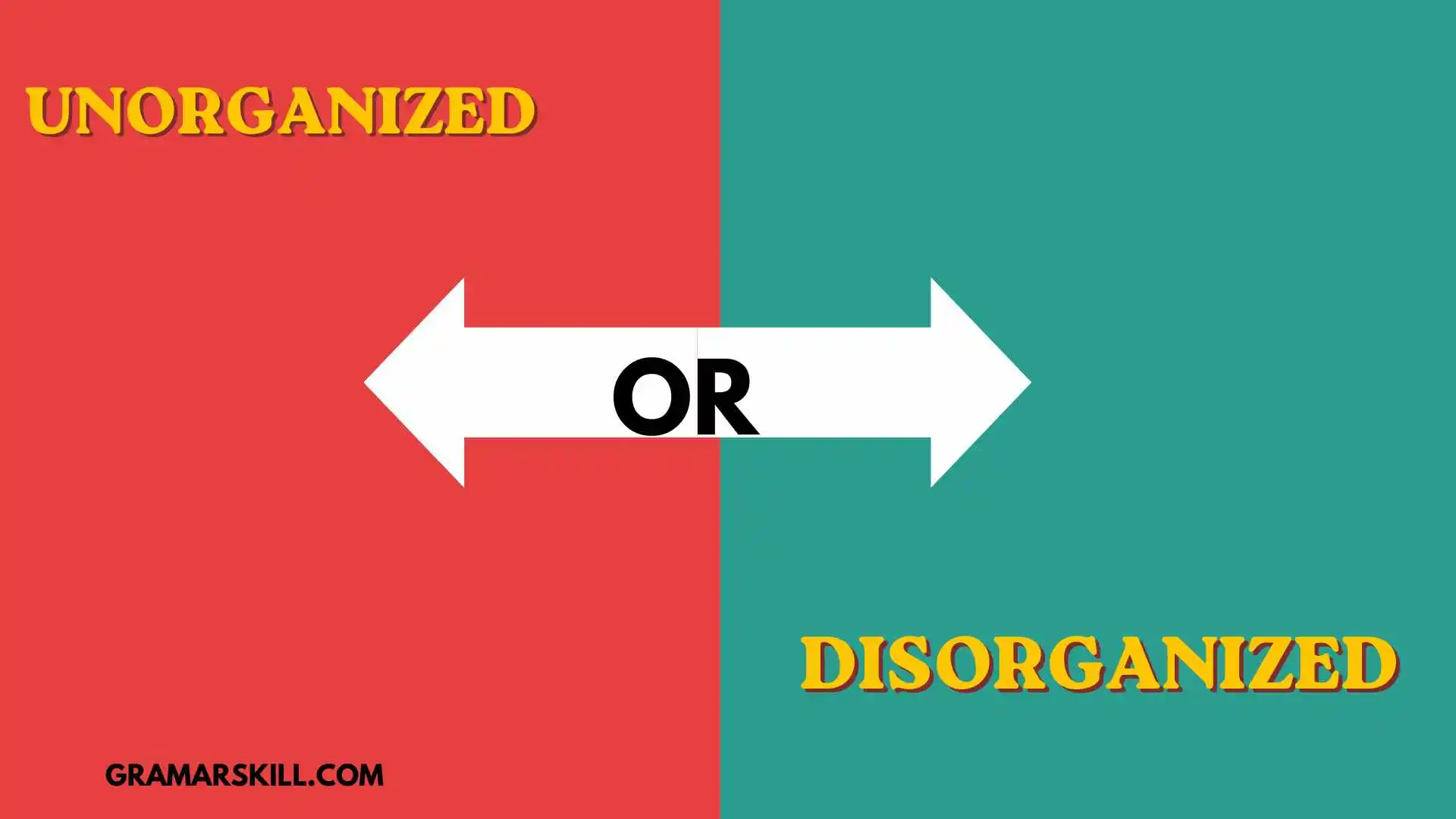
Many English learners and even native speakers often get confused between “unorganized” and “disorganized.” At first glance, both words seem similar and are sometimes used interchangeably. However, their meanings and usage can slightly differ depending on the context, tone, and regional preference.
Understanding the difference between these two words is important, especially if you want to improve your writing skills or sound more natural in both British (UK) and American (US) English. In addition, choosing the correct word helps you communicate more clearly and professionally.
In this detailed guide, we will break down the meanings, differences, usage, and common mistakes related to “unorganized” vs “disorganized.” By the end, you’ll know exactly when and how to use each word confidently.
Quick Answer
Both “unorganized” and “disorganized” are correct English words. However, they are not always used in the same way.
- Disorganized is more commonly used and widely accepted in both UK and US English.
- Unorganized is less common and usually refers to something that has never been organized at all.
👉 In most everyday situations, “disorganized” is the safer and more natural choice.
Meaning of the Correct Form
Disorganized – Meaning and Usage
The word “disorganized” refers to something that lacks order, structure, or planning, especially when it was expected to be organized.
It can describe:
- People
- Workspaces
- Systems
- Events
Examples in Sentences (US & UK English)
- She is very disorganized, so she often misses deadlines.
- The meeting was completely disorganized and confusing.
- His desk looks messy because he is disorganized.
- The event became disorganized due to poor planning.
👉 In both British and American English, “disorganized” is the most commonly used term.
Key Idea
Disorganized = Something that should be organized but is not.
Meaning of the Less Common Form
Unorganized – Meaning and Usage
The word “unorganized” means something that has not been organized yet or has never been structured.
It is less about failure and more about absence of organization from the beginning.
Examples in Sentences
- The files are still unorganized because we haven’t started sorting them.
- The group remains unorganized without leadership.
- His notes were completely unorganized at the start of the project.
👉 While correct, “unorganized” is less commonly used in everyday conversation, especially in UK English.
Key Idea
Unorganized = Something that has not been organized yet.
Keyword Comparison / Key Differences

Let’s clearly compare unorganized vs disorganized:
| Feature | Disorganized | Unorganized |
| Usage Frequency | Very common | Less common |
| Meaning | Lacks order (should be organized) | Not organized yet |
| Tone | More natural and standard | More technical or rare |
| UK English | Preferred | Rare |
| US English | Preferred | Used but less common |
Simple Difference
- Disorganized → Messy or poorly structured
- Unorganized → Not yet arranged or structured
Example Comparison
- The office is disorganized → It should be neat but isn’t
- The office is unorganized → No one has arranged it yet
👉 Therefore, disorganized focuses on disorder, while unorganized focuses on absence of organization.
Common Mistakes People Make
Many learners mix these words incorrectly. Let’s look at common mistakes:
❌ Mistake 1: Using “unorganized” instead of “disorganized”
- Incorrect: He is very unorganized in his work
- Correct: He is very disorganized in his work
👉 Why? Because the person should be organized but is not.
❌ Mistake 2: Thinking both words are always interchangeable
- Incorrect: The event was unorganized
- Better: The event was disorganized
👉 Events are expected to be organized, so disorganized is better.
❌ Mistake 3: Overusing “unorganized” in formal writing
In professional writing, “disorganized” sounds more natural and polished.
❌ Mistake 4: Ignoring regional preference
- In UK English, “disorganized” is strongly preferred
- In US English, both exist, but “disorganized” is still more common
Correct Usage in Sentences
Here are more real-life examples for better understanding:
Using “Disorganized”
- My schedule is completely disorganized this week.
- The team looked disorganized during the match.
- Her presentation was disorganized and hard to follow.
- The company suffered due to a disorganized management system.
Using “Unorganized”
- The documents are still unorganized on the table.
- The data remains unorganized until we sort it.
- The files were unorganized before the system update.
Mixed Comparison Examples
- His thoughts are disorganized, which makes communication difficult.
- The notes are unorganized, so we need to arrange them first.
Tips to Remember the Correct Usage
Here are some simple tricks to avoid confusion:
1 Tip : Think about expectation
- If something should be organized but isn’t → use disorganized
- If something has never been organized → use unorganized
2 Tip : Use “disorganized” by default
If you’re unsure, choose disorganized.
👉 It is correct in almost all situations.
3 Tip : Remember the prefix meaning
- Dis- = something is wrong or lacking
- Un- = something is not done yet
4 Tip : Think of people vs objects
- People → usually disorganized
- Objects not sorted yet → sometimes unorganized
5 Tip : Practice with examples
The more sentences you read and write, the easier it becomes to understand the difference.
FAQs
1. Is “unorganized” a real word?
Yes, “unorganized” is a correct English word, but it is less commonly used compared to “disorganized.”
2. Which is more common: unorganized or disorganized?
Disorganized is far more common in both UK and US English.
3. Can I use “unorganized” for people?
It’s possible, but not natural.
👉 It’s better to say someone is disorganized.
4. Is there a difference between UK and US usage?
Yes:
- UK English strongly prefers disorganized
- US English allows both, but still prefers disorganized
5. Is “unorganized” wrong in formal writing?
No, it’s not wrong. However, “disorganized” is more widely accepted and sounds better.
6. When should I use “unorganized”?
Use it when something has not yet been arranged or structured.
Example:
- The files are still unorganized
7. Which word should beginners use?
Beginners should mostly use “disorganized”, as it works in almost all situations.
Conclusion
In summary, both “unorganized” and “disorganized” are correct words, but they are not exactly the same. While “disorganized” describes something that lacks order or structure despite expectations, “unorganized” simply refers to something that has not been arranged yet.
However, in real-life usage, “disorganized” is far more common and preferred in both British and American English. Therefore, if you want to sound natural, clear, and professional, it’s best to use “disorganized” in most cases.
READ MORE ARTICLES..
Send or Sent: Simple Guide with Tips, Rules, and Usage 2026
Adress or Address: Common Mistakes and Easy Fixes 2026
Que or Queue: Differences, Definitions, and Usage Tips 2026
Excell or Excel: Meaning, Usage, and Examples 2026