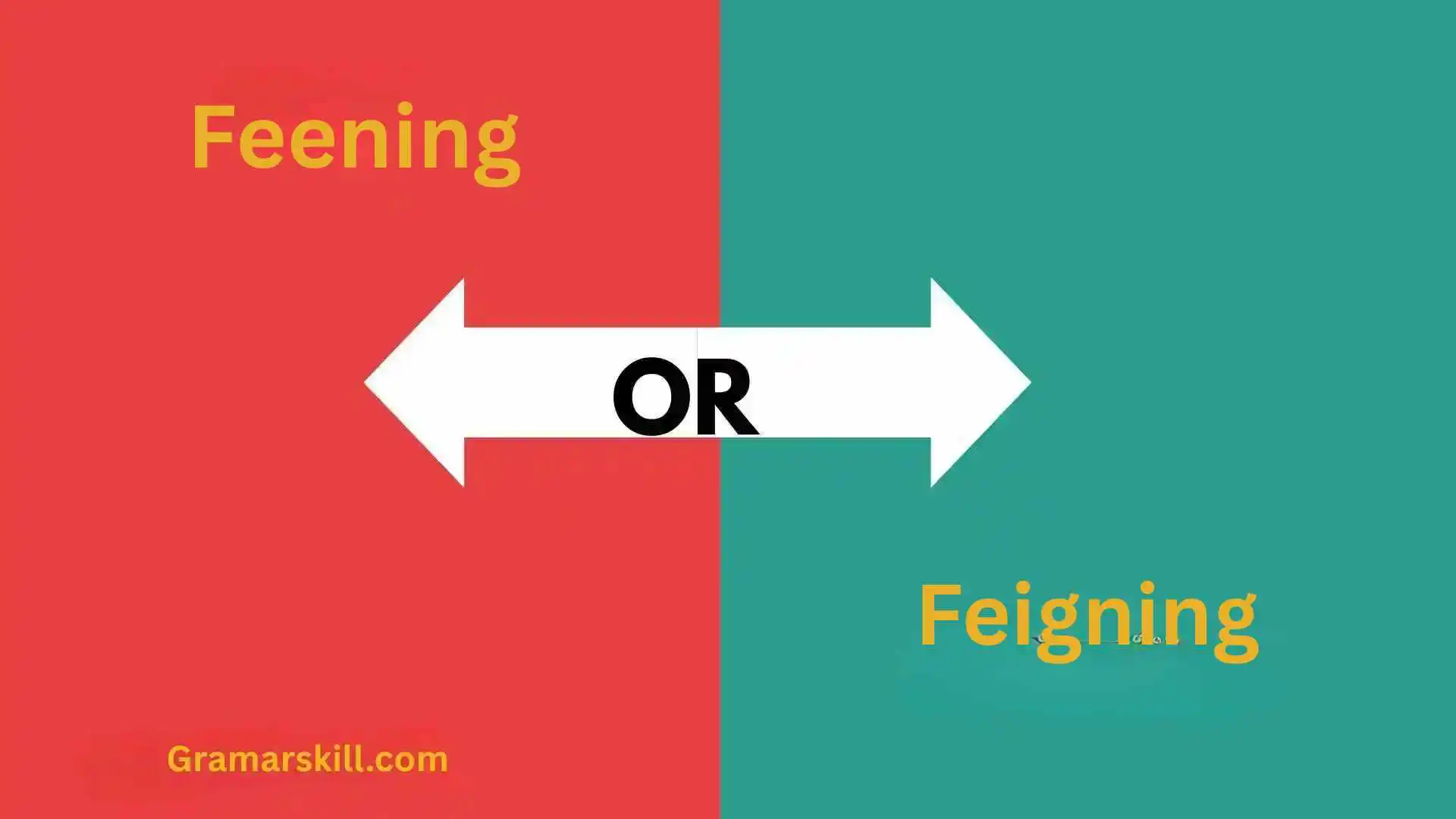
English is full of tricky words that sound alike but have very different meanings. One common source of confusion is the pair “feening” and “feigning.” Many people, both in the UK and the US, often mix them up in writing or speech. Misusing these words can make your sentences unclear or even change the meaning entirely.
Understanding the correct word to use is essential, not just for academic or professional writing, but also in everyday conversations. For example, imagine trying to say that someone is pretending to be sick but you accidentally write “feening sick” instead of “feigning sick.” The reader may get confused or misinterpret your meaning.
In addition, spelling and usage differences between British English and American English can sometimes make this even trickier. Although both varieties of English use “feigning” in the same way, regional usage and context may vary slightly. Therefore, this guide will provide clear explanations, examples, and tips for both UK and US audiences.
Quick Answer
Feigning is the correct word when you want to describe pretending, faking, or simulating something. For instance, “He is feigning illness” means he is pretending to be sick.
On the other hand, feening is generally a misspelling or misuse of “feigning,” although in very informal slang, “feening” can sometimes mean craving or wanting something intensely—mostly in American slang contexts.
If you’re unsure which one to use, always stick with “feigning” when referring to pretending.
Meaning of the Correct Form: Feigning
The word feigning is the present participle of the verb “feign.” It means to pretend, fake, or give a false appearance of something. It is widely used in both British and American English in formal and informal contexts.
Examples in British English:
- She was feigning surprise when she saw the gift.
- The student was feigning illness to avoid the exam.
- He is feigning interest in the meeting, but you can tell he’s bored.
Examples in American English:
- He kept feigning ignorance during the investigation.
- She’s feigning excitement, but you can see she’s disappointed.
- They were feigning confidence before the big game.
Note: The word “feigning” always relates to pretending or simulating something. It never refers to real feelings or desires.
Meaning of the Incorrect Form: Feening
The term feening is often a misheard or misspelled version of “feigning.” Many writers accidentally replace the “ai” in feigning with “ee,” leading to “feening.”
However, in slang usage, particularly in American English:
- Feening can mean craving or desiring something intensely, usually in informal contexts.
- Example (US slang): “I’m feening for a coffee right now” → meaning “I really want coffee.”
In British English, this slang usage is less common, so using “feening” in formal writing is almost always incorrect.
Key takeaway: Unless you are deliberately using American slang for craving, feening is wrong when you mean pretending.
Keyword Comparison / Key Differences
| Feature | Feigning | Feening |
| Meaning | Pretending, faking, simulating | Informal craving/desire (US slang); often incorrect spelling for pretending |
| Usage | Formal, informal, both UK & US | Informal, mostly US; rarely used in UK English |
| Example (UK) | She was feigning happiness despite feeling sad | ❌ Incorrect in formal UK English |
| Example (US) | He is feigning ignorance during questioning | I’m feening for pizza (slang) |
| Correctness | Always correct when meaning “pretending” | Incorrect in most cases unless slang |
Tip: If your goal is formal writing, academic papers, emails, or clear communication, always use “feigning.”
Common Mistakes People Make
Many people confuse these words because they sound similar. Let’s look at the most common mistakes:
- Writing “feening” instead of “feigning” in formal writing
- ❌ Incorrect: She is feening illness to skip work.
- ✅ Correct: She is feigning illness to skip work.
- Assuming “feening” is correct in British English
- British English rarely uses “feening” as slang. Using it may confuse UK readers.
- Using “feening” when you mean craving in casual US contexts
- ✅ Correct in US slang: He’s feening for a new video game.
- ❌ Incorrect if intended to mean “pretending.”
- Mixing the two in speech or informal writing
- Example mistake: “Stop feening surprise!” (Meant: feigning)
- Corrected: “Stop feigning surprise!”
- Ignoring spelling patterns
- Feigning → uses “ei” after “f”
- Feening → uses “ee,” which is usually wrong for pretending
Correct Usage in Sentences
Here’s a practical guide with real-life examples for UK and US audiences:
British English Examples:
- Feigning illness: “John was feigning illness to get a day off work.”
- Feigning interest: “She smiled, feigning interest in the conversation, but her mind was elsewhere.”
- Feigning surprise: “He opened the present, feigning surprise, though he already knew about it.”
American English Examples:
- Feigning ignorance: “The defendant kept feigning ignorance to avoid answering the tough questions.”
- Feigning excitement: “She was feigning excitement about the company’s announcement, but she wasn’t thrilled.”
- Feigning confidence: “Even though he was nervous, he feigned confidence during his presentation.”
Tips on Sentence Structure:
- Use “feigning + noun” → feigning illness, feigning surprise
- Use “feigning + verb” → feigning not knowing, feigning to listen
Tips to Remember the Correct Usage
- Think “Fake + ing”
- Feigning = faking something, pretending.
- Example: “Feigning happiness” → faking happiness
- Check your vowels
- Feigning → “ei” is always used for pretending
- Feening → “ee” is usually slang or wrong
- Use context clues
- If it’s about pretending → feigning
- If it’s about craving (US slang) → feening
- Mnemonic Trick:
- “Feign” sounds like “fake in” → think fake in action = pretending.
- UK vs US Usage Tip:
- UK: Stick to feigning; “feening” can confuse readers.
- US: “Feening” is OK in informal contexts for craving, but never for pretending.
FAQs (Frequently Asked Questions)
1. Is “feening” ever correct?
- Yes, in informal American slang it can mean craving or wanting something.
- No, if you mean pretending, especially in formal writing.
2. Can I use “feigning” in casual conversations?
- Absolutely! Both UK and US speakers use it to describe pretending or faking something.
3. What is the difference between “feigning” and “pretending”?
- They are very similar. Feigning is more formal and often used in writing; pretending is more casual.
4. How do I remember the spelling of “feigning”?
- Think “fake in action” → feigning. Remember the “ei” in the middle.
5. Is “feening” used in the UK?
- Rarely. British English typically does not recognize “feening” as correct. Use “feigning.”
6. Can “feigning” be used for emotions?
- Yes. You can feign happiness, sadness, surprise, or interest.
7. Is “feening” slang or a typo?
- Usually, it’s a typo for feigning. In American slang, it can mean craving, but it’s informal.
Conclusion
Understanding the difference between feening and feigning is crucial for clear communication. Feigning always means pretending, while feening is either a slang term for craving (US only) or a common misspelling.
To avoid mistakes:
- Use feigning in all formal and most informal contexts.
- Remember the “ei” spelling pattern.
- Consider your audience: UK readers will almost always expect feigning.
By mastering this small but important difference, you’ll make your writing and speech more precise, professional, and universally understandable.
READ MORE ARTICLES..
Mean Time or Meantime: Grammar Rules Made Simple 2026
Semicolon or Colon: What is the difference and usage. 2026
trys or tries: What is the difference & how to use them.2026
Amid or Amidst: Correct Usage, Definitions, and Examples 2026

I am Julian Parker, a passionate grammar enthusiast and content writer dedicated to making English rules simple and easy to understand. I specialize in breaking down complex grammar topics into clear, practical explanations. I enjoy helping readers improve their writing skills with confidence. My goal is to make learning grammar engaging, simple, and accessible for everyone.