Many English learners and even native speakers often wonder whether to use “trys” or “tries” in sentences. This confusion usually arises because English has many irregular verbs and tricky plural forms. Choosing the wrong form can make your writing look unprofessional or grammatically incorrect.
Understanding the correct form is particularly important for both UK and US audiences. While British and American English share most rules, there are slight differences in spelling, grammar, and usage that can confuse writers and learners.
In this article, we’ll break down the differences between “trys” and “tries”, provide practical examples, highlight common errors, and offer tips to remember the correct usage. Whether you are a student, professional, or casual writer, this guide will make the rule clear and easy to follow.
Quick Answer
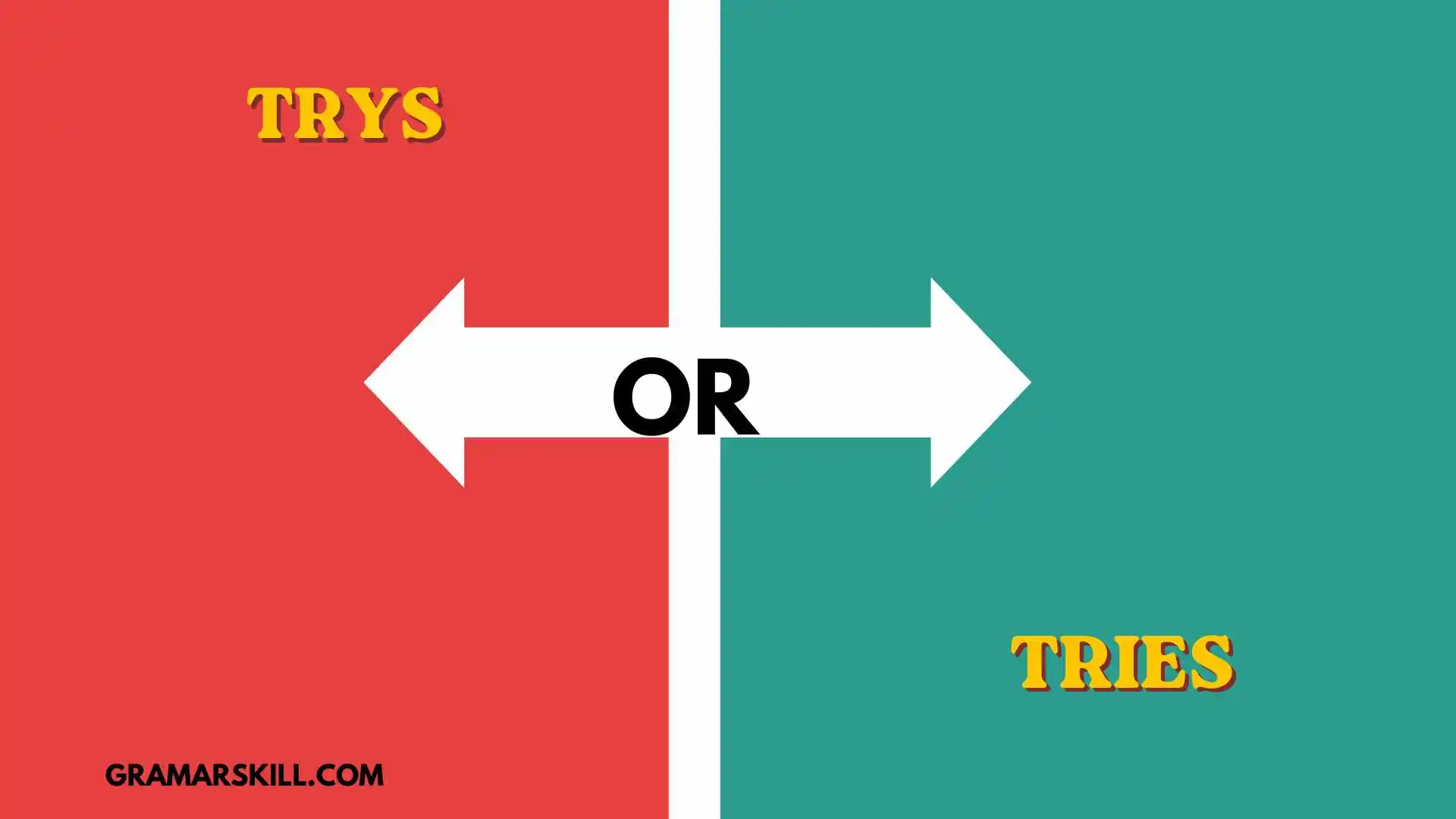
The correct form is “tries”, which is the third-person singular present tense of the verb “try.”
- ✅ Example: She tries her best every day.
- ❌ Incorrect: She trys her best every day.
In modern English, “trys” is considered incorrect. Remembering this rule ensures your writing is grammatically correct in both UK and US English.
Meaning of the Correct Form
The word “tries” is derived from the verb “try” and is used when the subject is he, she, it, or any singular noun in the present tense.
- US English Example:
- He tries to exercise every morning.
- She tries different recipes every weekend.
- UK English Example:
- The cat tries to catch the toy.
- She tries her best in every exam.
Key points about “tries”:
- It is always spelled with -ies when forming the third-person singular.
- It conveys an action being attempted in the present.
- It works for both British and American English; there is no difference here.
Meaning of the Incorrect Form
“Trys” is a common mistake made by those who forget the spelling rule for verbs ending with “y.”
- ❌ Example: She trys to finish her work.
- ✅ Correct: She tries to finish her work.
Why is “trys” incorrect?
- In English, when a verb ends in a consonant + y, you replace “y” with “ies” for the third-person singular.
- Exceptions exist for verbs ending in a vowel + y, e.g., play → plays, not plaies.
Trys or Tries Meaning
“Tries” is the correct spelling and is the third-person singular form of the verb “try.” For example, “She tries her best every day.” The word “trys” is not considered a standard English spelling and is generally viewed as incorrect. When discussing the action of attempting something, always use “tries.”
Keyword Comparison / Key Differences
Here’s a quick comparison between trys and tries:
| Form | Correct? | Usage | Notes (UK & US) |
| tries | ✅ Yes | Third-person singular present tense | Standard in both UK & US English |
| trys | ❌ No | Incorrect spelling of “tries” | Avoid in all formal writing |
Tip: Always check if the verb ends in a consonant + y. If yes, switch y → ies for he/she/it.
1 Trys or Tries Examples
| Topic | Information |
|---|---|
| Correct Spelling | Tries is the correct spelling of the third-person singular form of the verb try. For example: She tries her best every day and He tries to arrive on time. |
| Incorrect Spelling | Trys is not considered a standard English spelling. In formal writing, exams, and professional communication, you should always use tries instead of trys. |
| More Examples | The student tries to answer every question. • My dog tries to catch the ball. • The company tries to improve customer service. |
2 Trys or Tries Exercises
| Exercise | Answer |
|---|---|
| She ___ to finish her homework before dinner. | tries |
| He ___ his best in every match. | tries |
| The baby ___ to walk without help. | tries |
| They ___ to solve the problem. | try |
| My brother ___ new recipes every weekend. | tries |
3 Trys or Tries Grammar
| Grammar Rule | Explanation |
|---|---|
| Base Verb | The base form of the verb is try. |
| Third-Person Singular | When the subject is he, she, it, try changes to tries. |
| Why It Changes | Verbs ending in a consonant + y usually change y to i and add -es. |
| Examples | She tries hard. • He tries every day. • It tries to work properly. |
4 Tries or Trys
| Comparison | Tries | Trys |
|---|---|---|
| Spelling Status | ✅ Correct | ❌ Incorrect |
| Dictionary Recognition | Accepted in standard English | Not accepted in standard English |
| Use in Writing | Formal and informal writing | Should be avoided |
| Example | She tries to help everyone. | She trys to help everyone. (incorrect) |
Quick Tip: Whenever you are writing about he, she, or it performing the action of try, always use tries, not trys.
Common Mistakes People Make
Many writers make these mistakes due to unfamiliarity with spelling rules. Here are the most frequent ones:
- Using “trys” in formal writing
- ❌ She trys to complete her tasks on time.
- ✅ She tries to complete her tasks on time.
- Mixing with plural nouns
- ❌ The dogs trys to escape.
- ✅ The dog tries to escape.
- Confusing with verbs ending in a vowel + y
- ✅ He plays football every day.
- ❌ He plaies football every day.
- Not adjusting for UK spelling conventions
- In this case, tries works identically in both UK and US English.
Practical tip: If your verb ends in y, remember the consonant + y rule to form the third-person singular.
Correct Usage in Sentences
Here are multiple examples for both UK and US readers:
US English Examples:
- She tries to eat healthy every day.
- He tries to finish his assignments before deadlines.
- The baby tries to walk without support.
UK English Examples:
- He always tries to be polite with strangers.
- The student tries to learn new vocabulary every week.
- My dog tries to jump onto the sofa.
Note: The usage of tries is identical in UK and US English; spelling does not change.
Tips to Remember the Correct Usage
- Consonant + Y Rule:
- For verbs ending in a consonant + y, switch y → ies in third-person singular.
- Example: try → tries, cry → cries
- Vowel + Y Exception:
- If the verb ends in a vowel + y, just add s.
- Example: play → plays, enjoy → enjoys
- Mnemonic Trick:
- “Try, then ies for he/she/it” – simple and effective for remembering.
- Check Your Subject:
- If your subject is he, she, it, or a singular noun, use tries.
- Proofread Always:
- If unsure, read your sentence aloud; “trys” often sounds wrong.
FAQs About [trys or tries]
1. Is “trys” ever correct?
No. “Trys” is considered grammatically incorrect in modern English. Always use tries.
2. Does UK English use “trys” differently from US English?
No. Both UK and US English follow the same rule: third-person singular verbs ending in a consonant + y become -ies.
3. How do I know when to use “tries”?
Use tries whenever your subject is he, she, it, or a singular noun.
4. Are there exceptions to this rule?
Yes, only for verbs ending in a vowel + y (like play → plays).
5. Can “tries” be plural?
No. “Tries” is singular in third-person present tense. The plural form is for the noun “try” (e.g., He made several tries to win the game).
6. Can “try” be used as a noun?
Yes. For example: He made three tries before succeeding.
7. Any tips to avoid mistakes?
Remember the consonant + y → ies rule and read your sentences aloud. If it sounds off, it probably is wrong.
Trys or Tries Rugby
In rugby, the correct term is “tries,” which is the plural form of “try.” A try is the main method of scoring points by grounding the ball in the opponent’s in-goal area. For example, “The team scored three tries in the match.” The spelling “trys” is not used in official rugby terminology.
Conclusion
Understanding the difference between trys and tries is crucial for proper English writing. Remember:
- ✅ Use tries for third-person singular present tense.
- ❌ Avoid trys it is incorrect.
- Both UK and US English follow the same rules here.
- Apply the consonant + y rule for other verbs ending in y.
By keeping these rules in mind, you can write confidently, avoid common mistakes, and communicate clearly in both British and American English. Start practicing today, and make sure your next sentence always “tries” its best!
READ MORE ARTICLES..
Planning or Planing: what is difference & usage.
Label or Lable: Differences, Examples, and Writing Tips in 2026
Ho or Hoe: What’s the Correct Spelling and Meaning? 2026
Cleanup or Clean Up: What’s the difference & usage?

I’m Henry Collins, a passionate grammar enthusiast who loves making English simple and clear for everyone. I enjoy breaking down tricky grammar rules into easy, everyday language. Through my writing, I aim to help learners build confidence and write with accuracy. My goal is to turn confusion into clarity one word at a time.