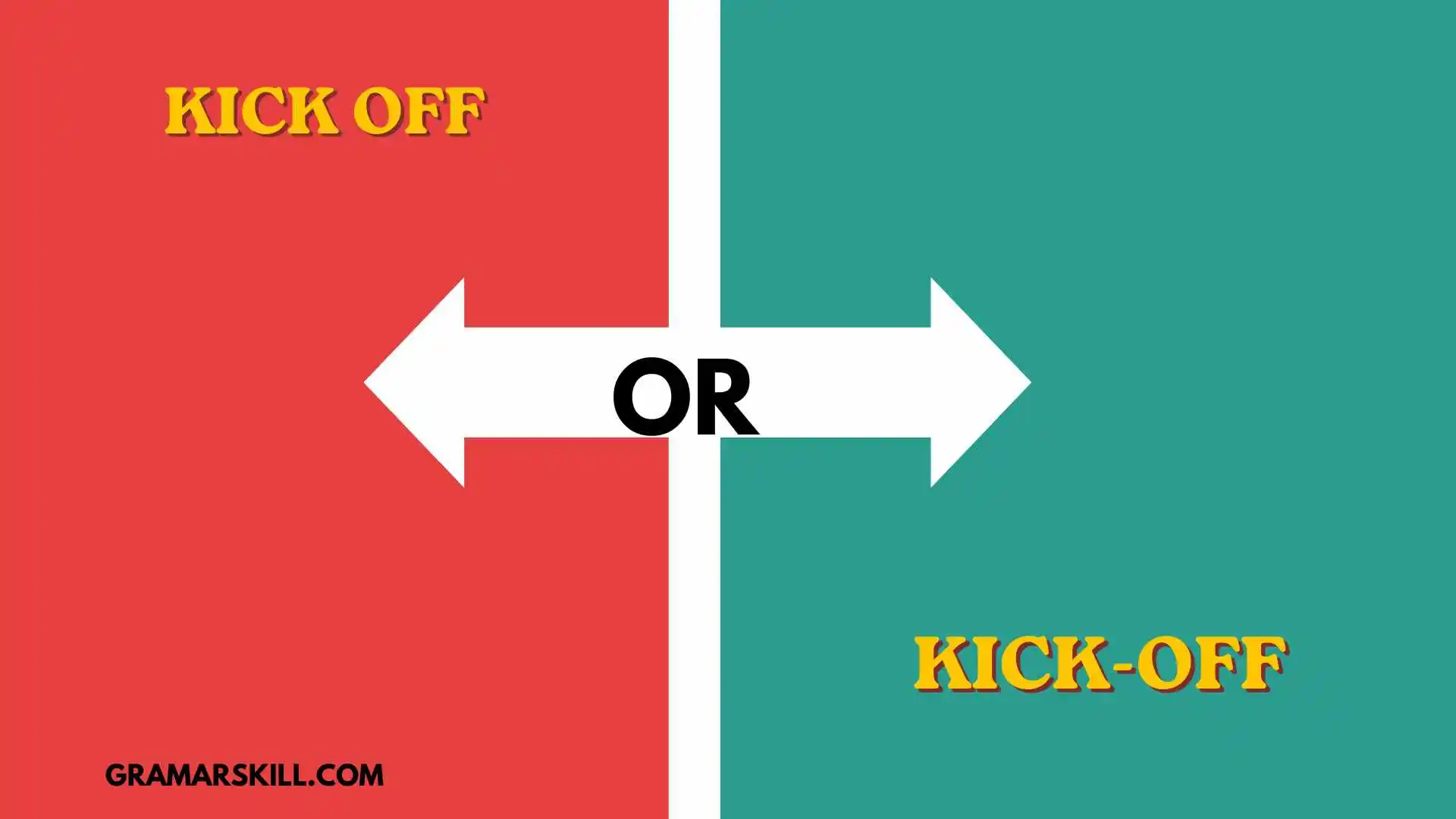
Many English learners and even native speakers often get confused between “kick off” and “kick-off”. Although these two look similar, they have different roles in sentences, and using them incorrectly can make your writing or speaking seem awkward.
Understanding the difference is particularly important because both British English (UK) and American English (US) use these terms in everyday communication. Whether you are talking about sports, meetings, or events, knowing when to use the correct form will make your English clearer and more professional.
This article will guide you step by step, explaining the differences, providing examples, and offering tips to remember the correct usage. By the end, you will confidently know when to write kick off and when to write kick-off, no matter which variety of English you use.
Quick Answer
Kick off (two words) is usually a verb phrase, meaning to start something.
Example: The manager will kick off the meeting at 10 a.m.
Kick-off (with a hyphen) is usually a noun or adjective, referring to the start of an event.
Example: The kick-off of the football match was delayed due to rain.
In short: verb → kick off | noun/adjective → kick-off
Meaning of the Correct Form
Kick Off (Verb)
Kick off is a phrasal verb that means to begin or start something.
Examples in sentences:
- UK English: We will kick off the conference with a short welcome speech.
- US English: The CEO will kick off the training session tomorrow morning.
Usage notes:
- It can be used for sports, events, meetings, or any activity.
- It often implies energy or excitement at the start.
Other examples:
- Let’s kick off the party with some music!
- The campaign will kick off next week.
Kick-Off (Noun / Adjective)
Kick-off is a noun or an adjective. It refers to the beginning of an event or action.
Examples in sentences:
- UK English: The kick-off for the new project is scheduled for Monday.
- US English: Attendance at the kick-off meeting is mandatory for all employees.
As an adjective:
- We held a kick-off event to celebrate the launch.
- Kick-off time for the game is 7 p.m.
Key point: Use kick-off when you are naming or describing the start of something.
Meaning of the Incorrect Form
Many people mistakenly write kick-off when they mean kick off as a verb, or vice versa.
Incorrect usage examples:
- ❌ We will kick-off the presentation at 9 a.m. → Incorrect (verb should be kick off)
- ❌ The kick off of the match was exciting. → Incorrect (noun should be kick-off)
Why this happens:
The confusion often comes from seeing “kick-off” in sports contexts, where it refers to the start of a football (soccer) game. People incorrectly generalize the hyphenated form to all uses.
Keyword Comparison / Key Differences

| Feature | Kick Off (Verb) | Kick-Off (Noun / Adjective) |
| Part of speech | Verb | Noun / Adjective |
| Meaning | To begin/start something | The start or beginning of something |
| Example UK | We will kick off the meeting. | The kick-off was delayed by rain. |
| Example US | The manager will kick off training. | The kick-off meeting starts at 9 a.m. |
| Hyphen | No hyphen | Hyphen required |
| Common context | Meetings, events, sports | Sports, projects, formal events |
UK vs US English:
- Both forms are used in both regions.
- In UK English, kick-off is slightly more common in sports contexts, while kick off remains standard for verbs.
- In US English, the rules are the same; the distinction is consistent in writing.
Different usage of (kick off & kickoff)
| Heading | Information |
|---|---|
| Kick Off or Kickoff Meaning | “Kick off” is usually a verb phrase that means to start or begin something. “Kickoff” is a noun or adjective referring to the start of an event, activity, or project. For example, a meeting can kick off at 9 AM, while the kickoff of the project happens on Monday. |
| Kick Off or Kickoff Meeting | In business settings, “kickoff meeting” is the correct noun phrase for the first meeting of a project. “Kick off a meeting” is the verb form used when describing the action of starting the meeting. Both forms are correct depending on sentence structure. |
| Kick Off or Kickoff Football | In football, “kickoff” refers to the opening kick that starts a game or restarts play after scoring. “Kick off” is used as a verb, such as “The referee will kick off the match at 7 PM.” The noun form is more common when discussing the event itself. |
| Kick Off Synonym | Common synonyms for “kick off” include start, begin, launch, initiate, commence, and open. The best synonym depends on the context. For example, businesses often use “launch,” while everyday conversations may use “start” or “begin.” |
| Kick Off or Kickoff NFL | In NFL discussions, “kickoff” is the standard noun used for the opening play of a game. You may also see terms like NFL Kickoff Game or season kickoff. As a verb, “kick off” describes the action of starting the game. |
| Kick Off or Kickoff Party | “Kickoff party” is the correct noun phrase for a celebration that marks the beginning of an event, season, or project. If describing the action, use “kick off,” such as “The company will kick off the event with a party.” Both forms are grammatically correct when used appropriately. |
Common Mistakes People Make
- Using kick-off as a verb
- ❌ We will kick-off the event now.
- ✅ We will kick off the event now.
- Using kick off as a noun
- ❌ The kick off is scheduled for 3 p.m.
- ✅ The kick-off is scheduled for 3 p.m.
- Confusing sports jargon with general usage
- ❌ The meeting’s kick-off is at 10 a.m. → Confusing verb/noun usage
- ✅ The meeting will kick off at 10 a.m. (verb)
- ✅ The kick-off of the meeting is at 10 a.m. (noun)
- Writing inconsistently
- Avoid mixing forms in the same sentence. Stick with the correct form based on part of speech.
- Overusing the hyphen
- Hyphens are only needed for nouns/adjectives, not verbs.
Correct Usage in Sentences
In UK English
Verb examples:
- The teacher will kick off the lesson with a short quiz.
- We kicked off the festival with a parade through the town.
Noun/Adjective examples:
- The kick-off event attracted hundreds of people.
- Kick-off time for the football match is 6 p.m.
In US English
Verb examples:
- The manager kicked off the meeting with a motivational speech.
- They will kick off the workshop at 8 a.m.
Noun/Adjective examples:
- The kick-off of the product launch was a huge success.
- Attendance at the kick-off meeting is compulsory.
Tips to Remember the Correct Usage
- Think “action” vs “thing”
- Action? → kick off
- Thing/start? → kick-off
- Sports trick:
- If you are talking about the moment the ball is kicked, it’s usually kick-off (noun).
- If you are describing starting the match, you might use kick off (verb).
- Replace with “begin” or “start”
- If “begin” works, use kick off (verb).
- If “beginning” fits better, use kick-off (noun).
- Mnemonic:
- Kick off → action → two words
- Kick-off → noun → hyphen joins it like a title
FAQs
1. Can I use “kick-off” as a verb?
No. Always use kick off without a hyphen when it is a verb.
2. Is “kick off” used differently in the US and UK?
No. Both regions use it similarly. The main difference is in spelling preference for other words, not this phrasal verb.
3. Can “kick-off” be used as an adjective?
Yes. For example: We had a kick-off meeting to discuss the project.
4. How do I know when to hyphenate?
Hyphenate only when using kick-off as a noun or adjective, never as a verb.
5. What is the origin of “kick off”?
It comes from sports, especially football (soccer), meaning to start the game by kicking the ball. Later, it was adopted in business and casual contexts.
6. Are there similar phrasal verbs with hyphen confusion?
Yes. Examples: set up / set-up, log in / log-in, check in / check-in follow the same pattern.
7. Can I use “kick off” in casual conversation?
Absolutely. It is commonly used in informal and formal contexts in both UK and US English.
Conclusion
Understanding the difference between kick off and kick-off is simple once you remember the rules:
- Kick off → verb → to start or begin
- Kick-off → noun/adjective → the start or beginning
By using these correctly, your writing and speaking will be clear, professional, and grammatically accurate.
Quick Tip: Think of “kick off” as an action you do and “kick-off” as the moment or event itself.
Next time you write about a football match, a meeting, or an event, you will never confuse the two forms. Start practicing today and kick off your mastery of English grammar!

I’m Henry Collins, a passionate grammar enthusiast who loves making English simple and clear for everyone. I enjoy breaking down tricky grammar rules into easy, everyday language. Through my writing, I aim to help learners build confidence and write with accuracy. My goal is to turn confusion into clarity one word at a time.