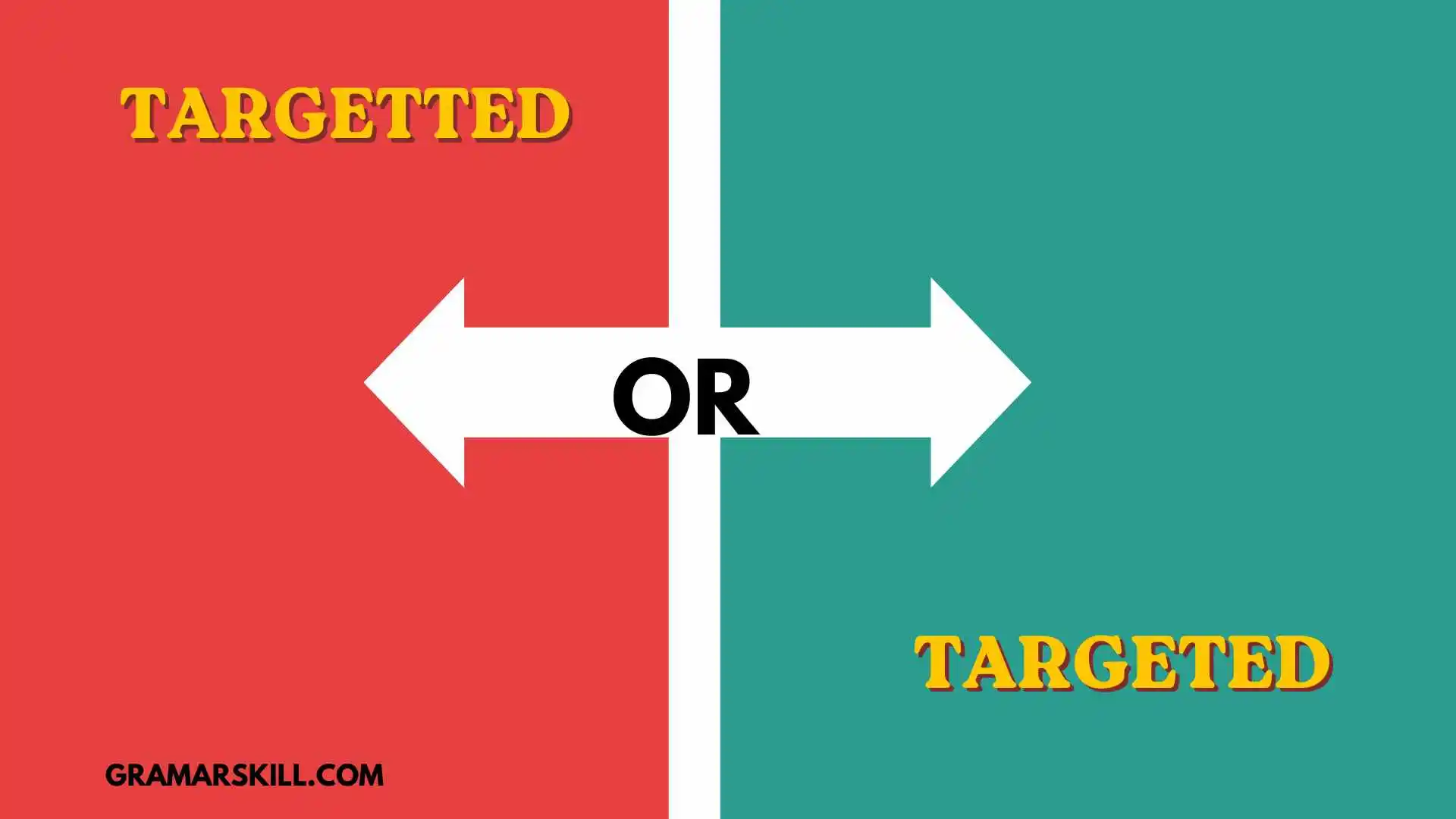
Have you ever paused while writing “targetted” or “targeted”? You are not alone. Many writers, especially non-native English speakers, struggle with this choice. The confusion arises because English spelling rules are sometimes tricky, and different forms may appear in older texts or informal writing
Understanding the correct form is crucial, especially if you write professionally or academically. Using the wrong spelling can make your work look careless and may even confuse readers. Additionally, British English (UK) and American English (US) have subtle differences in spelling conventions, which can make things even more confusing.
In this article, we will break down the correct usage, highlight common mistakes, and provide practical examples for both UK and US English. By the end, you will confidently know which form to use in every context.
Quick Answer
The correct spelling is “targeted”. The form “targetted” with a double t is incorrect in standard English.
Whether you are writing for a UK or US audience, always use “targeted”. It works as the past tense or past participle of the verb target, meaning to aim at a specific goal, audience, or object.
Example:
- Correct: The campaign targeted young adults.
- Incorrect: The campaign targetted young adults.
Using the correct form ensures your writing looks professional, clear, and trustworthy.
Meaning of the Correct Form
Targeted is the past tense and past participle of the verb target, which means:
- To aim at something intentionally.
- To focus on a specific group or goal.
Examples in US English:
- The marketing team targeted college students with their new product.
- Cybersecurity measures targeted potential online threats.
Examples in UK English:
- The charity targeted low-income families to provide support.
- The government targeted specific regions for improvement projects.
Meaning of the Incorrect Form
The form “targetted” is sometimes seen in informal texts or older writings. People may mistakenly add a double t, thinking it follows a spelling rule similar to “stopped” (where a consonant doubles after a short vowel).
However, the rule does not apply to “target.” The vowel in “target” is not short in a way that requires doubling the t.
Incorrect Examples:
- The company targetted new customers. ❌
- He targetted the wrong market segment. ❌
Keyword Comparison / Key Differences
| Aspect | Targeted (Correct) | Targetted (Incorrect) |
| Definition | Past tense of “target” | Incorrect spelling |
| Accepted in US English | ✅ | ❌ |
| Accepted in UK English | ✅ | ❌ |
| Example | The ad targeted teenagers. | The ad targetted teenagers. ❌ |
| Reason | Standard past tense form | Spelling mistake |
Tip: Always remember that “targeted” has a single t after the vowel e.
| Heading | Information |
|---|---|
| Targetted or Targeted British Spelling | In British English, targeted is the preferred and most widely accepted spelling. Although some people write targetted, major dictionaries and style guides generally recommend targeted as the standard form. |
| Targeted or Targetted Meaning | Both targeted and targetted carry the same meaning: directed at a specific person, group, goal, or object. However, targeted is the correct and commonly accepted spelling in modern English. |
| Targeted or Targetted in English | In English, targeted is the standard past tense and past participle of the verb target. It is used in both British and American English, while targetted is considered a less common variant. |
| Targetted or Targeted Oxford Dictionary | The Oxford English Dictionary and Oxford Learner’s Dictionaries recognize targeted as the standard spelling. Writers following Oxford style should use targeted in formal and academic writing. |
| Targeted or Targetted Grammar | Grammatically, targeted functions as both a verb and an adjective. It follows standard English spelling conventions, making it the preferred choice in professional, educational, and business communication. |
| Targeted or Targetted Examples | Targeted: “The company targeted young customers with its new campaign.” “Police conducted a targeted operation.” Targetted (less common): “The group was targetted by scammers.” Most modern writers would use targeted instead. |
Common Mistakes People Make
Many writers mistakenly write “targetted” due to:
- Misapplying doubling rules
- Words like stopped or fitted double the consonant after a short vowel.
- Example: “The runner stopped suddenly.” ✅
- But in target, the vowel is not short, so no doubling occurs.
- Typos or autocorrect errors
- Writing quickly may result in extra letters.
- Influence from regional spellings
- Some informal UK sources or social media posts may show targetted, but it is not standard.
- Misunderstanding past tense formation
- Remember: most regular verbs form the past tense with a single -ed.
Examples of common mistakes:
- ❌ The ad targetted children under 12.
- ❌ Our campaign targetted local businesses.
Corrected versions:
- ✅ The ad targeted children under 12.
- ✅ Our campaign targeted local businesses.
Correct Usage in Sentences
Here are practical examples to use “targeted” correctly:
Business & Marketing:
- The company targeted high-income customers for its premium products.
- Social media ads are targeted based on user interests.
Education & Training:
- The program targeted students struggling with mathematics.
- Workshops are targeted at professional development for teachers.
Healthcare & Medicine:
- Vaccination drives targeted vulnerable populations first.
- Research is targeted at curing rare diseases.
Technology & Security:
- Cybersecurity systems targeted potential threats proactively.
- AI tools are targeted to enhance user experience.
UK vs US English Note:
Both regions use targeted identically. However, you may find UK English using slightly more formal contexts:
- UK: The initiative targeted rural communities for improvement.
- US: The initiative targeted rural communities for enhancement.
Tips to Remember the Correct Usage
- Single “t” rule:
- Remember, the past tense of target always has one t: target → targeted.
- Think of related verbs:
- Compare with enter → entered, offer → offered.
- They all keep a single t.
- Mnemonic trick:
- “Aiming is single-minded, not double.”
- One goal = one t.
- Avoid shortcuts:
- Some typing autocorrects “targetted,” but always manually check.
- Visual reminder:
- Imagine drawing a target: only one arrow hits it → one t in “targeted.”
FAQs Section
Q1: Is “targetted” ever correct?
- No. “Targetted” is always considered a spelling mistake in both UK and US English.
Q2: Should I use “targeted” in academic writing?
- Yes, always. Using the correct spelling ensures professionalism and clarity.
Q3: Is there any difference in pronunciation between UK and US English?
- No, pronunciation remains the same: /ˈtɑːrɡɪtɪd/ (US) or /ˈtɑːɡɪtɪd/ (UK).
Q4: What about social media posts? Can I write “targetted” informally?
- Even on social media, it’s better to use targeted. Consistency helps maintain credibility.
Q5: How do I remember this for proofreading?
- Always check that -ed verbs from regular verbs like target only have a single consonant after the vowel unless standard rules dictate otherwise.
Q6: Does “targeted” work for all audiences?
- Yes. Both UK and US readers accept targeted universally.
Conclusion
In summary, the correct spelling is “targeted”, not “targetted.” This applies to both UK and US English, whether in academic writing, professional emails, or casual content. Remember that adding an extra t is a common mistake, but avoiding it ensures your writing remains professional and clear.
To master English spelling, always double-check verbs like target, follow the single-consonant rule, and practice using examples in daily writing.
READ MORE ARTICLES..
To Long or Too Long: Differences, Usage, and Tips 2026
Eery or Eerie: Difference Explained in the Easiest Way 2026
Too Late or To Late: What’s the difference & usage? 2026
If I Was or If I Were Advanced English Grammar Rules for 2026

I’m Henry Collins, a passionate grammar enthusiast who loves making English simple and clear for everyone. I enjoy breaking down tricky grammar rules into easy, everyday language. Through my writing, I aim to help learners build confidence and write with accuracy. My goal is to turn confusion into clarity one word at a time.