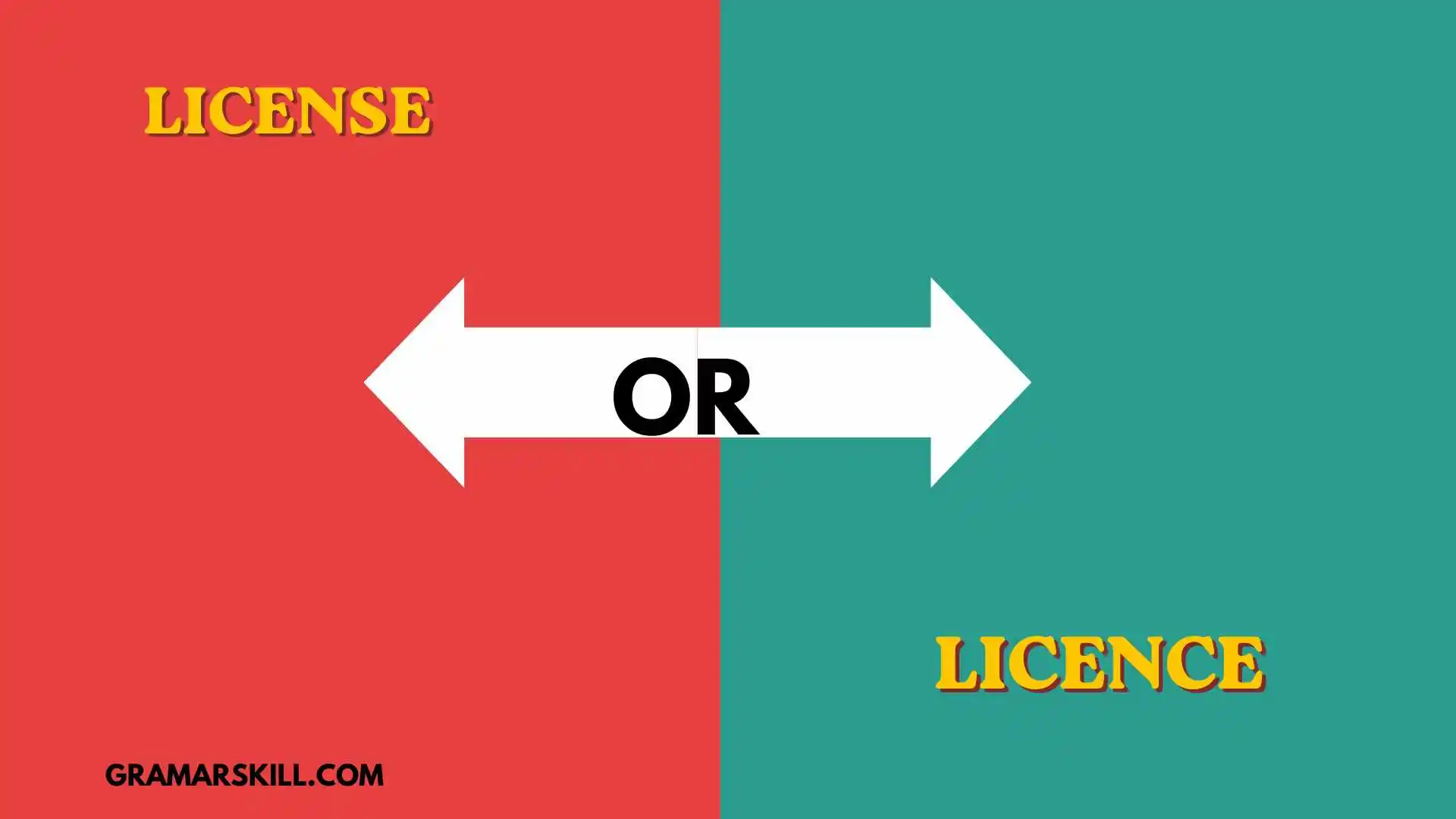
Many English learners and even native speakers often get confused between “license” and “licence.” At first glance, they look almost identical. However, their usage depends on whether you are writing in British English (UK) or American English (US).
This confusion becomes more important when writing formally, such as in academic papers, business emails, or legal documents. Using the wrong form can make your writing look less professional or inconsistent. Therefore, understanding the difference between “license” and “licence” is essential for clear and correct communication.
In addition, this topic is a great example of how spelling and grammar rules can vary between regions. So, whether you are writing for a UK or US audience, knowing the correct form will help you write confidently.
Quick Answer
- In American English (US):
👉 “License” is used as both a noun and a verb. - In British English (UK):
👉 “Licence” is a noun
👉 “License” is a verb
Simple rule to remember:
- UK: Licence (noun), License (verb)
- US: License (noun + verb)
Meaning of the Correct Form
Let’s break this down clearly so you can understand both meanings and usage.
1. “License” (American English)
In the United States, “license” works as both a noun and a verb.
As a Noun:
It means official permission to do something.
Examples (US):
- I need a driver’s license to drive legally.
- The restaurant has a license to sell alcohol.
- She applied for a business license.
As a Verb:
It means to give permission officially.
Examples (US):
- The government licensed the company to operate.
- This software is licensed for personal use.
- They will license the product next year.
👉 In short, Americans use “license” for everything.
2. “Licence” (British English)
In the UK, things are a bit different.
As a Noun:
“Licence” is used as a noun, meaning official permission.
Examples (UK):
- He has a driving licence.
- The shop needs a licence to sell alcohol.
- She lost her TV licence.
As a Verb:
In British English, the verb form changes to “license.”
Examples (UK):
- The council will license the new restaurant.
- This product is licensed under UK law.
- They plan to license the software globally.
👉 So, in the UK:
- Licence = noun
- License = verb
Meaning of the Incorrect Form (Common Confusion)
There is no truly “incorrect” form, but using the wrong version for your audience can be considered a mistake.
Common Errors:
- Using “licence” in American English ❌
- Using “license” as a noun in British English ❌ (in formal writing)
Example Mistakes:
- US: “I got my driving licence.” ❌
- UK: “I have a driving license.” (informal but often discouraged in formal UK writing)
👉 Therefore, the issue is not about right or wrong globally it’s about regional correctness.
Keyword Comparison / Key Differences
Here’s a simple comparison table:
| Feature | British English (UK) | American English (US) |
| Noun form | Licence | License |
| Verb form | License | License |
| Usage style | Two different spellings | One spelling for both |
| Example (noun) | Driving licence | Driver’s license |
| Example (verb) | To license a product | To license a product |
Key Takeaways:
- UK separates noun and verb forms.
- US uses one spelling for both.
- Context matters depending on your audience.
| Heading | Short Information |
|---|---|
| Driving License or Licence | The correct spelling depends on the type of English being used. In American English, driver’s license is the standard form. In British English, driving licence is the correct spelling for the official document that allows someone to drive. |
| Licence or License Oxford English Dictionary | According to the Oxford English Dictionary and British English rules, licence is generally used as a noun, while license is used as a verb. American English typically uses license for both noun and verb forms. |
| License or Licence to Operate | In British English, a company may hold a licence to operate, while regulators may license the business. In American English, license to operate is commonly used for both the noun and verb forms. |
| Licence and License Examples | Examples include: “She received her driving licence” (British English) and “He got his driver’s license” (American English). As a verb, “The authority will license the new operator” is correct in both varieties. |
| License or Licence Agreement | A licence agreement is the preferred noun form in British English legal writing, whereas license agreement is standard in American English. Both terms refer to a contract granting permission to use intellectual property, software, or other rights. |
Common Mistakes People Make
Even experienced writers make mistakes with these words. Let’s look at some common ones.
1. Mixing UK and US English
Example:
- “I got my driving licence and will license my car.” ❌
👉 This mixes UK and US styles. Choose one style and stay consistent.
2. Using “Licence” as a Verb in UK English
Incorrect:
- “The company will licence the product.” ❌
Correct:
- “The company will license the product.” ✅
3. Using “Licence” in American English
Incorrect:
- “I renewed my driving licence.” ❌
Correct:
- “I renewed my driver’s license.” ✅
4. Ignoring Audience Context
For example:
- Writing for a UK audience but using US spelling.
- Writing for a US company but using UK grammar.
👉 Always consider your audience before choosing the spelling.
Correct Usage in Sentences
Let’s explore more real-life examples for both UK and US usage.
American English Examples
- She forgot her driver’s license at home.
- The state will license new drivers next month.
- You need a license to start a business.
- This app is licensed for educational use.
British English Examples
- He applied for a fishing licence.
- The council will license the event.
- She carries her driving licence everywhere.
- The company is licensed under UK regulations.
Mixed Context Examples (Global Use)
- You must have a valid license/licence to operate legally.
- The government will license the new system soon.
👉 Tip: If you are writing for an international audience, you can choose one style and stay consistent.
Tips to Remember the Correct Usage
Here are some simple tricks to help you remember:
1. The “C” for “Concrete” Trick (UK)
- Licence (noun) → has C
- Nouns are “things” (concrete ideas)
👉 So: Licence = noun (UK)
2. The “S” for “Action” Trick
- License (verb) → has S
- Verbs show action
👉 So: License = verb (UK + US)
3. One Rule for the US
- Americans keep it simple:
👉 Always use “license”
4. Think of Similar Word Pairs
This pattern is similar to:
- Practice (noun) / Practise (verb) in UK English
👉 Helps you remember the same rule applies.
5. Stay Consistent
Choose one style:
- UK English → use licence + license
- US English → use license only
FAQs
1. Is “license” or “licence” correct?
Both are correct. However, “license” is used in American English, while “licence” (noun) and “license” (verb) are used in British English.
2. Why do UK and US spell it differently?
English evolved differently in the UK and US. Over time, spelling rules became simplified in American English, while British English kept traditional forms.
3. Can I use “license” in the UK?
Yes, but only as a verb in formal British English. For nouns, “licence” is preferred.
4. Is “licence” used in the US?
No, “licence” is not used in standard American English. Americans always use “license.”
5. What is a driver’s license/licence?
It is an official document that allows a person to drive legally:
- US: driver’s license
- UK: driving licence
6. How can I remember the difference easily?
Use this simple rule:
- UK → Licence (noun), License (verb)
- US → License (everything)
7. Which form should I use in international writing?
Choose one style (UK or US) and use it consistently throughout your writing. Consistency matters more than the choice itself.
Conclusion
Understanding the difference between “license” and “licence” is simple once you know the rules. While both words refer to permission, their usage depends on regional English.
- In American English, things are straightforward “license” is used for both noun and verb.
- In British English, there is a clear distinction “licence” (noun) and “license” (verb).
However, the most important thing is consistency. Whether you choose UK or US English, stick to one style throughout your writing. This will make your content clearer, more professional, and easier to understand.
READ MORE ARTICLES..
Label or Lable: Differences, Examples, and Writing Tips in 2026
Ho or Hoe: What’s the Correct Spelling and Meaning?
Cleanup or Clean Up: What’s the difference & usage? 2026
Programing or Programming: What’s the difference & usage? 2026

I’m Henry Collins, a passionate grammar enthusiast who loves making English simple and clear for everyone. I enjoy breaking down tricky grammar rules into easy, everyday language. Through my writing, I aim to help learners build confidence and write with accuracy. My goal is to turn confusion into clarity one word at a time.