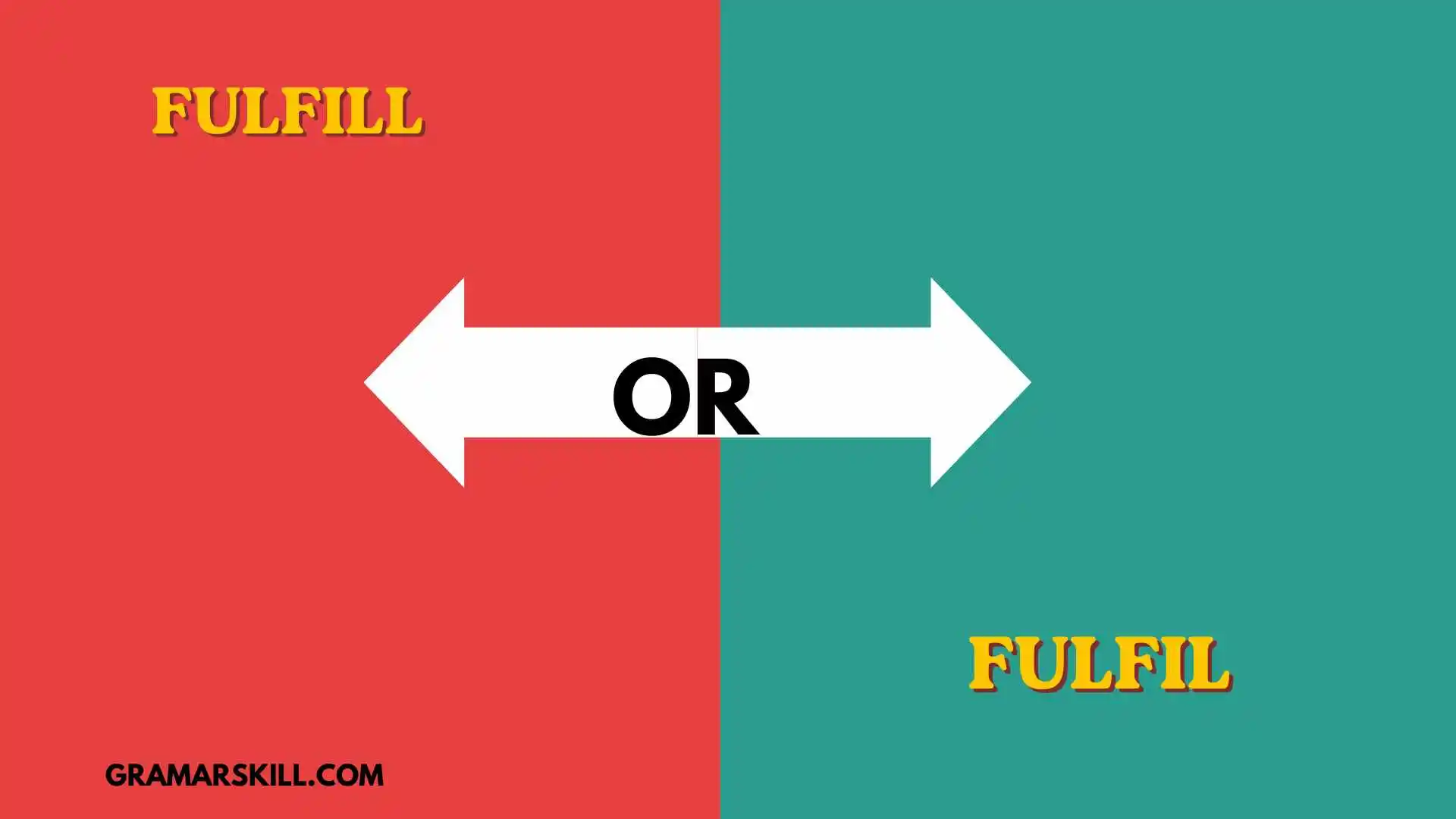
Many English learners and even native speakers often feel confused when choosing between “fulfill” and “fulfil.” At first glance, both words look almost identical. However, the difference lies in spelling conventions rather than meaning.
This confusion mainly happens because English has two major variations: British English (UK) and American English (US). Each version follows slightly different spelling rules. As a result, words like fulfill/fulfil, color/colour, and organize/organise often create uncertainty.
Understanding the difference is important because it helps you write correctly based on your audience. For example, if you’re writing for a UK audience, one spelling is preferred. On the other hand, US readers expect a different form. Therefore, knowing when to use each version can improve your writing clarity and professionalism.
Quick Answer
Both “fulfill” and “fulfil” are correct spellings of the same word.
- “Fulfill” is the preferred spelling in American English (US)
- “Fulfil” is the preferred spelling in British English (UK)
They have the same meaning and can be used in the same situations. The only difference is the regional spelling preference.
Meaning of the Correct Form
The word fulfill/fulfil means:
- To complete something successfully
- To achieve a goal, promise, or requirement
- To carry out a duty or responsibility
Examples in American English (Fulfill)
- I will fulfill my promise to help you.
- She worked hard to fulfill her dreams.
- The company aims to fulfill customer expectations.
Examples in British English (Fulfil)
- He tried to fulfil his responsibilities.
- They want to fulfil all legal requirements.
- She hopes to fulfil her lifelong ambition.
👉 As you can see, the meaning stays exactly the same in both cases.
Meaning of the Incorrect Form (If Any)
There is no incorrect form between “fulfill” and “fulfil.” Both are correct.
However, problems happen when people:
- Mix spelling styles in the same document
- Use the wrong version for their audience
For example:
❌ Using “fulfil” in a US academic paper
❌ Using “fulfill” in a UK formal document
👉 These are not grammar errors, but they can look unprofessional or inconsistent.
Fulfill vs Fulfil: Key Differences
Here is a simple comparison to make things clear:
| Feature | Fulfill (US) 🇺🇸 | Fulfil (UK) 🇬🇧 |
| Spelling Style | American | British |
| Number of “l” | Double “l” | Single “l” |
| Meaning | Same | Same |
| Usage | USA, Canada | UK, Australia |
Why the Difference Exists
The difference comes from historical spelling reforms. American English, influenced by Noah Webster, simplified many words by:
- Removing extra letters
- Making spellings more phonetic
👉 That’s why “fulfill” uses double “l”, while British English keeps “fulfil” shorter.
| Heading | Information |
|---|---|
| Fulfill or Fulfil Meaning | Both fulfill and fulfil mean to complete, achieve, carry out, or satisfy something such as a promise, goal, duty, or requirement. The meaning is exactly the same; only the spelling differs. |
| Fulfill or Fulfil Oxford Dictionary | According to the Oxford style, fulfil is the preferred British English spelling, while fulfill is commonly used in American English. Both forms are recognized as correct. |
| Fulfill or Fulfil Grammar | Grammatically, fulfill and fulfil function as verbs. They can be used in different tenses, such as fulfilled, fulfilling, and fulfills/fulfils. The choice depends on whether you are using American or British English. |
| Fulfill or Fulfil Examples | Examples: American English: “She worked hard to fulfill her dream.” British English: “She worked hard to fulfil her dream.” Both sentences have the same meaning but use different regional spellings. |
| Fulfill or Fulfil Synonym | Common synonyms include accomplish, achieve, complete, perform, execute, satisfy, realize, and carry out. These words can often replace fulfill/fulfil depending on the context. |
Common Mistakes People Make
Even though the difference is simple, many people still make mistakes.
1. Mixing UK and US Spellings
❌ The company will fulfil all customer expectations and organize deliveries.
✔ The company will fulfil all customer expectations and organise deliveries. (UK)
✔ The company will fulfill all customer expectations and organize deliveries. (US)
👉 Always stick to one style consistently.
2. Assuming One Version Is Wrong
Some people think:
- “Fulfil” is incorrect ❌
- “Fulfill” is incorrect ❌
👉 In reality, both are correct depending on the region.
3. Forgetting Audience Context
For example:
- Writing for a UK university → use fulfil
- Writing for a US blog → use fulfill
4. Overcorrecting Spellings
Sometimes people try to “fix” their writing and accidentally create inconsistency.
❌ He will fulfil his dream and fulfill his duties.
✔ He will fulfil his dream and fulfil his duties. (UK)
✔ He will fulfill his dream and fulfill his duties. (US)
Correct Usage in Sentences
Let’s look at more real-life examples.
American English (Fulfill)
- They hired her to fulfill a leadership role.
- The brand promises to fulfill customer needs quickly.
- He finally fulfilled his dream of becoming a doctor.
- The contract was fulfilled on time.
British English (Fulfil)
- She hopes to fulfil her ambitions.
- The company must fulfil its obligations.
- He fulfilled (past tense often same in writing) his duties responsibly.
- They aim to fulfil customer expectations.
Verb Forms (Same for Both)
| Form | US Spelling | UK Spelling |
| Base | fulfill | fulfil |
| Past | fulfilled | fulfilled |
| -ing Form | fulfilling | fulfilling |
👉 Notice: The past and continuous forms usually look the same in both versions.
Tips to Remember the Correct Usage
Here are some easy tricks:
1. Think About Your Audience
- US audience → fulfill
- UK audience → fulfil
2. Remember the Double “L” Rule (US)
American English often prefers double letters:
- fulfill
- traveling
- canceled
👉 So, “fulfill” fits this pattern.
3. Keep It Consistent
Once you choose a style:
✔ Use it throughout your writing
✔ Don’t switch halfway
4. Use Spell Check Tools
Most writing tools:
- Detect US or UK English
- Suggest the correct version automatically
5. Learn by Association
Think of:
- Fulfill → Full + Fill (US style, longer spelling)
- Fulfil → Shorter UK version
FAQs About Fulfill or Fulfil
1. Is “fulfil” wrong in American English?
No, it’s not wrong. However, it is uncommon in the US. Most American readers expect “fulfill.”
2. Is “fulfill” wrong in British English?
No, but it may look unusual. British English prefers “fulfil.”
3. Which spelling should I use in academic writing?
Use the spelling style required by your institution:
- UK universities → fulfil
- US universities → fulfill
4. Do “fulfill” and “fulfil” have different meanings?
No, they have exactly the same meaning. Only the spelling differs.
5. Why does American English use “fulfill”?
American English simplified spelling rules, often using double letters for clarity and consistency.
6. What about past tense fulfilled or fulfiled?
✔ Correct: fulfilled
❌ Incorrect: fulfiled
👉 Always use double “l” in past tense, even in UK English.
7. Can I use both spellings in one document?
No. You should choose one style and stay consistent throughout your writing.
Conclusion
The difference between “fulfill” and “fulfil” is simple but important. Both words have the same meaning, but they belong to different versions of English.
- Use “fulfill” for American English
- Use “fulfil” for British English
The key is consistency. Once you choose a style, stick to it throughout your writing. This not only improves readability but also makes your work look more professional.
👉 In the end, your goal is clear communication. So, choose the spelling that matches your audience and context.
READ MORE ARTICLES..
Eery or Eerie: What’s the difference & usage? 2026
Too Late or To Late: What’s the difference & usage?
If I Was or If I Were: What’s the difference & usage? 2026
Different Than or Different From: Easy guide with examples 2026

I am Julian Parker, a passionate grammar enthusiast and content writer dedicated to making English rules simple and easy to understand. I specialize in breaking down complex grammar topics into clear, practical explanations. I enjoy helping readers improve their writing skills with confidence. My goal is to make learning grammar engaging, simple, and accessible for everyone.