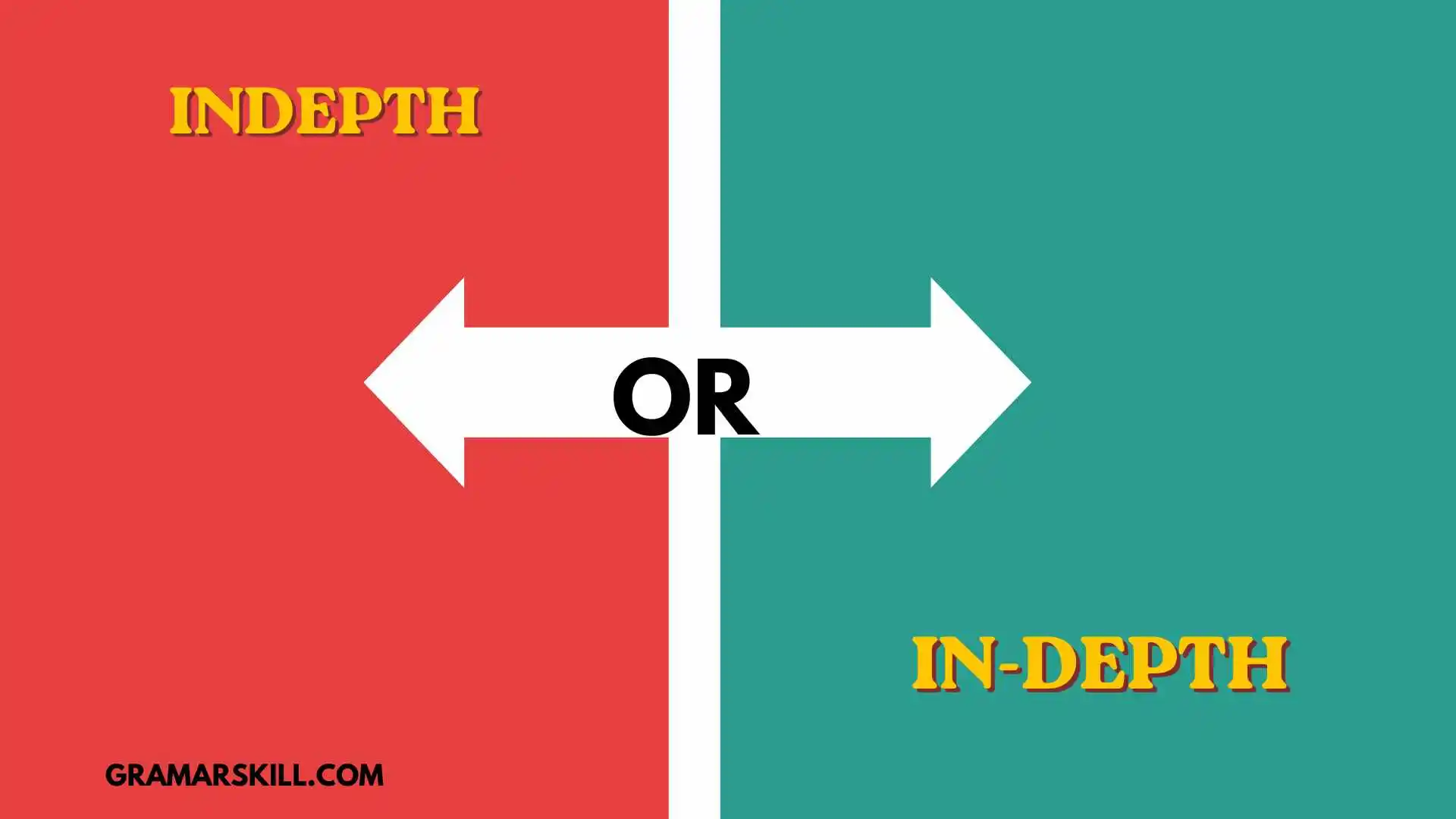
Many English learners and even native speakers often wonder: should it be “indepth” or “in-depth”? This confusion arises because English has many words that sound correct but are actually spelled differently depending on context. Choosing the wrong form can make your writing look unprofessional or incorrect.
Understanding the difference is especially important for both UK and US audiences. While most people understand your meaning, using the correct form ensures clarity in academic, professional, and casual writing. It also helps maintain proper style in formal reports, articles, and emails.
In this article, we will dive deep into the correct usage, common mistakes, differences between British and American English, and practical tips to remember the correct spelling. By the end, you’ll never be confused again!
Quick Answer
The correct form is “in-depth”. The version “indepth” is incorrect and should be avoided.
Why?
- “In-depth” is a hyphenated adjective or adverb meaning thorough, detailed, or comprehensive.
- Example: We conducted an in-depth analysis of the market trends.
In short, always use in-depth. There is no valid reason to write “indepth” in English, whether British or American.
Meaning of the Correct Form
What Does “In-Depth” Mean?
“In-depth” is an adjective or adverb used to describe something that is thorough, comprehensive, or detailed.
- As an adjective:
She gave an in-depth presentation about climate change. - As an adverb:
The teacher explained the topic in-depth to the students.
Key Notes:
- Always hyphenate the word.
- Can describe analysis, research, reviews, reports, interviews, or discussions.
British English Example:
- The newspaper published an in-depth report on Brexit negotiations.
American English Example:
- The study offers an in-depth look at consumer behaviour.
Transition Words in Action:
- Therefore, conducting an in-depth review can prevent mistakes in the future.
- On the other hand, a superficial report will not give an in-depth understanding.
Meaning of the Incorrect Form
“Indepth” is commonly mistaken as correct because it sounds logical when spoken. However, it is not a valid word in English.
- Why it’s wrong:
- English requires a hyphen for this compound adjective or adverb.
- Writing “indepth” may confuse readers or make your writing appear informal or incorrect.
Example of incorrect usage:
- ❌ We conducted an indepth study of the economy.
- ✅ Correct version: We conducted an in-depth study of the economy.
Tip: If you can separate the words in your mind (in + depth), it’s always hyphenated.
Keyword Comparison / Key Differences
| Aspect | In-Depth | Indepth |
| Correctness | ✅ Correct | ❌ Incorrect |
| Part of Speech | Adjective / Adverb | None (invalid) |
| Usage | Formal, academic, professional | Informal / wrong |
| UK & US | Same usage in both | Not used in either |
| Example | An in-depth discussion | An indepth discussion (wrong) |
Summary: There’s no regional difference both UK and US English require the hyphen.
In Depth or In Depth Conversation
| Phrase | Correct Usage | Explanation | Example |
|---|---|---|---|
| In-depth conversation | ✅ Correct | Use in-depth (with a hyphen) when it acts as an adjective before a noun such as conversation. It describes something that is detailed and thorough. | We had an in-depth conversation about the project. |
| In depth conversation | ❌ Incorrect | Without a hyphen, the phrase is generally considered incorrect when used directly before a noun. | Incorrect: We had an in depth conversation about the project. |
| In-depth synonym | ✅ Correct | When referring to a synonym that means detailed, comprehensive, or thorough, in-depth functions as an adjective. | “Comprehensive” is an in-depth synonym often used in formal writing. |
| In depth synonym | ❌ Incorrect | The hyphen is needed because the phrase modifies the noun synonym. | Incorrect: This is an in depth synonym. |
| In-depth knowledge | ✅ Correct | Use in-depth before the noun knowledge to describe a deep and detailed understanding of a subject. | She has in-depth knowledge of digital marketing. |
| In depth knowledge | ❌ Incorrect | The hyphen should be included when the phrase appears before a noun. | Incorrect: He has in depth knowledge of grammar rule |
Common Mistakes People Make
Even experienced writers make mistakes with “in-depth.” Here are the most common ones:
- Omitting the hyphen
- ❌ We did an in depth review.
- ✅ We did an in-depth review.
- Writing as one word
- ❌ The report was indepth.
- ✅ The report was in-depth.
- Misplacing it as a verb
- ❌ We indepthed the topic yesterday.
- ✅ We explored the topic in-depth yesterday.
- Confusing with “thorough” or “detailed” without context
- While similar, “in-depth” emphasizes comprehensiveness, not just length.
- Overuse in casual writing
- Avoid using it unnecessarily in emails or informal chat. Use simple words like “detailed” instead.
Correct Usage in Sentences
Here are multiple examples of correct usage for UK and US English:
UK Examples:
- The professor gave an in-depth lecture on Shakespeare’s plays.
- We need an in-depth review before finalising the report.
- The documentary provides an in-depth analysis of London’s history.
US Examples:
- The article offers an in-depth look at the latest technology trends.
- He conducted an in-depth interview with the CEO.
- An in-depth understanding of marketing strategies is crucial for success.
Tips for Transition Words:
- In addition, we performed an in-depth study of the data.
- However, a superficial glance is not an in-depth examination.
- Therefore, an in-depth discussion is necessary before the meeting.
Tips to Remember the Correct Usage
- Think “in + depth” – always hyphenate.
- Check your context – use only for detailed, comprehensive work.
- Replace indepth in your brain – mentally add the hyphen.
- Read aloud – “in-depth” sounds natural; “indepth” sounds off.
- Use synonyms for casual writing – like “detailed” or “thorough” if hyphen feels formal.
Mnemonic Trick:
- Imagine digging in the depth of a subject. The hyphen connects “in” to “depth,” like a bridge.
FAQs About “[indepth or in-depth]”
1. Can I use “indepth” in informal writing?
No. Even in informal writing, the correct form is in-depth. “Indepth” is not recognized in any dictionary.
2. Is “in depth” without a hyphen correct?
Only when used as a prepositional phrase.
- We explored the topic in depth. ✅ (adverbial phrase, no hyphen needed)
- We did an in-depth analysis. ✅ (adjective before noun, hyphen required)
3. Do British and American English spell it differently?
No. Both use in-depth. The rules are the same.
4. Can I use “in-depthly”?
No. The word “in-depthly” is incorrect. Use “thoroughly” or “in-depth” instead.
5. How do I remember the hyphen?
Think of it as linking “in” + “depth.” Without the hyphen, it looks like a single incorrect word.
6. Can I replace “in-depth” with “thorough”?
Yes, in casual writing. But “in-depth” conveys a slightly more analytical and formal tone.
7. Is it okay to start a sentence with “In-depth”?
Yes. Example: In-depth research is essential for accurate results.
Conclusion
In summary, the correct form is “in-depth”, and “indepth” is always incorrect. This applies to both UK and US English. Always hyphenate it when used as an adjective or adverb, and remember that it means detailed, thorough, or comprehensive.
Key Takeaways:
- ✅ Correct: an in-depth analysis, studied in-depth
- ❌ Incorrect: an indepth analysis, studied indepth
- Use synonyms like thorough or detailed for casual writing.
- Remember the hyphen: it’s the key to professional and correct English.
Now that you know the correct usage, start applying in-depth confidently in your writing, emails, articles, and reports!
READ MORE ARTICLES..
Halves or Halfs: The Right Plural Form of Half You Should Use 2026
grandad or granddad: What’s the difference and usage?
vaccum or vacuum: What’s the difference & usage? 2026
Coliseum or Colosseum: What’s the difference & usage?

I’m Henry Collins, a passionate grammar enthusiast who loves making English simple and clear for everyone. I enjoy breaking down tricky grammar rules into easy, everyday language. Through my writing, I aim to help learners build confidence and write with accuracy. My goal is to turn confusion into clarity one word at a time.