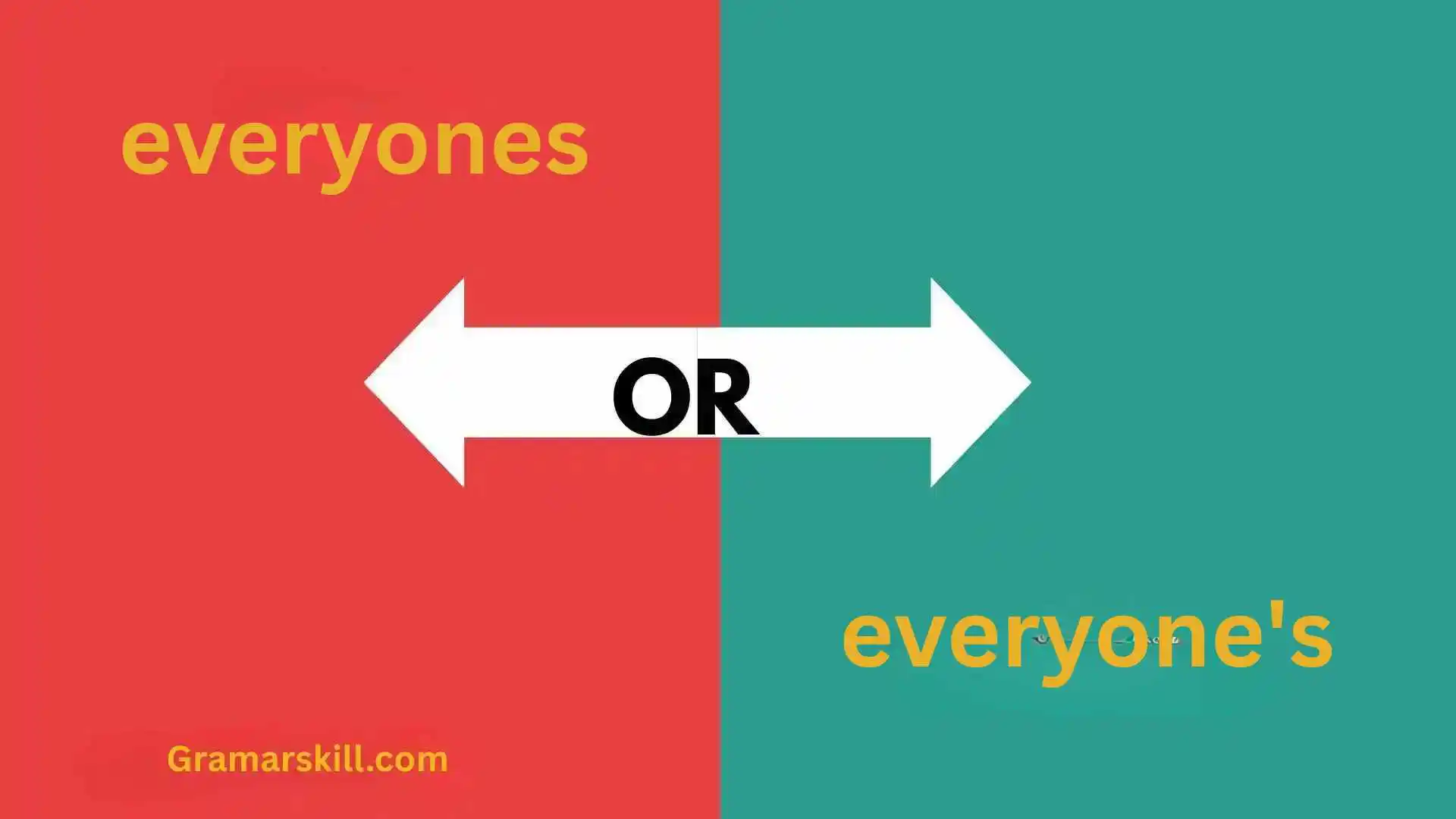
English punctuation, especially the use of apostrophes, often confuses even native speakers. One common dilemma arises with the words “everyones” and “everyone’s.” At first glance, these may seem interchangeable, but in reality, there is a significant difference. Misusing them can affect clarity, professionalism, and even how your writing is perceived.
In both UK and US English, understanding when to use everyone’s versus everyones is essential. While the UK tends to be slightly stricter with punctuation in formal writing, the US also emphasises clarity. Therefore, mastering this small but crucial distinction will make your writing more precise and professional.
By the end of this article, you’ll have a complete understanding of which form is correct, common mistakes, examples in real-life contexts, and tips to remember the right usage.
Quick Answer
The correct form is “everyone’s”, with an apostrophe. It is the possessive form of “everyone,” meaning something belongs to all people. For example:
- Everyone’s opinion matters. (Everyone’s opinion = the opinion of all people)
The form “everyones” without an apostrophe is incorrect in standard English. Using it in formal or casual writing is considered a mistake in both British and American English.
Meaning of the Correct Form: Everyone’s
Everyone’s is a contraction of “everyone is” in some contexts, but more commonly, it is the possessive form of “everyone.” It is used to indicate that something belongs to all people in a group.
Examples in British English:
- Everyone’s favourite author is J.K. Rowling.
- I appreciate everyone’s help in organising the event.
Examples in American English:
- Everyone’s welcome to join the meeting at 3 PM.
- I love seeing everyone’s smiling faces at the party.
Key points to remember:
- The apostrophe ‘s shows possession, indicating that what follows belongs to all members of the group.
- It works for singular nouns that represent a collective group.
Meaning of the Incorrect Form: Everyones
“Everyones” without the apostrophe is not standard English. It is often seen as a typo or an informal mistake. Writers may accidentally omit the apostrophe, but in professional, academic, and online writing, it is considered incorrect.
Incorrect usage examples:
- Everyones opinion matters. ❌
- I hope everyones enjoying the party. ❌
Even though readers may understand the meaning, using “everyones” can make your writing look careless or unprofessional.
Keyword Comparison / Key Differences
| Feature | Everyone’s | Everyones |
| Correct form? | ✅ Yes | ❌ No |
| Shows possession? | Yes | No |
| Can be used in contractions? | Sometimes (everyone’s = everyone is) | No |
| British English usage | Standard | Incorrect |
| American English usage | Standard | Incorrect |
| Example | Everyone’s bag is on the table. | Everyones bag is on the table. ❌ |
Key takeaway: Always use the apostrophe for possession or contraction. Avoid “everyones” in formal writing.
Common Mistakes People Make
Even experienced writers sometimes misuse everyone’s, especially in fast typing or social media posts. Here are common mistakes:
- Omitting the apostrophe:
- Incorrect: Everyones opinion is valuable. ❌
- Correct: Everyone’s opinion is valuable. ✅
- Confusing with “everyone is”:
- Incorrect: Everyone’s happy with the results. ❌ if you mean “Everyone is”
- Correct: Everyone is happy with the results. ✅
(Tip: Contractions like “everyone’s” = “everyone is” work in informal contexts.)
- Using “everyones” as plural:
- Incorrect: Everyones were invited to the party. ❌
- Correct: Everyone was invited to the party. ✅
- Mixing UK & US conventions:
- UK English might emphasise more formal punctuation in letters or essays.
- US English allows “everyone’s” in casual writing but still requires the apostrophe.
- Social media typos:
- Everyones excited for the weekend! ❌
- Everyone’s excited for the weekend! ✅
Correct Usage in Sentences
Here are multiple real-life examples showing how everyone’s can be used correctly in both UK and US contexts:
Possessive usage:
- Everyone’s luggage should be collected from the carousel. (UK & US)
- I read everyone’s feedback on the survey. (UK & US)
- Everyone’s schedule has been updated for the conference. (US)
Contraction usage (everyone is):
- Everyone’s invited to the charity event tomorrow. (US & UK informal)
- Everyone’s enjoying the sunny weather in London. (UK)
- Everyone’s coming to the party, so bring snacks! (US)
Professional context:
- Everyone’s contribution to the project will be recognised at the annual meeting. (UK & US)
- Please ensure everyone’s documents are submitted before Friday. (US)
Tips to Remember the Correct Usage
- Look for possession: If you are talking about something belonging to all people, always add ‘s.
- Tip: “Everyone owns something” → “everyone’s”
- Check for contraction: If you mean “everyone is,” it can be shortened to everyone’s.
- Example: Everyone’s ready = Everyone is ready
- Avoid “everyones”: If you see the word without an apostrophe, stop and check if it should be everyone’s.
- Mnemonic trick: Think:
- Everyone
- ‘s = something belongs to them.
- UK vs US: Both use everyone’s identically in meaning. UK writing may emphasise apostrophe usage more in formal contexts.
FAQs About “everyones” vs “everyone’s”
1. Can I use “everyones” in informal writing?
- Technically, no. Even in informal contexts, it’s better to use everyone’s to avoid confusion.
2. Is “everyone’s” only possessive?
- No, it can also be a contraction for everyone is, e.g., Everyone’s happy.
3. Does UK English differ from US English here?
- Very little. Both versions require everyone’s with an apostrophe for proper usage.
4. Can “everyone’s” be plural?
- No. “Everyone” is always singular, so “everyone’s” refers to something belonging to all collectively.
5. How do I remember when to use the apostrophe?
- If it shows possession or replaces “is,” use ‘s. Otherwise, check the sentence structure.
6. What is a common mistake in social media?
- People often write everyones in tweets, captions, or messages. Always correct it to everyone’s.
7. Can “everyone’s” appear at the start of a sentence?
- Yes, e.g., Everyone’s responsibility is important for success.
Conclusion
Understanding the difference between everyones and everyone’s is crucial for clear and professional English writing. The key rule is simple:
- Use everyone’s with an apostrophe to indicate possession or a contraction for “everyone is.”
- Avoid everyones without an apostrophe, as it is incorrect in both UK and US English.
By practising correct usage, double-checking apostrophes, and following our simple mnemonic tricks, you can ensure your writing is clear, polished, and grammatically correct.
READ MORE ARTICLES..
is it a hour or an hour: What’s the difference & usage? 2026
Less or Equal to Sign in Math: Definition, Uses, and Tips 2026
When to Use Colon or Semi Colon with Easy Examples 2026
Ladder or Latter: Meaning, Usage, and Common Mistakes (2026)

I am Julian Parker, a passionate grammar enthusiast and content writer dedicated to making English rules simple and easy to understand. I specialize in breaking down complex grammar topics into clear, practical explanations. I enjoy helping readers improve their writing skills with confidence. My goal is to make learning grammar engaging, simple, and accessible for everyone.