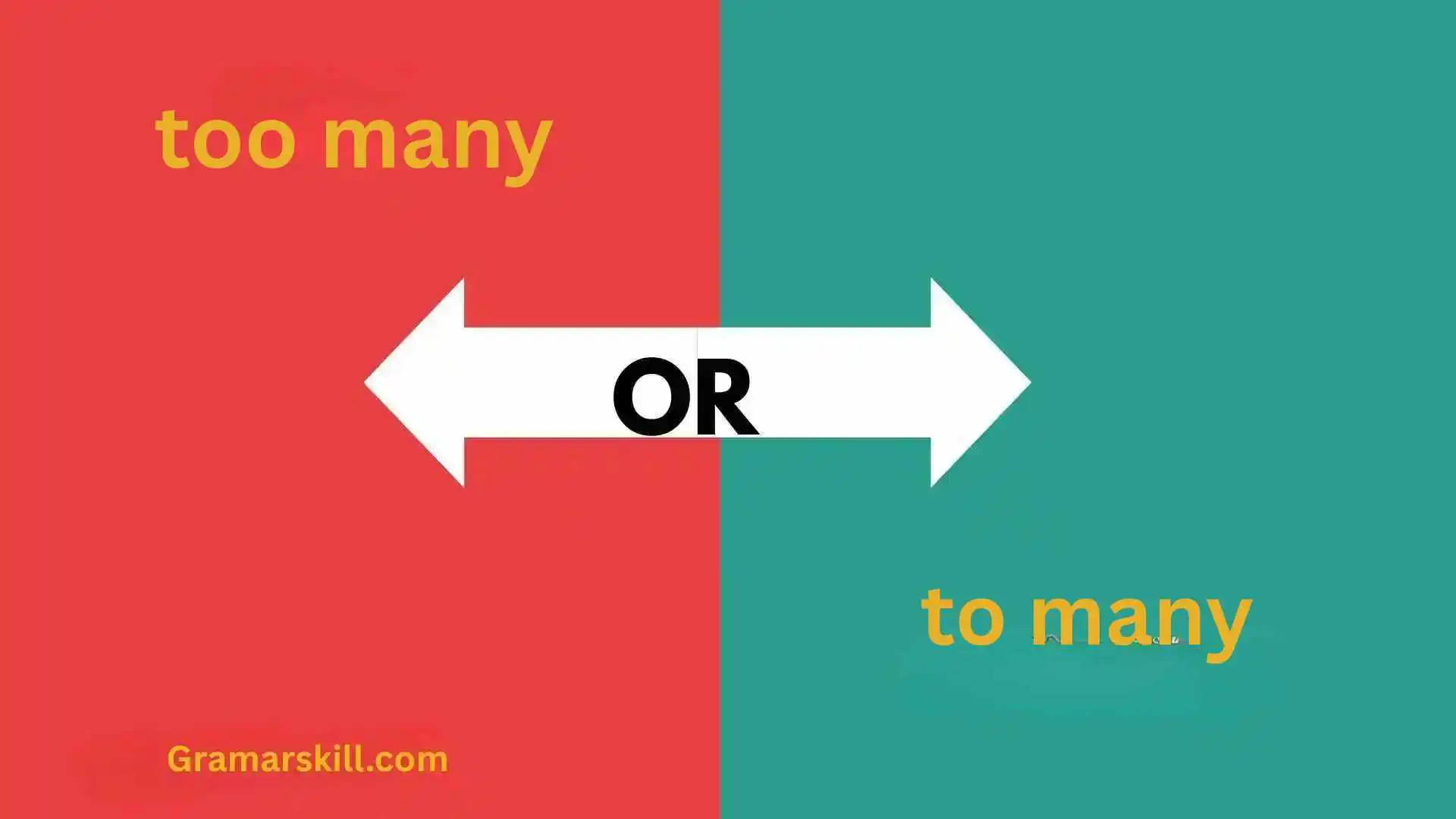
Many people often get confused between “too many” and “to many”, especially when writing emails, essays, or casual messages. While they may sound the same when spoken, their meanings and grammatical correctness are entirely different. Misusing them can make sentences unclear and sometimes even change the meaning completely.
Understanding this difference is important not only for students and professionals but also for anyone communicating in English daily. Both British and American English follow the same rules for this usage, although minor style differences may exist. For instance, British English tends to emphasize formal correctness in writing, while American English often accepts informal shortcuts but even there, the “to many” error remains incorrect.
In this article, we will break down the difference between “too many” and “to many”, provide examples, and give practical tips to avoid mistakes. By the end, you will have a clear understanding of how to use the correct form every time.
Quick Answer
“Too many” is the correct form. It is used to indicate an excessive number of something. For example, “There are too many cars on the road.”
“To many” is always incorrect in standard English writing. It is usually a typo or mistake when someone intends to write “too many”.
In short, always use “too many” when talking about an excessive quantity.
Meaning of the Correct Form: “Too Many”
“Too many” is used to describe an excessive quantity more than is desired, acceptable, or manageable. It is typically followed by countable nouns.
Examples (UK & US English):
- UK: There are too many students in the classroom today.
- US: We have too many emails to answer before lunch.
- UK: I ate too many biscuits, and now I feel sick.
- US: She has too many shoes in her closet.
Key Points:
- Works only with countable nouns (books, cars, apples, emails).
- Expresses excessiveness.
- Can be used in both spoken and written English.
Meaning of the Incorrect Form: “To Many”
The phrase “to many” is grammatically incorrect and should never be used to indicate excess. People often mistakenly type “to” instead of “too,” because both words are pronounced the same in casual speech.
Incorrect Examples:
- There are to many cars on the road. ❌
- I bought to many gifts for the party. ❌
Why it’s wrong:
- “To” is a preposition or part of an infinitive (to go, to see).
- It does not express excess or quantity.
Remember: If you mean “more than enough,” always use “too many.”
Keyword Comparison / Key Differences
| Feature | Too Many | To Many |
| Correct? | ✅ Yes | ❌ No |
| Meaning | Excessive quantity | None (incorrect) |
| Type of noun | Countable only | N/A |
| UK Usage | Correct | Incorrect |
| US Usage | Correct | Incorrect |
| Example | Too many people attended the event. | To many people attended the event. ❌ |
Transition tip: When in doubt, think about whether you are describing too much of something. If yes, it’s too many.
Common Mistakes People Make
Even native speakers sometimes mix up “too” and “to”. Here are the most frequent mistakes:
- Typos in casual writing
- I have to many assignments to finish. ❌
- Correct: I have too many assignments to finish. ✅
- I have to many assignments to finish. ❌
- Using “too many” with uncountable nouns (common confusion)
- Incorrect: There is too many water in the bottle. ❌
- Correct: There is too much water in the bottle. ✅
- Incorrect: There is too many water in the bottle. ❌
- Switching “too” and “to” in emails or messages
- I sent the report to many times. ❌
- Correct: I sent the report too many times. ✅
- I sent the report to many times. ❌
- Mispronunciation leading to spelling errors
- Spoken casually: “I ate to many sweets.” ❌
- Written correctly: I ate too many sweets. ✅
- Spoken casually: “I ate to many sweets.” ❌
Correct Usage in Sentences
Here are real-life examples for both UK and US audiences:
UK Examples:
- Too many people queueing for the bus.
- She bought too many dresses for the party.
- There are too many regulations in this policy.
- He drank too many cups of tea before dinner.
- Too many visitors arrived at the museum today.
US Examples:
- Too many cars cause traffic jams in New York City.
- I received too many notifications on my phone.
- There are too many mistakes in this report.
- She has too many friends on social media.
- Too many children attended the school event.
Tips:
- Always follow “too many” with a plural countable noun.
- Pair with verbs that indicate action or feeling: eat, buy, see, attend.
Tips to Remember the Correct Usage
- Think “excessive” – if it’s too much, it’s too many.
- Countable nouns only – books, emails, bottles, people.
- Use mnemonics: Too = excess, To = direction.
- Double-check in writing – if it sounds like “too much of something,” type too many.
- Practice with examples – write your own sentences every day.
FAQs
1. Can I use “too many” with uncountable nouns?
No. Use too much instead. Example: There is too much sugar in the coffee.
2. Is “to many” ever correct?
No. It is always a mistake when referring to quantity.
3. Are there differences between UK and US English for “too many”?
Not in meaning. Both use it the same way. Style differences may exist in formal writing.
4. Can I use “too many” in negative sentences?
Yes. Example: There aren’t too many students in the library today.
5. How do I remember “too many” vs “to many”?
Remember: Too = excess, To = direction or infinitive.
6. Can “too many” be used in questions?
Yes. Example: Are there too many people in this room?
7. Can I shorten “too many” in casual speech?
Sometimes people say “lots of,” but “too many” is still correct for formal writing.
Conclusion
Understanding the difference between “too many” and “to many” is essential for clear, correct English. While “too many” expresses an excessive number of countable items, “to many” is always incorrect. Both UK and US English follow the same rules, making it easy to remember and apply.
Key takeaways:
- Always use too many with countable nouns.
- Avoid the common typo “to many.”
- Check your sentences for clarity and correctness, especially in professional or academic writing.
READ MORE ARTICLES..
a comparison using like or as: Difference & usage? 2026
greater than or equal to symbol on keyboard.
todays or today’s: What’s the difference & usage? 2026
halloween this or that: What’s the usage?

I am Julian Parker, a passionate grammar enthusiast and content writer dedicated to making English rules simple and easy to understand. I specialize in breaking down complex grammar topics into clear, practical explanations. I enjoy helping readers improve their writing skills with confidence. My goal is to make learning grammar engaging, simple, and accessible for everyone.