Many English learners and even native speakers often get confused between “label” and “lable.” At first glance, both words look similar, and it is easy to assume they are just spelling variations like British and American English differences. However, this is not the case here.
Spelling mistakes like this can affect your writing quality, whether you are writing emails, academic papers, blog posts, or social media content. Therefore, understanding the correct form is essential for clear and professional communication in both UK (British English) and US (American English) contexts.
In this detailed guide, you will learn the correct spelling, meaning, usage, examples, common mistakes, and easy tips to remember the right word. By the end, you will never confuse “label” and “lable” again.
Quick Answer
The correct spelling is “label.”
The word “lable” is incorrect and considered a spelling mistake in both British and American English.
- ✅ Correct: label
- ❌ Incorrect: lable
Use “label” whenever you want to refer to a tag, name, or description attached to something.
Meaning of the Correct Form (Label)
The word “label” is a noun and a verb. It is widely used in everyday English across both the UK and the US.
As a Noun
A label refers to a piece of paper, tag, or description attached to an object to provide information.
Examples (UK & US):
- Please read the label before using the medicine.
- The product’s label shows the ingredients clearly.
- She checked the clothing label for washing instructions.
As a Verb
To label means to attach a tag or describe something.
Examples:
- They labeled all the boxes before moving.
- Do not label people based on their appearance.
- The teacher labeled the charts for better understanding.
Spelling Note (UK vs US)
There is a small difference in verb forms:
- US English: labeled, labeling
- UK English: labelled, labelling
Examples:
- US: The boxes were labeled correctly.
- UK: The boxes were labelled correctly.
👉 Notice that British English doubles the “l” when adding suffixes.
Meaning of the Incorrect Form (Lable)
The word “lable” does not exist in standard English. It is simply a common spelling mistake of “label.”
Why Do People Write “Lable”?
Many people make this mistake because:
- They mix up the letter order (-el vs -le)
- They type quickly and swap letters accidentally
- They assume it follows a different spelling pattern
Incorrect Examples:
- ❌ Please check the lable on the bottle.
- ❌ The box has no lable.
Corrected Versions:
- ✅ Please check the label on the bottle.
- ✅ The box has no label.
Label vs Lable: Key Differences
Let’s clearly compare both words:
| Feature | Label (Correct) | Lable (Incorrect) |
| Spelling Status | ✅ Correct | ❌ Incorrect |
| Meaning | Tag, name, or description | No meaning |
| Usage | Formal & informal writing | Never used |
| UK/US Difference | Minor (labelled vs labeled) | Not applicable |
Key Takeaway
👉 “Label” is the only correct spelling. “Lable” is always wrong.
Label or Lable Examples
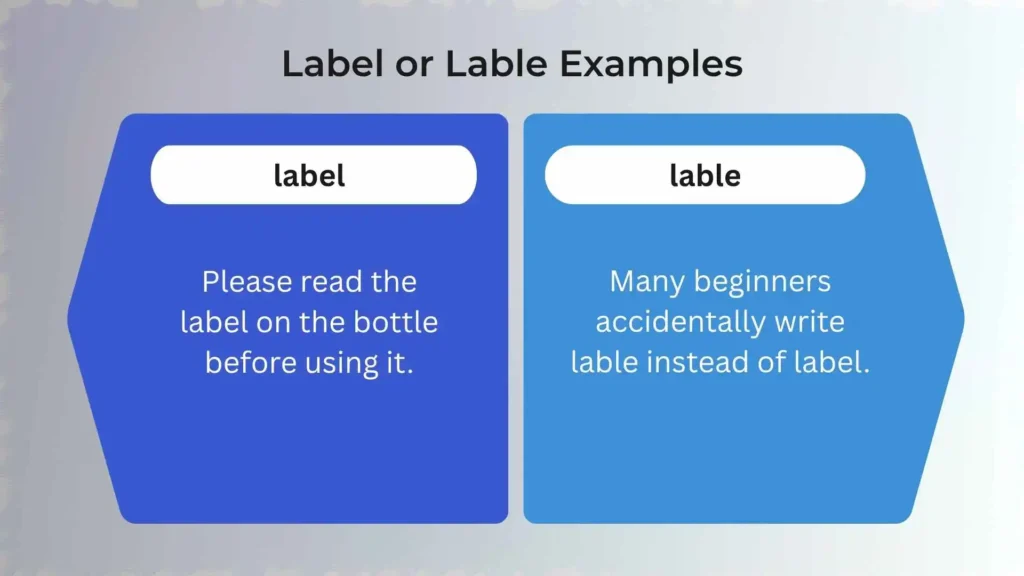
| Word | Correct or Incorrect | Meaning | Example Sentence |
|---|---|---|---|
| Label | Correct | A word, tag, or sticker used to identify something | Please read the label on the bottle before using it. |
| Lable | Incorrect | This is a spelling mistake of “label” | Many beginners accidentally write lable instead of label. |
| Correct Examples with “Label” |
|---|
| Put a label on your notebook. |
| The shirt label shows the size and price. |
| She carefully removed the label from the jar. |
| Every file needs a clear label. |
Common Mistakes People Make
Even though the rule is simple, many people still make errors. Let’s look at the most common ones.
1. Mixing Letter Order
People often switch “el” to “le.”
- ❌ lable
- ✅ label
2. Assuming British vs American Difference
Some think:
- “label” = American
- “lable” = British
👉 This is incorrect. Both UK and US use “label.”
3. Typing Errors
Fast typing can lead to mistakes.
- ❌ lable (mistyped)
- ✅ label
4. Confusion with Similar Words
Words like “table” or “cable” may influence spelling.
- table
- cable
- ❌ lable (incorrect pattern)
- ✅ label (correct)
Difference Between Lable and Label
| Term | Meaning | Correct or Incorrect? | Example |
|---|---|---|---|
| Label | A word, tag, sticker, or description used to identify something. | ✅ Correct spelling | Please read the label on the bottle before use. |
| Lable | A common misspelling of “label.” | ❌ Incorrect spelling | “Lable” should be written as label. |
Lable or Label
| Word | Usage |
|---|---|
| Label | The correct spelling in both American and British English. |
| Lable | Incorrect spelling and should be avoided in formal writing. |
Example:
✔ Correct: The product label contains important information.
✘ Incorrect: The product lable contains important information.
Label or Lable in English
| Topic | Explanation |
|---|---|
| Correct Spelling | The correct spelling in English is label. |
| Incorrect Spelling | Lable is not considered correct in standard English grammar. |
| Why People Confuse Them | Many people mix the letters “e” and “l” while typing quickly. |
| Easy Trick to Remember | Think of the word as “la + bel” → label. |
| Common Usage | The word “label” is commonly used in schools, offices, shops, and product packaging. |
Correct Usage in Sentences
Here are multiple examples to help you understand how to use “label” correctly in real-life situations.
Everyday Use
- Always read the label before buying food.
- The jar has a clear label.
Workplace Examples
- Please label all files properly.
- The manager asked us to label each product.
Educational Context
- The teacher asked students to label the diagram.
- Each part of the plant was clearly labeled (US) / labelled (UK).
Social Context
- Do not label people unfairly.
- Society often tries to label individuals.
Shopping & Products
- Check the clothing label for size details.
- The price label is missing.
Tips to Remember the Correct Usage
If you often forget the correct spelling, these tips will help you remember easily.
1. Break the Word
Think of it as:
- la + bel = label
2. Compare with “Table” Trick
- table → ends with -ble
- label → ends with -bel
👉 Notice the difference carefully.
3. Say It Clearly
Pronounce it as:
- LAY-buhl
This helps you remember the correct order.
4. Use Spell Check Tools
Modern tools automatically correct “lable” to “label.”
5. Practice Writing
Write sentences using “label” daily:
- I wrote a label.
- I checked the label.
6. Remember This Rule
👉 “Label has ‘bel’ at the end, not ‘ble.’”
FAQs About Label or Lable
1. Is “lable” ever correct in English?
No, “lable” is always incorrect. It is a spelling mistake in both UK and US English.
2. What is the correct spelling: label or lable?
The correct spelling is “label.”
3. Is there a British spelling of “label”?
Yes, but only in verb forms:
- UK: labelled, labelling
- US: labeled, labeling
👉 The base word “label” remains the same.
4. Why do people confuse “label” and “lable”?
People confuse them due to:
- Letter order mistakes
- Fast typing
- Influence of similar words
5. How can I avoid spelling “label” incorrectly?
You can:
- Practice writing it
- Use spell check
- Remember the “la + bel” trick
6. Can “label” be used as both noun and verb?
Yes.
- Noun: The label is clear.
- Verb: Please label the box.
7. Do Americans and British people spell “label” differently?
No, both use “label.”
The difference appears only in forms like:
- US: labeled
- UK: labelled
Conclusion
To sum up, the confusion between “label” and “lable” is very common, but the rule is simple:
- ✅ Label is correct
- ❌ Lable is incorrect
Both British and American English use “label” as the standard spelling. The only minor variation appears in verb forms like labelled (UK) and labeled (US).
By understanding this difference, practicing regularly, and using simple memory tricks, you can avoid this mistake in your writing. Therefore, always double-check your spelling and use “label” with confidence.

I’m Henry Collins, a passionate grammar enthusiast who loves making English simple and clear for everyone. I enjoy breaking down tricky grammar rules into easy, everyday language. Through my writing, I aim to help learners build confidence and write with accuracy. My goal is to turn confusion into clarity one word at a time.